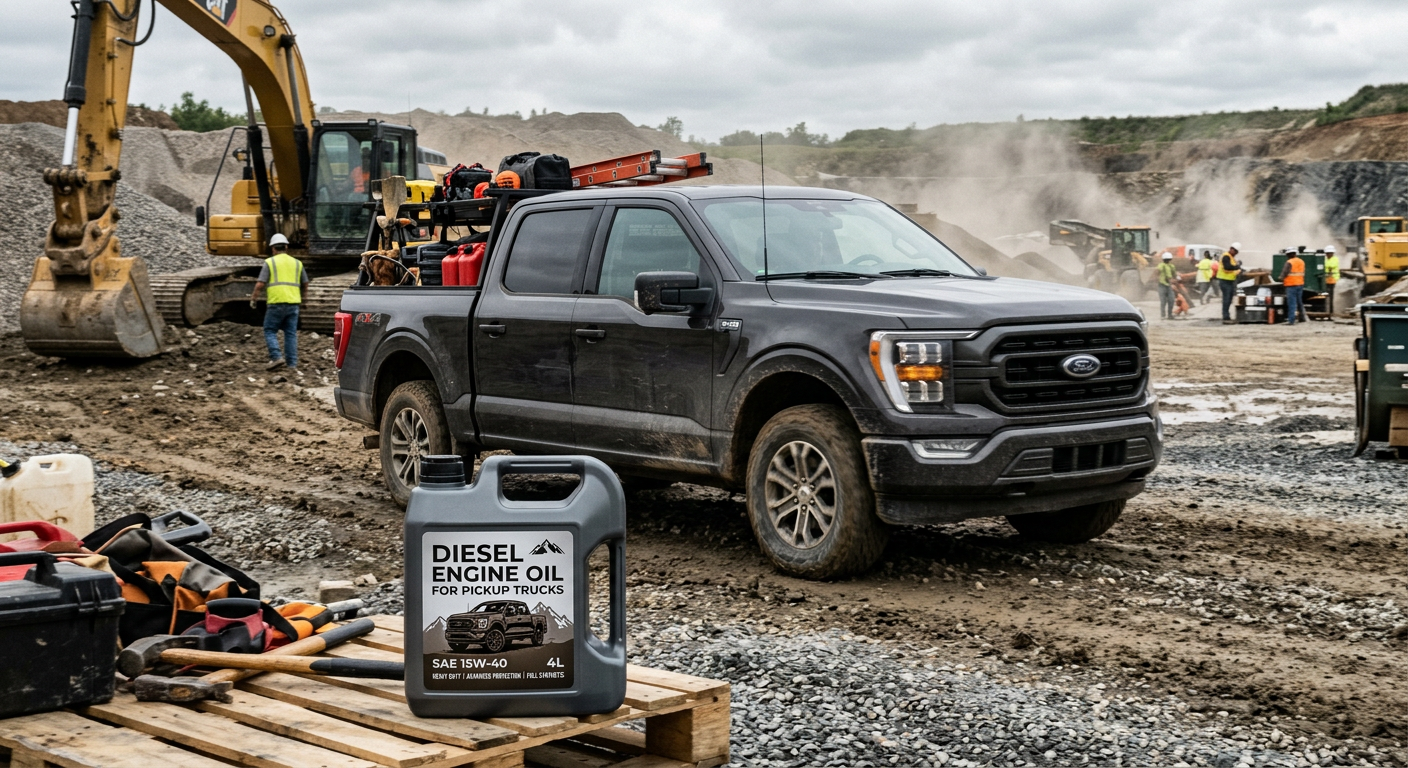
Best Diesel Engine Oil for Pickup Trucks in the United States
Quick Answer

If you need diesel engine oil for pickup trucks in the United States, the most dependable choices are products that match the engine generation, emissions system, towing load, climate, and drain interval target of your truck. For current American diesel pickups such as the Ford Super Duty Power Stroke, Ram Heavy Duty Cummins, and Chevrolet Silverado/GMC Sierra Duramax, the safest mainstream approach is to use API CK-4 heavy-duty diesel oil in the viscosity specified by the owner’s manual, most commonly 10W-30 or 15W-40, while many newer light-duty and cold-climate applications also use 5W-40 full synthetic.
For buyers who want a practical supplier shortlist, Shell Rotella, Mobil Delvac, Chevron Delo, Valvoline, Phillips 66, and AMSOIL are widely trusted across the United States. These brands are easy to source in major logistics and service hubs such as Houston, Dallas, Chicago, Atlanta, Los Angeles, Memphis, and the inland freight corridors feeding the Midwest and Southeast. Buyers with distributor, private-label, or fleet needs can also consider qualified international suppliers with strong certification support, stable production, and technical service. Cost-competitive manufacturers from China, when they provide documented API-aligned formulations, batch consistency, and responsive pre-sale and after-sale support, can be a practical option for wholesalers, regional brands, and commercial fleets seeking better cost-performance.
- Best overall mainstream availability: Shell Rotella T6 and T5 ranges
- Strong fleet and mixed-duty choice: Mobil Delvac 1300 Super and Delvac 1
- Very good heavy-duty value: Chevron Delo 400 line
- High-performance synthetic option: AMSOIL Heavy-Duty Diesel series
- Good private-label and distribution opportunity: certified OEM-oriented international manufacturers with U.S.-focused documentation and logistics support
United States Market Overview

The market for diesel engine oil for pickup trucks in the United States is shaped by a combination of vehicle mix, emissions technology, climate diversity, freight patterns, and owner behavior. Diesel pickups remain especially important in towing, agriculture, oilfield support, utility service, construction, and long-distance work where torque, durability, and payload matter more than initial purchase price. In states such as Texas, Oklahoma, North Dakota, Pennsylvania, and Montana, diesel pickups are often used in severe-duty cycles that involve idling, heavy trailer towing, dusty environments, and long highway runs. These conditions place unusual stress on lubricant oxidation stability, soot handling, shear stability, and anti-wear protection.
Another major factor is the split between owner-operators and professionally managed fleets. Individual pickup owners often choose premium synthetics for convenience and cold-start confidence, especially in northern states such as Minnesota, Wisconsin, Michigan, and upstate New York. Meanwhile, service fleets and municipal operators frequently prioritize approved viscosity, drain interval discipline, and cost per mile. As a result, both premium branded oils and competitively priced private-label products have space in the market.
Distribution channels also matter. The United States lubricant trade is concentrated around ports, inland intermodal hubs, and regional warehousing centers. Imported lubricant products and private-label packaging often enter through Los Angeles/Long Beach, Houston, Savannah, Newark, and Norfolk before moving inland. Domestic blending and large national distributors serve repair shops, dealers, farm stores, truck stops, and e-commerce channels. For buyers searching for steady supply rather than one-time retail purchase, supplier resilience, documentation, and logistics execution are just as important as the oil formula itself.
For that reason, businesses that want to compare product families or explore broader sourcing options often review the full lubricant product range available from manufacturers that cover both automotive and heavy-duty applications. In the United States, that breadth helps distributors reduce SKU fragmentation and serve gasoline pickups, diesel pickups, agricultural machines, and commercial vehicles from one supply base.
Market Growth Trend

The U.S. diesel pickup oil market is mature, but value growth continues because of synthetic upgrades, tighter emissions compatibility needs, and increased owner awareness of total operating cost. The trend is particularly visible in high-mileage towing regions and cold-weather states where buyers move from conventional 15W-40 to synthetic or synthetic blend 5W-40 and 10W-30 products.
Why the Right Oil Matters for Diesel Pickup Trucks
Diesel pickup engines operate differently from gasoline engines. They create higher compression, more soot, stronger piston deposit stress, and often face severe loads from towing and off-road driving. Trucks equipped with exhaust gas recirculation systems, diesel particulate filters, and selective catalytic reduction hardware also require oils designed to protect both engine components and aftertreatment systems. Using the wrong oil can increase wear, accelerate oxidation, raise oil consumption, shorten filter life, and in some cases affect emissions-system durability.
For pickup owners in the United States, the most common mistake is assuming all heavy-duty diesel oil is interchangeable. It is not. Viscosity grade, base oil quality, additive chemistry, and specification level all matter. A truck used for hot-weather hauling in Arizona may be well served by a robust 15W-40 or 10W-30 depending on OEM guidance, while a winter-operated pickup in Colorado or North Dakota may benefit from a synthetic 5W-40 for improved cold flow and faster lubrication at startup. The best choice depends on the real use case, not just the label.
Main Product Types for Diesel Pickup Use
In the United States, most diesel pickup lubricants fall into four practical categories: conventional heavy-duty diesel oil, synthetic blend diesel oil, full synthetic diesel oil, and specialty high-mileage or extended-drain formulations. The category you choose affects cold starts, oxidation resistance, drain planning, and price per service.
| Oil Type | Typical Viscosity | Best For | Main Strength | Trade-Off | Typical U.S. Use Case |
|---|---|---|---|---|---|
| Conventional HDEO | 15W-40 | Older trucks and warm climates | Low purchase cost and strong basic protection | Less cold-flow performance | Farm pickups in Texas and Oklahoma |
| Synthetic Blend HDEO | 10W-30, 15W-40 | Mixed-use work trucks | Balanced cost and performance | Still below top synthetic performance | Utility fleets in the Midwest |
| Full Synthetic HDEO | 5W-40, 10W-30 | Cold weather, towing, premium maintenance | Excellent startup flow and oxidation stability | Higher upfront cost | Snow-state pickups and mountain towing |
| Extended-Drain Formulas | 5W-40, 10W-30 | Managed fleets with oil analysis | Supports optimized service intervals | Needs disciplined monitoring | Commercial service fleets |
| Low-SAPS Compatible Oils | 10W-30, 5W-40 | DPF-equipped pickups | Better aftertreatment compatibility | May cost more | Late-model diesel pickups nationwide |
| High-Mileage Diesel Oils | 15W-40, 10W-30 | Older high-hour engines | Deposit control and seal-focused benefits | Not always needed for newer trucks | Used pickups in contractor fleets |
This comparison shows why buyers should not focus only on price per gallon. The correct oil type can reduce wear during cold starts, improve turbocharger cleanliness, and help maintain stable oil pressure under heavy load.
Key Specifications U.S. Buyers Should Check
Before buying diesel engine oil for pickup trucks, always verify the owner’s manual and the exact engine year. In most cases, U.S. buyers should look for API CK-4 for modern applications, though some older vehicles may reference CJ-4, CI-4 Plus, or earlier categories. Viscosity selection must match the engine maker’s guidance and ambient temperature. Some light-duty diesel pickups and certain mixed-fleet applications are optimized for 10W-30, while others allow or prefer 15W-40 or 5W-40.
Buyers should also verify that the oil supports turbocharged diesel use and, where relevant, diesel particulate filter compatibility. For bulk or private-label sourcing, ask for technical data sheets, material safety data, batch test documents, and whether the supplier’s formula is aligned to current North American heavy-duty performance needs.
Top Suppliers in the United States
The supplier landscape includes multinational majors, U.S.-focused independent lubricant brands, and global OEM manufacturers supporting private-label and wholesale models. The table below highlights suppliers that are concrete and relevant to the U.S. market.
| Company | Service Region | Core Strength | Key Offerings | Best Buyer Type | Notes |
|---|---|---|---|---|---|
| Shell Rotella | Nationwide United States | Very broad retail and commercial availability | T4 15W-40, T5 blend, T6 full synthetic | Retail buyers, fleets, repair shops | Strong presence in truck stops and farm channels |
| Mobil Delvac | Nationwide United States | Fleet credibility and premium heavy-duty technology | Delvac 1300 Super, Delvac Extreme, Delvac 1 ESP | Fleets, dealers, mixed-duty operators | Widely used in commercial diesel environments |
| Chevron Delo | Nationwide with strong West and South coverage | Strong deposit control reputation and value | Delo 400 XLE, Delo 400 SDE | Contractors, owner-operators, fleets | Common in agriculture and construction channels |
| Valvoline | Nationwide United States | Service network and aftermarket reach | Premium Blue, heavy-duty diesel lines | Quick-lube chains, retail buyers | Well known in service center channels |
| Phillips 66 / Kendall | Nationwide with strong central U.S. distribution | Commercial network and industrial crossover supply | Guardol series, Super-D XA lines | Distributors, regional fleets | Useful for mixed industrial accounts |
| AMSOIL | Nationwide direct and dealer network | Premium synthetic and enthusiast reputation | Heavy-Duty Diesel & Marine, Signature lines | Performance users, severe-duty owners | Often chosen for long-haul and towing confidence |
| Feller (Shandong) Lubricants Co., Ltd. | U.S.-focused export, distributor, OEM, and regional partner supply | Broad product depth, OEM flexibility, bulk and private-label support | Diesel oils from CH-4 to CJ-4 aligned ranges, packaging from retail bottles to bulk containers | Brand owners, importers, wholesalers, fleets | Best fit for buyers seeking cost-performance and supply customization |
This table is useful because supplier fit depends on your business model. A retail truck owner may prioritize store availability, while a distributor may care more about packaging flexibility, documentation, and factory-direct economics.
Industry Demand by Use Segment
Demand for diesel pickup oil in the United States is not evenly distributed. Agriculture, towing, construction support, oilfield service, and utility fleets are among the most lubricant-intensive segments because they operate under severe duty and rack up high engine hours even when mileage is moderate.
Buying Advice for U.S. Truck Owners and Fleet Buyers
Buying the right diesel engine oil for pickup trucks starts with application clarity. A private owner in Florida using a Ram 2500 for occasional towing has different needs from a contractor in Denver running multiple diesel pickups at altitude, in winter, and under continuous trailer load. The following buying framework is practical for U.S. conditions:
- Match the exact API category and viscosity to the truck’s manual
- Consider full synthetic for cold starts, towing, or longer service intervals
- Check whether the truck has DPF, EGR, and modern aftertreatment hardware
- Buy from suppliers with stable U.S. logistics or reliable national distribution
- For wholesale and private-label projects, request technical data, COA, SDS, and packaging options before ordering
- Evaluate cost per mile or cost per operating hour, not just shelf price
It is also wise to think about storage and supply continuity. Large buyers in Houston, Kansas City, Indianapolis, and Memphis often prefer suppliers that can stage inventory near freight corridors or replenish quickly through established warehousing networks. That reduces downtime and keeps maintenance schedules predictable.
Applications Across U.S. Industries
Diesel pickup oils serve more than just personal trucks. They support critical work across industries where the pickup is an essential tool rather than a lifestyle product. The same oil family may be used in owner-operated tow vehicles, ranch trucks, field service pickups, municipal maintenance units, and small fleet work trucks.
| Industry | Typical Pickup Use | Operating Conditions | Recommended Oil Focus | Popular Viscosity | Why It Matters |
|---|---|---|---|---|---|
| Agriculture | Field support, feed hauling, livestock transport | Dust, idling, low-speed load | Soot control and wear protection | 15W-40, 10W-30 | Reduces engine stress in stop-start rural work |
| Construction | Site transport and trailer towing | Heavy loads, heat, idle time | Shear stability and oxidation resistance | 15W-40, 5W-40 | Supports high-temperature durability |
| Utilities | Service body trucks and emergency response | Mixed city/highway cycles | Cold-start and all-season consistency | 10W-30, 5W-40 | Improves uptime in varied weather |
| Oil & Gas | Lease road service and crew support | Dust, remote operation, long hours | Extended-drain potential with monitoring | 10W-30, 15W-40 | Helps reduce service interruptions |
| Towing & RV | Fifth-wheel and equipment trailer towing | High load and sustained highway heat | Turbo cleanliness and thermal stability | 5W-40, 10W-30 | Protects under continuous pulling stress |
| Municipal | Road service, parks, maintenance departments | Frequent starts and seasonal variation | Balanced cost and OEM compliance | 10W-30 | Supports consistent public fleet maintenance |
The explanation behind this table is simple: industry use determines how fast oil degrades. Towing, idling, dust exposure, and repeated cold starts all push oil differently, so the buyer’s industry profile is a reliable shortcut to the right product category.
Trend Shift in Oil Preference
Across the United States, there is a clear shift from conventional 15W-40 toward blends and synthetics, especially where newer diesel pickups, colder winters, and service-efficiency goals are involved. This does not mean 15W-40 is disappearing; it remains important in hot regions and older trucks. But the market mix is moving.
Case Studies from Typical U.S. Use
A landscaping contractor in the Dallas–Fort Worth area running three diesel pickups for trailer towing may find that moving from a basic conventional oil to a synthetic blend 10W-30 reduces seasonal variability, improves startup smoothness, and helps standardize service planning. A ranch operation near Amarillo using older diesel pickups in heat and dust may still prefer a proven 15W-40 because the trucks operate in predictable warm conditions and cost control matters. A snow-removal contractor in Minneapolis with late-model diesel trucks often benefits from full synthetic 5W-40 because winter cranking and rapid oil circulation are critical during overnight dispatch.
In the Appalachian region, pickups used by utility contractors face steep terrain, frequent idling, and year-round weather changes. Here, stable viscosity retention and good turbo deposit control become more important than lowest shelf price. On the West Coast, buyers serving California’s stricter operational expectations often place more emphasis on documented performance, emissions-system compatibility, and supply consistency. These examples show that there is no single best oil for every buyer. The correct answer depends on duty cycle, climate, and maintenance discipline.
Local Supplier Comparison
For U.S. buyers, comparing suppliers side by side is more useful than comparing advertising claims. The table below focuses on availability model, support quality, and commercial fit.
| Supplier | Availability Model | Service Regions | Core Strengths | Key Offerings | Ideal Buyer |
|---|---|---|---|---|---|
| Shell Rotella | Retail, commercial distribution, national chains | All 50 states | Strong shelf presence and trusted HDEO portfolio | 15W-40, 10W-30, 5W-40 ranges | Owner-operators and mainstream fleets |
| Mobil Delvac | Distributor and fleet supply | All 50 states | Fleet-oriented technical reputation | Conventional through premium synthetic | Managed fleets and service providers |
| Chevron Delo | Distributor, commercial, ag supply stores | Nationwide, especially West and South | Heavy-duty durability and strong value | Delo 400 family | Agriculture and construction users |
| Valvoline | Retail plus service-center network | Nationwide | Aftermarket accessibility | Diesel oils for service maintenance channels | Retail buyers and quick-service operations |
| Phillips 66 / Kendall | Regional and national distribution | Nationwide with central corridor strength | Balanced commercial supply model | Heavy-duty engine oil lines and mixed-fleet support | Distributors and industrial-linked fleets |
| Feller (Shandong) Lubricants Co., Ltd. | OEM, ODM, wholesale, private label, bulk, regional distribution | U.S. import channels via major ports and inland distribution partners | Flexible packaging, broad specifications, strong documentation, factory-direct economics | Diesel oils, gasoline oils, gear oils, hydraulic oils, coolant | Importers, brand owners, wholesalers, multi-SKU distributors |
This comparison matters because the best supplier is not always the most famous retail brand. A distributor in Savannah or Houston may need a partner that can support multilingual labels, bulk drums, private packaging, and a wider lubricant portfolio. A ranch operator in Kansas may simply want the easiest API-correct product to source locally. Both are valid buying paths.
What U.S. Distributors and Fleets Should Ask Suppliers
When selecting a supplier for diesel engine oil for pickup trucks, especially at wholesale level, buyers should request more than a price sheet. Ask how the product is tested, whether the formula is suitable for modern emissions-equipped diesel engines, what packaging formats are available, how quickly replenishment can be arranged, and what support is provided after sale. If the supplier claims compatibility with demanding heavy-duty standards, request the technical basis for that claim.
It is also wise to ask about line breadth. Many U.S. buyers prefer a supplier that can cover diesel oil, gasoline oil, gear oil, hydraulic oil, transmission fluid, and coolant under one procurement relationship. That simplifies purchasing and reduces inventory complexity. Buyers interested in broader sourcing options can review a manufacturer’s operations through its company background and assess whether it has the production scale and quality systems needed for sustained North American business.
Our Company
Feller (Shandong) Lubricants Co., Ltd. is relevant to the United States diesel pickup oil market because it combines broad heavy-duty product coverage with operational discipline that commercial buyers actually need. Its diesel engine oil portfolio spans value-oriented CH-4 products through higher-tier CI-4 and premium CJ-4 synthetic diesel formulations designed for turbocharged engines and DPF-sensitive applications, while its manufacturing system is backed by ISO 9001 and ISO 14001 certification, nitrogen-protected blending technology for improved oxidation stability, modern automated filling capability, and documented batch consistency with a 99.99% pass rate. For U.S. customers, that product strength matters because it provides evidence of controlled formulation and testing rather than generic export claims. The company also supports multiple cooperation models, serving end users, distributors, dealers, brand owners, and entrepreneurs through OEM and ODM formulation development, wholesale programs, retail-ready packaging, private-label production, and regional distribution partnerships, which is particularly useful for American importers, aftermarket chains, and local lubricant brands building diesel pickup product lines. In practical service terms, Feller is not positioned as a distant one-time exporter: it already serves partners across more than 60 countries through a network of over 500 B2B clients, maintains strategically organized warehousing and a 72-hour global shipping mechanism, provides pre-sale and after-sale technical support, oil analysis guidance, documentation including COA, MSDS, TDS, and approval paperwork, and has proven experience adapting products, labels, and support to local market requirements. For U.S. buyers who want cost-performance without giving up technical accountability, this combination of scale, certification, export track record, customization capability, and responsive support makes Feller a credible long-term market participant. Buyers can explore the official website or use the U.S. business inquiry channel to discuss pickup-truck diesel oil supply, private-label opportunities, and regional distribution needs.
How to Choose Between Retail Brand and OEM Supply
A retail brand is usually the better choice for individual truck owners who need quick availability, easy warranty confidence, and low transaction complexity. An OEM or private-label manufacturer is often a better choice for regional distributors, fleet service companies, agricultural supply businesses, and local brands that want control over packaging, price structure, and product assortment. In the United States, this decision is especially important for buyers near trade hubs like Houston, Los Angeles, Savannah, and Newark, where imported private-label programs can be integrated into existing distribution networks more efficiently.
If your business sells to pickup owners in Texas, Arizona, Georgia, or the Midwest, a private-label diesel oil range can be attractive when supported by credible technical documentation and dependable replenishment. If you only service your own small fleet, a known national brand may still be simpler. The right route depends on volume, brand strategy, and operational complexity.
2026 Outlook: Technology, Policy, and Sustainability
By 2026, the U.S. diesel pickup oil market is expected to move further toward lower-viscosity efficiency-focused heavy-duty formulations, broader synthetic adoption, and more disciplined maintenance supported by oil analysis and telematics. Technology trends include better additive systems for oxidation control, stronger soot dispersion performance, and improved protection for turbocharged engines operating under higher thermal loads. Policy pressure will continue to influence lubricant design indirectly through emissions durability expectations, fleet efficiency goals, and procurement standards in public-sector and large commercial accounts.
Sustainability is also becoming more practical than promotional. Buyers increasingly ask whether longer oil life, cleaner formulations, lower packaging waste, and supply-chain efficiency can reduce total environmental impact without risking engine protection. In the United States, this matters most to municipal fleets, large contractors, and brand owners selling into procurement-sensitive channels. Suppliers that can show consistent quality control, accurate labeling, modern blending technology, and logistics efficiency will likely gain share. The growth of regional warehousing near freight corridors and port networks will also matter as buyers seek resilience after years of supply-chain volatility.
Common Mistakes U.S. Buyers Should Avoid
- Choosing oil only by price and ignoring viscosity and API category
- Using one universal product across different diesel pickup generations without checking OEM guidance
- Assuming towing always means thicker oil, even when the manual specifies otherwise
- Skipping technical documents when buying private-label or imported product
- Ignoring cold-start conditions in northern states
- Buying from suppliers with weak replenishment planning or poor after-sale support
These mistakes often lead to higher long-term costs than the small savings achieved at purchase. In severe-duty diesel service, correct lubricant selection is a maintenance decision, not just a procurement decision.
Practical Selection Guide by Use Case
For an older diesel pickup in warm climates with moderate towing, a dependable 15W-40 conventional or synthetic blend can still be sensible if it matches the manufacturer’s requirements. For mixed-use fleets that operate year-round across varied regions, 10W-30 CK-4 often offers a strong balance of protection and efficiency. For winter-heavy regions, mountain towing, or premium owner maintenance strategies, 5W-40 full synthetic is often the strongest choice. For distributors building a regional product line, a supplier with multiple viscosity grades, retail and drum packaging, and clear test documentation provides the most flexibility.
FAQ
What is the best diesel engine oil for pickup trucks in the United States?
The best choice depends on the truck model, emissions equipment, climate, and load. For many modern U.S. diesel pickups, an API CK-4 oil in the viscosity recommended by the owner’s manual is the correct starting point.
Is 15W-40 still good for diesel pickups?
Yes, especially for older trucks and warm-climate work use, but many newer pickups also allow or prefer 10W-30 or 5W-40 depending on the engine and operating conditions.
Is synthetic diesel oil worth it for pickup trucks?
In many U.S. applications, yes. Synthetic oil is especially valuable for cold starts, heavy towing, high heat, long highway runs, and buyers seeking better oxidation stability.
Can I use heavy-duty truck oil in a diesel pickup?
If the viscosity and specification match the pickup manufacturer’s requirements, many heavy-duty diesel engine oils are appropriate for pickup truck use. Always verify the owner’s manual first.
What should distributors ask an OEM supplier?
Ask for technical data sheets, safety documentation, batch consistency records, packaging options, viscosity range, API-aligned performance details, and replenishment lead times into the United States.
Are international suppliers a realistic option for the U.S. market?
Yes, especially for wholesalers, importers, and private-label programs. The key is choosing a supplier with proven export experience, certifications, clear documentation, stable production, and responsive local-market support.
Which U.S. regions buy the most diesel pickup oil?
High-demand areas include Texas, the Great Plains, the Midwest, the Mountain West, and logistics-heavy Southern markets where towing, agriculture, energy, and contractor use are common.
How often should diesel pickup oil be changed?
Service interval depends on engine design, oil type, duty cycle, and OEM guidance. Severe towing, idling, dust, and short-trip use usually require more conservative intervals than easy highway driving.
Final Takeaway
For most buyers in the United States, the right diesel engine oil for pickup trucks is not simply the most famous brand or the cheapest drum. It is the product that matches the truck’s specification, climate, emissions system, and real work profile while coming from a supplier that can actually support ongoing maintenance and supply continuity. National retail brands remain the easiest route for individual owners, but commercial buyers, regional distributors, and local brands should also evaluate qualified international manufacturers with documented quality systems, flexible cooperation models, and proven support for the U.S. market. That approach often creates the best balance of protection, availability, and cost-performance.

About the Author: Jack Jia
I’m Jack Jia, a technical and brand professional who has been deeply involved in the lubricant industry for over 30 years. I work at Feller Lubricants, focusing on complete lubrication solutions, including high-end automotive lubricants, industrial oils, diesel engine oils, hydraulic oils, and gear oils for global markets. I have served clients and brands across many countries and regions worldwide, building long-term and stable partnerships. Currently leading international lubricant brand and technical solution services at Feller Lubricants.
Share