10W-30 vs 10W-40 Gasoline Engine Oil in the United States
Quick Answer

For most gasoline passenger cars in the United States, 10W-30 is usually the better choice if the owner’s manual allows it, because it flows more easily at operating temperature, supports fuel economy, and fits a wide range of normal driving conditions. 10W-40 is not automatically superior; it is typically the better fit for older gasoline engines, hotter operating environments, higher-mileage vehicles with oil consumption, or engines that work harder under towing, steep grades, or prolonged summer heat.
If you need a practical rule, choose 10W-30 for mainstream sedans, compact SUVs, and light pickups driven in moderate conditions, and choose 10W-40 when the vehicle sees heavier loads, high ambient temperatures in places like Texas, Arizona, or inland California, or when the engine has noticeable wear and benefits from a slightly thicker protective film. In all cases, the owner’s manual and required API service category matter more than personal preference.
Buyers in the United States can source these grades from major domestic and global brands such as Valvoline, Pennzoil, Mobil, Castrol, Chevron Havoline, and Phillips 66. Qualified international suppliers can also be worth considering, especially when they hold relevant certifications, support OEM or private-label supply, and provide strong pre-sales and after-sales assistance. For distributors, workshops, and regional buyers, experienced Chinese manufacturers with stable quality systems and cost-performance advantages can be a practical option.
How the U.S. Market Sees 10W-30 and 10W-40

The United States remains one of the largest lubricant markets in the world, but the role of 10W-30 and 10W-40 has changed. Newer gasoline vehicles increasingly specify lower-viscosity oils such as 0W-20, 5W-20, and 5W-30 to improve fuel economy and support emissions compliance. Even so, 10W-30 and 10W-40 continue to hold strong relevance in specific parts of the market, especially for older vehicles, regional fleets, small repair shops, lawn and garden equipment, classic cars, and light commercial gasoline engines.
Demand patterns differ by region. In the Midwest and Northeast, colder winters push many newer vehicles toward lower winter grades, limiting demand for 10W products in everyday commuting applications. In contrast, the South, Gulf Coast, Southwest, and many inland logistics corridors still show stable interest in 10W-30 and 10W-40, especially in used-vehicle channels and service bays handling older engine platforms. High-mileage vehicles are a major driver. The average vehicle age in the United States has risen above 12 years, which directly supports continued replacement demand for thicker and more forgiving engine oil grades.
Wholesale buyers near major trade and distribution hubs such as Houston, Los Angeles, Savannah, Chicago, New Jersey, and Atlanta often purchase these grades in mixed packaging formats, from quart bottles to pails, drums, and bulk tank delivery. That is because the customer base is split between retail DIY consumers, independent garages, quick-lube outlets, used-car dealers, and fleet maintenance operations.
Market Growth Outlook Through 2026

The overall U.S. passenger car motor oil market is gradually shifting toward lower-viscosity synthetics, but 10W-30 and 10W-40 are expected to remain commercially meaningful through 2026 because the installed base of older gasoline engines is still large. Growth will not come mainly from new OEM fill recommendations. Instead, it will come from replacement demand, high-mileage maintenance, secondary vehicle ownership, and hot-climate use cases.
The line chart shows a realistic demand index rather than explosive growth. This reflects an important reality in the United States: while these grades are no longer the center of the newest-vehicle segment, they remain dependable sellers because the country’s used-car population is large and geographically diverse.
Understanding the Difference Between 10W-30 and 10W-40
Both oils share the same winter rating of 10W, which means their cold-start behavior is broadly similar within the same formulation quality level. The real difference lies in the second number. A 10W-40 oil is thicker at normal engine operating temperature than a 10W-30 oil. That thickness can help maintain oil film strength under heat and load, but it can also create a slight fuel economy penalty and may not be ideal for tighter-clearance engines designed around a lighter viscosity.
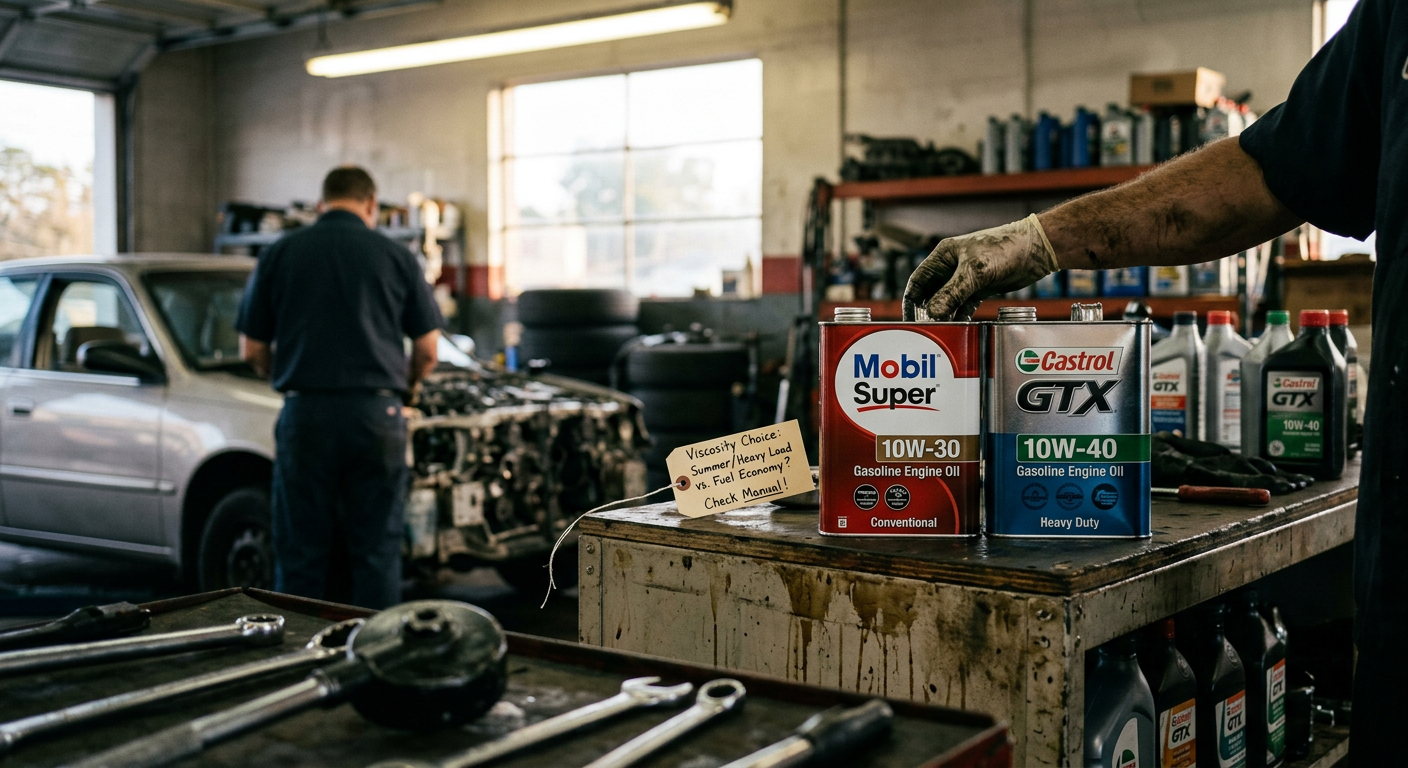
In everyday U.S. terms, 10W-30 is often chosen for balanced all-around driving, while 10W-40 is chosen for stress conditions. The key is not to assume thicker always means better. Superior lubrication is about matching viscosity to engine design, ambient temperature, driving load, and the manufacturer’s specification.
| Factor | 10W-30 | 10W-40 | What It Means in the United States |
|---|---|---|---|
| Operating temperature viscosity | Moderately thick | Thicker | 10W-40 better suits hotter states and heavier stress |
| Fuel economy | Usually better | Usually slightly lower | Useful for daily commuters and high annual mileage drivers |
| Older engine wear | Good if manual allows | Often better for worn engines | High-mileage vehicles may benefit from 10W-40 |
| Oil consumption control | Moderate | Often stronger | Helpful for engines burning oil between services |
| Hot-weather protection | Good | Very good | Important in Texas, Arizona, Nevada, and southern California |
| OEM compatibility | More common | More limited in new cars | Always check the owner’s manual first |
This comparison matters because many U.S. buyers still shop by habit rather than specification. The table makes clear that neither grade is universally superior. Each performs best in a specific operating window.
Which One Is Better for Different U.S. Driving Conditions
For suburban commuting in cities such as Columbus, Charlotte, Nashville, or Sacramento, 10W-30 is often the more practical option for compatible vehicles. It supports efficient circulation and is widely available at auto parts stores, mass retailers, and service centers. For long freeway runs in heat, loaded pickups in the Sun Belt, and older engines used in stop-and-go delivery work, 10W-40 may offer more thermal margin.
Drivers in northern states should be cautious about assuming these grades are optimal year-round. In cold winter starts around Minneapolis, Buffalo, Detroit, or Denver, many engines perform better with lower winter grades specified by the manufacturer. However, once temperatures rise, especially for legacy gasoline engines, 10W-30 and 10W-40 remain relevant and widely stocked.
Best Fit by Vehicle Type and Use Case
| Vehicle or Use Case | Typical Better Fit | Reason | Buyer Note |
|---|---|---|---|
| Modern family sedan | 10W-30 if approved | Better balance of protection and efficiency | Many newer models may require 5W-30 or 0W-20 instead |
| Older high-mileage sedan | 10W-40 | Helps maintain oil film and reduce consumption | Useful when engine wear is noticeable |
| Gasoline pickup used for towing | 10W-40 | Better high-temperature margin under load | Check manual and service temperature range |
| Compact SUV daily driver | 10W-30 | Suits normal commuting if approved | Popular in the used-vehicle maintenance segment |
| Classic car or older V8 | 10W-40 | Often matches looser tolerances and heat exposure | Additive needs may also matter |
| Light commercial gasoline van | Depends on duty cycle | 30 for normal load, 40 for harder service | Fleet maintenance data should guide the choice |
| Ride-share vehicle | 10W-30 | Frequent oil changes and fuel economy are priorities | Stop-start conditions may still justify premium formulations |
This table is especially useful for workshop buyers, distributor sales teams, and fleet managers because it converts a technical comparison into real application logic. Instead of asking which oil is superior in general, it asks which oil is superior for a particular machine and workload.
Industry Demand Across the United States
Passenger cars remain the biggest outlet, but the U.S. market for these viscosity grades also includes small fleets, independent repair chains, agricultural support vehicles, classic car restoration shops, and utility service providers using gasoline engines. In secondary markets outside major coastal metro centers, consumers often keep vehicles longer and rely on familiar grades such as 10W-30 and 10W-40.
The bar chart shows where practical demand remains strongest. Passenger cars and light trucks continue to dominate, but independent garages are crucial because they often influence grade selection for older vehicles no longer maintained at dealerships.
Product Types Available in This Segment
Not all 10W-30 or 10W-40 oils are the same. U.S. buyers can choose between conventional mineral oil, synthetic blend, full synthetic, and high-mileage formulations. The correct chemistry depends on drain interval goals, operating temperature, seal condition, and the service profile of the engine.
Conventional oils still sell well in price-sensitive channels, but synthetic blends have become especially popular because they offer a middle ground between cost and performance. Full synthetic 10W-30 and 10W-40 products attract buyers who want oxidation resistance, cleaner internals, and stronger thermal stability during highway heat or long service cycles. High-mileage variants are widely used for older American and Japanese gasoline engines that show seal aging or increased oil consumption.
| Product Type | Typical Advantage | Common U.S. Buyer | Best Application |
|---|---|---|---|
| Conventional 10W-30 | Lower upfront cost | Budget retail and older car owners | Normal short-interval service |
| Conventional 10W-40 | Cost-effective thicker film | Used car lots and older engines | High-mileage or warm-climate operation |
| Synthetic blend 10W-30 | Balanced cost and stability | Quick-lube shops and daily drivers | Mixed city and highway use |
| Synthetic blend 10W-40 | Better heat handling | Light truck and utility users | Towing and prolonged summer driving |
| Full synthetic 10W-30 | Strong oxidation control | Performance-minded retail buyers | Longer drain intervals if approved |
| Full synthetic 10W-40 | High thermal reserve | Performance, classics, harder service | Hot climates and engine stress |
| High-mileage 10W-30 | Seal-conditioning support | Owners of aging commuter vehicles | Moderate wear and slight seepage |
| High-mileage 10W-40 | Wear support plus thicker viscosity | Older SUVs and pickups | Oil consumption and hot-weather use |
The product mix matters for stocking decisions. A distributor serving Houston and Phoenix may lean more heavily toward synthetic blend and high-mileage 10W-40, while one serving mixed retail accounts in the Midwest may prefer conventional and blend 10W-30 in larger volumes.
Trend Shift Through 2026
The broad U.S. trend is moving toward synthetic content, stricter emissions compatibility, lower volatility, and more stable high-temperature protection. Even within older viscosity grades, buyers now expect better base oil quality and stronger additive performance than they did a decade ago.
The area chart highlights a realistic shift: not away from these grades entirely, but toward more advanced formulations within them. In 2026, sustainability pressure, waste oil management expectations, and end-user interest in longer service consistency will continue pushing the market toward better base stocks and stronger additive packages.
Buying Advice for U.S. Retailers, Workshops, and Fleets
The first buying rule is simple: match the oil to the owner’s manual or maintenance engineering standard. The second rule is to consider duty cycle honestly. A gasoline pickup hauling equipment in Dallas is not the same as a commuter sedan in Portland. The third rule is to evaluate supply reliability, packaging options, documentation, and support.
Retailers should stock recognizable viscosities in consumer-friendly bottle sizes, but also use shelf labels to explain when 10W-40 is appropriate and when it is not. Independent workshops should track comeback rates, oil consumption complaints, and summer overheating conditions to decide whether 10W-30 or 10W-40 reduces customer problems more effectively. Fleets should use used oil analysis where possible rather than relying on assumptions about thickness.
For importers and private-label buyers, packaging flexibility, stable batch control, technical data sheets, API alignment, and responsive claims handling are all more important than price alone. Ports such as Houston, Long Beach, Savannah, and Newark remain key logistics points for imported lubricant programs entering the U.S. market.
Local Suppliers and Major Brands in the United States
The U.S. market includes global majors, regional refiners, and private-label manufacturers. The best supplier depends on whether the buyer needs national retail coverage, workshop-focused supply, bulk industrial packaging, or OEM and distributor customization. The table below gives concrete names and practical positioning.
| Company | Service Region | Core Strengths | Key Offerings in This Segment |
|---|---|---|---|
| Valvoline | Nationwide United States | Strong installer network and consumer trust | 10W-30, 10W-40, high-mileage, synthetic blend, quick-lube support |
| Pennzoil | Nationwide United States | Major brand recognition and broad retail reach | Conventional and synthetic passenger car motor oils |
| Mobil | Nationwide United States | Premium synthetic positioning and strong technical reputation | Performance-oriented gasoline engine oils across multiple viscosities |
| Castrol | Nationwide United States | Retail penetration and workshop familiarity | High-mileage and synthetic options for older gasoline vehicles |
| Chevron Havoline | Strong in West, South, and national wholesale channels | Refining scale and dependable commercial supply | Passenger car motor oils for retail and professional users |
| Phillips 66 Lubricants | Nationwide with strong industrial and fleet channels | Distributor depth and commercial packaging flexibility | Automotive engine oils, bulk supply, regional distributor support |
| Citgo Lubricants | South, Midwest, and national distribution | Competitive pricing and broad packaging formats | Passenger car engine oils for workshops and retail channels |
| AMSOIL | Nationwide specialty network | High-performance synthetic focus | Premium formulations for severe-service users |
This supplier table helps buyers separate brand visibility from supply fit. A national brand may be ideal for retail confidence, while a distributor-focused producer may be better for margin, drum supply, or regional exclusivity.
Supplier and Product Position Comparison
The comparison chart shows why supplier selection is not only about brand prestige. Many U.S. buyers rank retail availability highest, but private label support and cost-performance become much more important for distributors, dealers, and fleet-oriented resellers.
Applications by Industry
These engine oils are not limited to private passenger cars. In the United States, gasoline-powered maintenance fleets, municipal vehicles, landscape service equipment, older service vans, and some agricultural support vehicles all contribute to demand. The practical choice depends on start-stop patterns, seasonal temperatures, and engine condition.
In landscaping and groundskeeping operations around Florida, Georgia, and the Carolinas, ambient heat can make 10W-40 attractive for certain gasoline-powered machines or older support vehicles. In municipal passenger fleet pools with regular maintenance intervals, 10W-30 is often the more efficient choice where approved. In restoration and enthusiast markets around California, Arizona, and the Midwest classic car belt, 10W-40 remains especially familiar.
Case Studies from Real U.S.-Style Buying Scenarios
A used-car dealer group in Houston managing older sedans and compact SUVs may prefer stocking both grades but report lower top-up complaints after switching high-mileage vehicles from 10W-30 conventional to 10W-40 high-mileage during summer months. This does not mean 10W-40 is always superior; it means the thicker grade better matched the wear profile and heat load of that particular inventory.
An independent workshop outside St. Louis servicing Japanese and domestic gasoline vehicles from model years 2005 to 2015 may find 10W-30 synthetic blend to be the most practical default for approved vehicles because it balances customer price sensitivity with improved oxidation control. The shop may reserve 10W-40 for older pickups, worn engines, and repeat customers with oil consumption issues.
A fleet operator in Phoenix running mixed light commercial gasoline vans may use oil analysis and notice that vehicles with sustained heat exposure and cargo load show more stable consumption on 10W-40, while lower-load city vans operate efficiently on 10W-30. This kind of segmented strategy is often more profitable than forcing one viscosity across the entire fleet.
What U.S. Buyers Should Check Before Placing Orders
Before choosing a product or supplier, confirm the API service level, whether the oil is conventional, blend, or full synthetic, the additive strategy for detergency and wear control, packaging options, and available technical documentation. Also check whether the supplier can deliver quarts, gallon jugs, pails, drums, totes, or bulk tank loads depending on your channel.
Distributors should review branding support, territory protection, lead times, claim response procedures, and whether the manufacturer can tailor labels for local market preferences. Workshop chains should check fill speed, handling convenience, and whether the product line includes matching filters or service accessories. Retailers should prioritize UPC readiness, shelf appeal, and return handling.
Our Company in the U.S. Supply Context
For buyers in the United States seeking a qualified international source, Feller presents a practical supply option because its gasoline engine oil range spans economy mineral oils, semi-synthetic grades, and flagship full synthetic formulations developed to relevant API, ILSAC, and ACEA performance targets and produced under ISO 9001 and ISO 14001 certified systems with a documented 99.99% batch pass rate, advanced nitrogen-protected blending technology, and complete supporting documents such as COA, MSDS, and TDS that help prove product consistency against international benchmarks. The company works with multiple customer types through flexible cooperation models including OEM and private-label manufacturing for brand owners, wholesale and container programs for distributors, supply for workshops and service networks, and tailored packaging from small retail bottles to bulk industrial formats, allowing end users, dealers, and regional importers to buy in the way that best matches their channel economics. Through its long export track record across more than 60 countries, established partner network of over 500 B2B clients, fast 72-hour shipment coordination, and active market experience in climate-diverse regions, the company supports U.S.-focused buyers with both online technical consultation and practical after-sales follow-up; buyers can review its background on the company page, explore suitable formulations through the product catalog, and arrange localized commercial discussions through the contact channel for long-term distribution, OEM, or supply partnerships.
How to Decide Between 10W-30 and 10W-40 for Inventory Planning
If you are a retailer, stock 10W-30 more broadly and 10W-40 more selectively, with emphasis on high-mileage and warm-climate demand. If you run workshops, map your customer base by vehicle age and usage pattern. If your region sees a large number of older domestic pickups, aging SUVs, and summer driving under heavy load, 10W-40 deserves stronger shelf presence. If your business serves mixed commuter vehicles with moderate mileage, 10W-30 should remain the lead SKU where approved.
Distributors should also consider local demographics. Sun Belt territories, inland logistics corridors, and rural markets often support a wider 10W-40 mix than colder urban regions. Bulk buyers should compare landed cost, packaging flexibility, documentation quality, and replenishment speed, not just per-unit price.
2026 Trends: Technology, Policy, and Sustainability
By 2026, the U.S. lubricant market will continue to be shaped by three large forces. The first is technology. Even older viscosity grades will face higher buyer expectations for oxidation stability, deposit control, and compatibility with longer real-world service intervals. The second is policy. Fuel economy and emissions frameworks will keep nudging the newest vehicles toward lower viscosities, but legacy vehicle support will remain a profitable aftermarket niche. The third is sustainability. Buyers increasingly ask about base oil efficiency, packaging reduction, waste oil handling, and whether a supplier can provide more stable products that help reduce unnecessary oil changes and downtime.
For 10W-30 and 10W-40 specifically, this means the market will likely become more specialized rather than disappear. Better formulations, more accurate fitment guidance, and smarter segmentation by engine age and duty cycle will define success. Suppliers that combine specification compliance, efficient logistics, and technical support will be better positioned than those competing only on price.
FAQ
Is 10W-40 better than 10W-30 for all gasoline engines?
No. In the United States, 10W-40 is usually better only when the engine operates under higher heat, heavier load, or greater wear, and when the manufacturer allows it. For many gasoline cars, 10W-30 is the more balanced choice.
Can I switch from 10W-30 to 10W-40 in summer?
You can consider it only if the owner’s manual permits that viscosity range. This is more common in older vehicles than in newer ones. Summer-only switching is sometimes used in hotter states, but it should be based on engine condition and manufacturer guidance.
Does 10W-40 reduce oil consumption?
It often can in older or worn gasoline engines because its higher operating-temperature viscosity may reduce burn-off or seepage. However, it is not a cure for mechanical problems such as bad valve seals or piston ring wear.
Is 10W-30 better for fuel economy?
In general, yes. Because it is thinner at operating temperature than 10W-40, it typically reduces internal drag slightly. For high-mileage U.S. commuters, this can make it the more practical choice when approved.
Which grade should workshops stock more of?
Most U.S. workshops should stock more 10W-30 than 10W-40, but the exact mix depends on vehicle age, climate, and customer profile. Shops serving many older pickups, SUVs, and worn engines may need a stronger 10W-40 inventory.
Are imported 10W-30 and 10W-40 oils reliable?
They can be, provided the supplier offers clear API-aligned formulations, stable manufacturing systems, documentation, and responsive after-sales support. For distributors and private-label programs, imported products can offer strong cost-performance when sourced from experienced manufacturers.
What packaging formats are common in the United States?
Quart bottles, 5-quart jugs, pails, drums, IBC totes, and bulk delivery are all common. Retail channels usually prefer smaller packs, while fleets and workshops often prefer drums or bulk systems.
What is the smartest buying strategy for 2026?
Use specification-first selection, keep a strong 10W-30 base for approved vehicles, add 10W-40 for hot-climate and high-mileage demand, and choose suppliers that combine formulation quality, logistics reliability, and technical support.

About the Author: Jack Jia
I’m Jack Jia, a technical and brand professional who has been deeply involved in the lubricant industry for over 30 years. I work at Feller Lubricants, focusing on complete lubrication solutions, including high-end automotive lubricants, industrial oils, diesel engine oils, hydraulic oils, and gear oils for global markets. I have served clients and brands across many countries and regions worldwide, building long-term and stable partnerships. Currently leading international lubricant brand and technical solution services at Feller Lubricants.
Share