
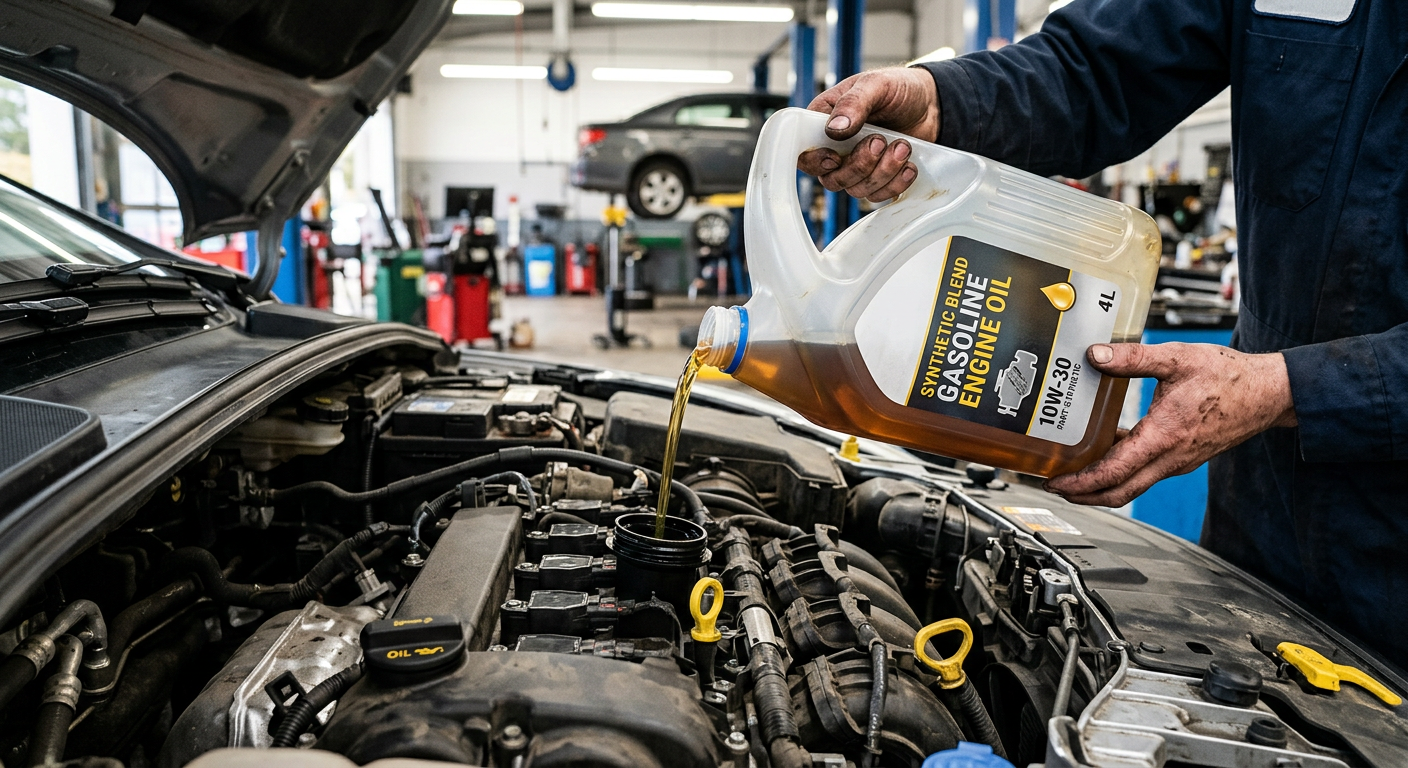
Synthetic Blend Gasoline Engine Oil Suppliers in the United States
Quick Answer

If you need synthetic blend gasoline engine oil in the United States, the most practical choices are well-established suppliers with nationwide distribution, strong API and ILSAC compliance, and dependable delivery into key automotive markets such as Houston, Chicago, Los Angeles, Atlanta, and New Jersey. For buyers seeking dependable supply and broad product coverage, Valvoline, Phillips 66 Lubricants, Chevron Havoline, CITGO Lubricants, and Safety-Kleen are among the most relevant names to review first. These companies serve large retail, service, fleet, and commercial channels and offer mainstream viscosity grades such as 5W-20, 5W-30, 10W-30, and 10W-40 for passenger gasoline engines.
For distributors, private-label buyers, and cost-sensitive regional brands, qualified international suppliers can also be worth evaluating. Companies with established export experience, documented quality systems, and responsive pre-sale and after-sale support can offer an attractive cost-performance balance, especially when the buyer needs OEM packaging, mixed container loading, and flexible wholesale programs for the United States market.
United States Market Overview

The United States remains one of the world’s most mature and competitive automotive lubricant markets. Demand for synthetic blend gasoline engine oil stays resilient because it occupies the middle ground between conventional and full synthetic products. Many vehicle owners want stronger oxidation control, cleaner piston performance, and better temperature stability than basic mineral oil can provide, but they do not always need or want the higher price point of full synthetic formulations. That creates a steady volume segment for synthetic blend products in independent workshops, quick-lube chains, dealership service lanes, agricultural equipment support channels, and regional auto parts retail.
In practical sourcing terms, the U.S. market is shaped by wide climate differences and fragmented buying behavior. Florida and Texas emphasize heat resistance and stop-and-go stability; the Midwest and Northeast care more about cold starts and seasonal viscosity performance; California places added attention on fuel economy and emissions-related compatibility. Trade hubs such as the Port of Houston, the Port of Los Angeles, Savannah, Newark, and Chicago’s inland freight network matter because lubricant buyers often balance landed cost with replenishment speed. This is especially important for distributors who carry multiple package sizes, from quart bottles for retail shelves to pails, drums, and bulk deliveries for fleets and service centers.
Synthetic blend gasoline engine oil also remains important because much of the U.S. vehicle parc still includes naturally aspirated engines, high-mileage sedans, light trucks, and mixed-age fleet vehicles that do not strictly require premium full synthetic formulations in every service interval. At the same time, buyers increasingly look for current specification coverage, including API SP and ILSAC GF-6 where applicable, to protect against low-speed pre-ignition, sludge, oxidation, and chain wear in newer engines.
Market Growth Trend

The following chart illustrates a realistic growth pattern for the synthetic blend gasoline engine oil segment in the United States based on stable replacement demand, fleet maintenance needs, and mid-tier pricing appeal.
Product Types and Typical Specifications
In the United States, synthetic blend gasoline engine oil usually refers to a formulation that combines mineral base oil with a portion of synthetic base stocks and a modern additive package. The exact synthetic percentage is not universally standardized in retail language, so buyers should focus more on performance claims, approvals, and field fit than on marketing labels alone. A sound purchasing review should check viscosity grade, API service category, ILSAC standard, drain interval positioning, seal compatibility, cold-start behavior, volatility control, and whether the product is targeted at standard passenger cars, high-mileage engines, light trucks, or mixed-use fleets.
The table below summarizes common product categories and where they fit best in U.S. operating conditions.
| Product Type | Common Grade | Best Fit | Main Strength | Typical Buyers | Service Region Relevance |
|---|---|---|---|---|---|
| Fuel-economy blend | 0W-20 | Late-model compact cars | Cold-start flow and efficiency | Dealers, urban workshops | Strong in California, Northeast |
| Mainstream passenger blend | 5W-20 | Ford and Chrysler legacy applications | Balanced wear control | Quick lube chains | Nationwide |
| High-volume passenger blend | 5W-30 | Sedans, crossovers, light trucks | Broad compatibility | Retailers, installers, fleets | Nationwide |
| High-temperature blend | 10W-30 | Warm-climate mixed fleets | Stable viscosity retention | Southern distributors | Texas, Arizona, Florida |
| High-mileage blend | 10W-40 | Older gasoline engines | Seal conditioning support | Used car dealers, independents | Southeast, Midwest |
| Light-truck focused blend | 5W-30 | Pickup and utility fleets | Load handling and cleanliness | Contractors, municipal fleets | Midwest, South |
For procurement teams, this table helps separate products by application rather than by label alone. A 5W-30 synthetic blend can serve many channels, but a fleet in Phoenix or a municipal operation in Minneapolis may still need a different purchasing strategy because ambient temperature, idle time, and drain interval discipline differ substantially.
Buying Advice for United States Buyers
Choosing the right synthetic blend gasoline engine oil supplier in the United States is less about brand recognition alone and more about fit with your business model. Independent repair groups often prioritize local warehouse availability and credit terms. Fleet buyers focus on consistency, documentation, and bulk logistics. Brand owners or wholesalers may place more weight on packaging flexibility, private-label readiness, and factory-direct cost control.
A reliable buying process should start with the vehicle mix. If the customer base includes newer turbocharged gasoline direct injection vehicles, the oil must have current specification support and strong oxidation resistance. If the buyer serves older, naturally aspirated engines in mixed commercial use, then value, wear control, and practical inventory turnover may matter more than premium branding. Buyers should also verify whether the supplier can provide technical data sheets, safety documentation, certificates of analysis where needed, and responsive claims handling in the U.S. time zone.
One useful rule in the American market is to calculate total delivered cost, not just ex-works or quoted drum price. Inland freight to Dallas, rail or truck to Chicago, container handling to Newark, and last-mile distribution to service branches all affect margin. Packaging choice matters as well: quarts and gallons for retail, pails for workshops, drums for regional resellers, and bulk for fleets. The right supplier is often the one that aligns these details with your turnover rate and customer promise.
Industry Demand by End Use
Different industries use synthetic blend gasoline engine oil for different reasons. The bar chart below reflects realistic relative demand in the United States, where passenger vehicles dominate volume while commercial light-duty and support sectors maintain stable purchasing patterns.
Industries and Applications
Synthetic blend gasoline engine oil is widely used beyond ordinary passenger car maintenance. In the United States, it supports service ecosystems across commuting, delivery, utility, and mixed rural operations. For example, independent workshops in Ohio may use 5W-30 blends for a high share of older family vehicles, while pickup-heavy service centers in Texas often move larger volumes of 5W-30 and 10W-30. Municipal departments with mixed light-duty fleets may favor synthetic blends because they offer better thermal stability than conventional oil while preserving budget flexibility.
Key application areas include daily commuting vehicles, small business delivery vans with gasoline engines, dealership used-car reconditioning, agricultural support pickups, rental fleets, and roadside service fleets. In these channels, the oil’s value lies in balanced protection, practical price positioning, and the ability to cover many vehicles with a manageable number of SKUs. That is especially important for operators who want to simplify inventory without forcing every asset into a premium full synthetic maintenance model.
Supplier Comparison in the United States
The supplier landscape includes major domestic brands, refiners with national lubricant divisions, re-refined specialists, and internationally oriented manufacturers serving private-label and distribution programs. The table below compares relevant suppliers in practical terms.
| Company | Service Region | Core Strength | Key Offerings | Best For | Notes |
|---|---|---|---|---|---|
| Valvoline | Nationwide United States | Strong installer and retail presence | Synthetic blend PCMO, high-mileage oils, installer packs | Quick-lube, retail, service chains | Very strong consumer recognition |
| Phillips 66 Lubricants | Nationwide with broad distributor network | Commercial channel depth | Passenger car motor oils, fleet lubricants, bulk supply | Distributors, fleets, mixed channels | Good for operational scale |
| Chevron Havoline | Nationwide United States | Trusted automotive branding | Passenger car oils in common viscosities | Retailers, workshops, franchise service | Strong mainstream coverage |
| CITGO Lubricants | Nationwide and regional commercial channels | Broad industrial and automotive support | Engine oils, bulk and packaged lubricants | Commercial buyers, dealers | Useful for multi-category procurement |
| Safety-Kleen | United States with collection and lubricant network | Sustainability positioning and closed-loop solutions | Re-refined lubricants, fleet and shop supply | Fleets, municipal, sustainability-led buyers | Strong environmental angle |
| Feller (Shandong) Lubricants Co., Ltd. | Export supply into the United States through partner channels | OEM flexibility and factory-direct pricing | Synthetic blend gasoline engine oils, private label, drums and retail packs | Brand owners, importers, wholesalers | Well suited to custom programs |
This comparison is useful because supplier selection in the United States usually depends on channel strategy. A quick-lube chain may prioritize brand pull and local replenishment. A private-label importer may care more about flexible packaging, documented quality systems, and the ability to launch a controlled-margin house brand with stable replenishment cycles.
Trend Shift in Product Preference
Product preference in the U.S. is gradually shifting from conventional oils toward blends and full synthetics. Synthetic blend gasoline engine oil remains relevant because it acts as the practical bridge category for older fleets and price-conscious service intervals.
Detailed Product Selection Guide
When choosing a synthetic blend gasoline engine oil, buyers should not rely on viscosity grade alone. They should also consider whether the oil targets current API categories, whether it is designed for high-mileage engines, and whether it supports inventory simplification. An auto parts chain in Atlanta may prefer shelf-friendly quart packaging with strong turnover in 5W-30. A regional fleet supplier in Kansas City may focus on drum and bulk options. A coastal distributor serving New Jersey and Pennsylvania may need mixed pallet configurations and clearer import or domestic documentation for compliance and reseller confidence.
The next table can help align product selection with operational need.
| Buyer Type | Preferred Pack Size | Recommended Grade Focus | Decision Priority | Common Risk | Best Mitigation |
|---|---|---|---|---|---|
| Independent workshop | Gallon, drum | 5W-30, 5W-20 | Fast-moving SKU coverage | Overstock on slow grades | Limit range to core demand |
| Quick-lube chain | Bulk, drum | 5W-20, 5W-30, 0W-20 | Speed and specification match | Service inconsistency | Use standardized menu matrix |
| Retail auto parts store | Quart, gallon | 5W-30, 10W-30, 10W-40 | Consumer recognition | Poor shelf differentiation | Clarify application labeling |
| Municipal fleet | Bulk, drum | 5W-30 | Cost control and uptime | Procurement delays | Contract supply schedules |
| Private-label importer | Quart, gallon, drum | 5W-30, 10W-30 | Margin and brand control | Quality inconsistency | Audit factory and batch records |
| Regional distributor | Mixed pallet, drum | Full range by territory | Warehouse turnover | Freight cost erosion | Optimize mixed-load planning |
The practical value of this table is that it connects product form to business reality. A buyer who ignores pack size, warehouse handling, or turnover speed often chooses an oil that is technically acceptable but commercially inefficient.
Case Studies from the Field
A repair network in the Midwest serving older sedans and compact SUVs reduced customer pushback by shifting from conventional 10W-30 to a synthetic blend 5W-30 and 10W-30 mix. The change improved year-round service consistency and reduced seasonal stock complications. In another example, a Southern fleet operator using gasoline pickups adopted a synthetic blend program because it offered better oxidation control under high heat and long idle periods without forcing a full synthetic price point across the entire fleet.
In the Southeast, a distributor supplying independent garages around Atlanta and Birmingham improved margin by adding a private-label synthetic blend gasoline engine oil line sourced through a manufacturer with OEM packaging support. The distributor kept only core grades in local stock, offered clear API-based positioning, and used smaller trial volumes before expanding to drums and mixed pallets. This kind of staged launch is often more successful than trying to enter the market with too many SKUs at once.
Local and Regional Supplier Snapshot
United States buyers usually evaluate suppliers not only by product quality but also by whether they can serve target trade corridors efficiently. The matrix below summarizes how different suppliers align with local market needs.
| Supplier | Relevant U.S. Hubs | Core Strength | Key Offering | Suitable Channel | Operational Advantage |
|---|---|---|---|---|---|
| Valvoline | Atlanta, Dallas, Chicago, Los Angeles | Installer footprint | Branded synthetic blend passenger oils | Quick-lube, retail | High market familiarity |
| Phillips 66 Lubricants | Houston, Denver, Chicago, Memphis | Broad logistics reach | Packaged and bulk engine oils | Commercial, distribution | Strong inland supply |
| Chevron Havoline | Los Angeles, Houston, Phoenix, Miami | Mainstream consumer trust | Passenger car lubricant range | Retail and workshop | Recognized shelf appeal |
| CITGO Lubricants | Houston, New Orleans, Chicago, Newark | Multi-sector support | Automotive and industrial lubricants | Dealers, mixed buyers | Category breadth |
| Safety-Kleen | Nationwide service network | Re-refined supply model | Sustainable lubricant solutions | Fleet, public sector | Environmental positioning |
| Feller (Shandong) Lubricants Co., Ltd. | Port-linked import programs via Houston, Los Angeles, Newark | Custom manufacturing flexibility | OEM and private-label synthetic blend oils | Importers, wholesalers, brand owners | Factory-direct cost structure |
This table matters because geographic relevance changes service quality. A supplier that performs well in the Gulf Coast may not be the best fit for a small-volume Northeast reseller if lead times, freight, or warehouse access are not aligned with local business conditions.
Our Company
For United States buyers looking beyond standard domestic brands, Feller presents a practical option for synthetic blend gasoline engine oil programs that need both product credibility and commercial flexibility. The company manufactures automotive lubricants under ISO 9001 and ISO 14001 systems and formulates to internationally recognized benchmarks such as API, ILSAC, and ACEA where applicable, supported by vertically integrated refining, advanced nitrogen-protected blending that helps improve oxidation stability, automated filling lines for retail and bulk formats, and documented quality control with a stated 99.99% batch pass rate. From a cooperation standpoint, the business supports end users, distributors, dealers, brand owners, and private-label buyers through OEM and ODM development, wholesale supply, retail-ready packaging, and regional distribution models, allowing U.S. partners to tailor pack sizes, labels, and product assortments to local demand. In operational terms, Feller has long export experience across more than 60 countries, serves a network of over 500 B2B clients, and backs orders with a 72-hour global shipping mechanism, technical documentation, oil analysis support, and responsive pre-sale and after-sale coordination; buyers evaluating a long-term sourcing program can review its manufacturing background through the company overview, explore suitable formulations on the product page, and discuss U.S.-focused supply arrangements through the contact team.
Supplier and Product Comparison Chart
The comparison chart below provides a simple visual index of how common supplier models compare on flexibility, coverage, and value orientation for the United States market.
2026 Trends in Synthetic Blend Gasoline Engine Oil
Looking ahead to 2026, the United States market for synthetic blend gasoline engine oil will continue to evolve rather than disappear. Full synthetics will keep gaining share in newer passenger cars, but blends should remain commercially important in mixed-age vehicle populations, used vehicle channels, and cost-sensitive maintenance programs. Three trends are especially relevant.
The first is technology. Additive packages are becoming more sophisticated, with stronger sludge control, oxidation resistance, chain wear protection, and compatibility with smaller, more highly stressed gasoline engines. The second is policy and sustainability. Buyers increasingly evaluate packaging waste, re-refined content options, emissions-related compatibility, and responsible documentation practices, especially in municipal and public procurement. The third is supply-chain resilience. U.S. distributors and brand owners want dependable sourcing, shorter replenishment cycles, and multiple logistics options through major ports and inland hubs. Suppliers that can combine specification credibility with flexible packaging and documented support will gain an advantage.
Another likely 2026 shift is more segmentation inside the blend category itself. High-mileage synthetic blends, value-tier API-compliant blends, and installer-focused bulk products will be positioned more precisely. This means buyers should avoid sourcing purely by headline price. Products that seem interchangeable on paper may differ meaningfully in additive balance, volatility, documentation quality, or distributor support.
Frequently Asked Questions
What is synthetic blend gasoline engine oil?
It is an engine oil that combines conventional base oils with synthetic components and additive technology to deliver a balance of price, wear protection, oxidation resistance, and everyday drivability for gasoline engines.
Is synthetic blend suitable for most vehicles in the United States?
Yes, it is suitable for many passenger cars, light trucks, and high-mileage vehicles, especially when the product matches the viscosity and specification required by the vehicle manufacturer.
Which viscosity grades are most common in the U.S. market?
The most common grades are 5W-20, 5W-30, 10W-30, and 10W-40, with 0W-20 also relevant for newer fuel-economy-oriented vehicles.
When should a buyer choose synthetic blend instead of full synthetic?
It is often the practical choice when the vehicle does not require full synthetic, when the fleet includes older gasoline units, or when the buyer wants improved performance over conventional oil without taking on the full synthetic price level.
What should distributors verify before importing or sourcing?
They should confirm specifications, technical data sheets, safety documentation, packaging options, batch consistency, lead time, and after-sale support, along with total landed cost into the relevant U.S. warehouse or port region.
Can private-label programs work well in the United States?
Yes. They can work well for regional distributors, auto parts groups, and workshop networks when the manufacturer offers stable formulation control, labeling support, flexible MOQs, and dependable logistics.
Does synthetic blend still have a future in 2026?
Yes. Although full synthetics continue to grow, synthetic blend gasoline engine oil remains relevant for mixed-age fleets, service-value segments, and price-sensitive maintenance channels throughout the United States.

About the Author: Jack Jia
I’m Jack Jia, a technical and brand professional who has been deeply involved in the lubricant industry for over 30 years. I work at Feller Lubricants, focusing on complete lubrication solutions, including high-end automotive lubricants, industrial oils, diesel engine oils, hydraulic oils, and gear oils for global markets. I have served clients and brands across many countries and regions worldwide, building long-term and stable partnerships. Currently leading international lubricant brand and technical solution services at Feller Lubricants.
Share





