
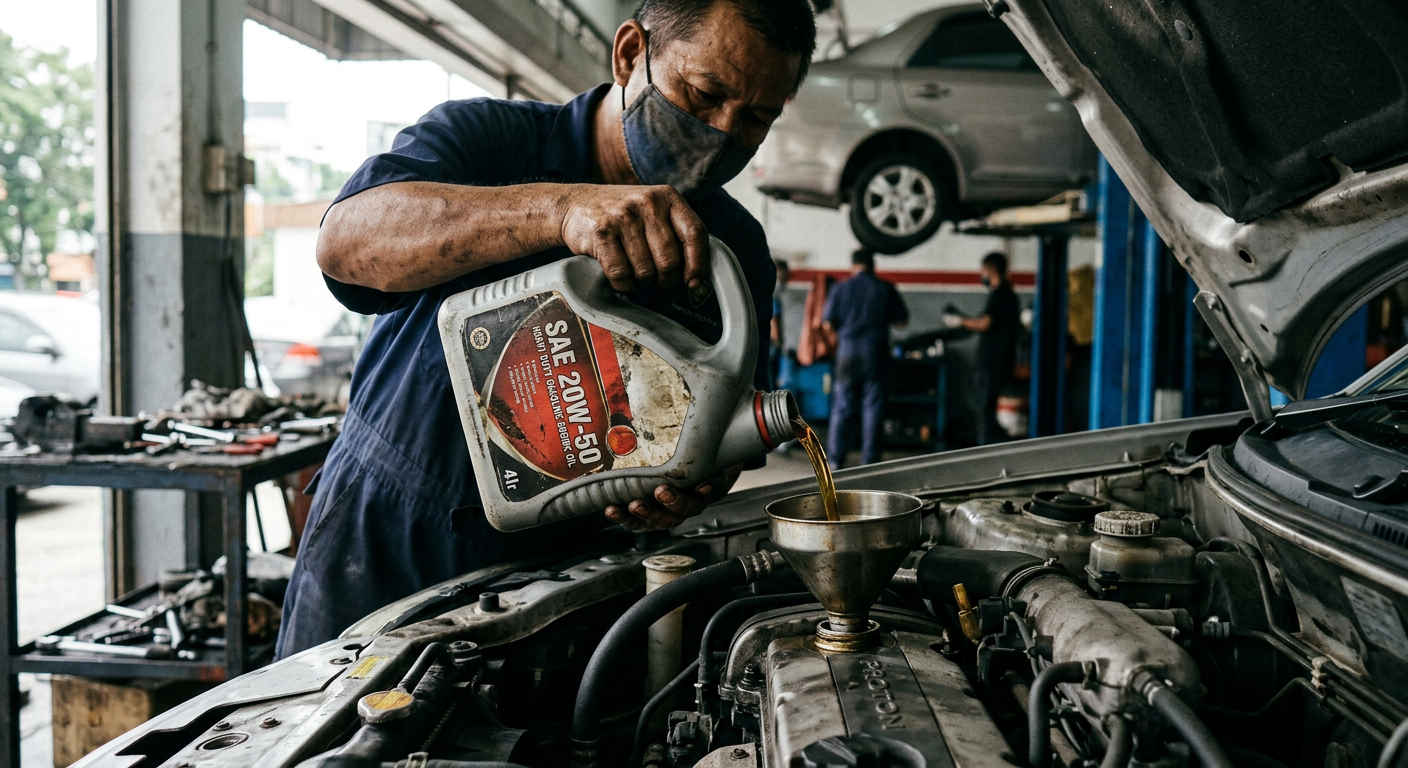
SAE 20W-50 gasoline engine oil buying guide for the United States
Quick Answer

For buyers in the United States, SAE 20W-50 gasoline engine oil is best suited to older gasoline engines, classic cars, air-cooled motorcycles that share similar viscosity needs, high-mileage vehicles with increased oil consumption, and equipment operating in sustained heat or under heavy load. It is not the default choice for most new passenger cars, because many newer engines are designed for lower-viscosity oils such as 0W-20, 5W-20, or 5W-30. The best buying decision depends on the vehicle manufacturer’s specification first, then climate, engine age, duty cycle, and whether the oil must also meet API service categories required by the engine.
In the United States, practical local options include Valvoline, Castrol, Mobil, Phillips 66, Chevron, and NAPA-branded oils supplied through established distribution networks in cities such as Houston, Los Angeles, Chicago, Atlanta, and Miami. Buyers serving fleets, repair chains, agricultural users, or private-label programs should also consider qualified international suppliers, including Chinese manufacturers with relevant documentation, stable OEM production, and responsive pre-sales and after-sales support, because they can offer strong cost-performance value for regional distribution and branded lubricant programs.
If you need a fast decision, choose SAE 20W-50 gasoline engine oil when the owner’s manual allows it and your engines work in hot weather, show wear, or run continuously under load. Choose a supplier with clear API documentation, dependable packaging options, lot traceability, and regional logistics support so inventory moves smoothly through U.S. ports and inland warehouses.
United States market overview

The U.S. lubricant market remains one of the most mature and technically demanding in the world. Demand for SAE 20W-50 gasoline engine oil is smaller than demand for modern low-viscosity passenger car motor oils, yet it remains important in several durable market segments. These include classic and collector cars, older pickup trucks and sedans, repair shops focused on high-mileage vehicles, agricultural support fleets in hot states, small commercial gasoline equipment, and some performance applications where a thicker oil film is preferred. In states such as Texas, Arizona, Florida, Nevada, and inland California, sustained ambient heat often reinforces demand for higher-viscosity formulations for compatible engines.
Trade and logistics matter in this category. Imported and domestically blended lubricants move through major ports such as Houston, Long Beach, Savannah, Newark, and Los Angeles, then distribute inland through bulk terminals, packaging warehouses, and aftermarket channels. For B2B buyers, especially lubricant distributors and regional brand owners, the main decision variables are not only viscosity and API level but also packaging flexibility, label compliance, availability of technical data sheets, and the ability to keep supply stable during seasonal demand swings.
The aftermarket in the United States also values trust. Buyers want consistent base oil quality, additive stability, and a realistic service recommendation that matches engine design rather than marketing promises. That is why established brands continue to lead shelf presence, while emerging private-label and OEM supply programs grow by offering better margins to distributors and retail chains.
The chart above shows a realistic demand index pattern rather than explosive growth. In the United States, this viscosity grade grows steadily because the installed base of older gasoline engines remains large, especially outside dense urban centers. At the same time, 20W-50 faces long-term pressure from fuel-economy standards and newer engine designs that require thinner oils. The result is a stable specialty market with durable B2B opportunities rather than a mass-market growth race.
How SAE 20W-50 gasoline engine oil fits U.S. applications

SAE 20W-50 gasoline engine oil is a multigrade engine oil designed to flow like an SAE 20 grade at lower temperatures while maintaining the higher viscosity protection of an SAE 50 grade when the engine reaches operating temperature. In practical U.S. use, that means thicker film strength in hot running conditions, useful support for worn seals and clearances in older engines, and stronger resistance to viscosity thinning under heavy heat. These traits make it attractive for some high-mileage gasoline engines, vintage engines with larger internal clearances, classic V8s, and older work vehicles in warm regions.
However, suitability depends on the engine. Many modern American, Japanese, Korean, and European gasoline vehicles sold in the United States are engineered around tighter tolerances and lower-viscosity oils. Using 20W-50 in those engines without manufacturer approval can reduce cold-start performance, affect fuel economy, and potentially interfere with variable valve timing behavior. That is why distributors, workshops, and fleet buyers should treat this viscosity as a targeted solution, not a universal recommendation.
In the U.S. market, demand is strongest where there is a practical maintenance logic: hot-climate fleets, classics, older SUVs, agricultural support vehicles, gas-powered pumps and generators, and some commercial gasoline engines that run for long periods at stable load. The grade also remains relevant in independent repair channels where technicians work with engines showing wear-related consumption or pressure drop and need a thicker oil within approved viscosity ranges.
Common product types in this category
U.S. buyers usually find SAE 20W-50 gasoline engine oil in three main formulation styles: mineral, semi-synthetic, and full synthetic. Mineral 20W-50 remains common in value-focused channels because it serves older engines at an accessible cost. Semi-synthetic 20W-50 often balances thermal stability and price, making it attractive for mixed retail and workshop environments. Full synthetic 20W-50 is less common but important for premium high-temperature performance, oxidation resistance, and extended service confidence in compatible engines.
| Product type | Typical U.S. buyer | Main advantage | Limit | Typical use case | Best fit climate |
|---|---|---|---|---|---|
| Mineral SAE 20W-50 | Independent repair shops | Lower acquisition cost | Shorter oxidation life than synthetic options | Older sedans and pickups | Warm to hot regions |
| Semi-synthetic SAE 20W-50 | Regional distributors | Balanced cost and durability | Mid-range price point | High-mileage mixed vehicle parc | Broad warm-weather use |
| Full synthetic SAE 20W-50 | Performance and premium channels | Better thermal stability | Higher cost | Performance or severe-duty gasoline engines | High heat and sustained load |
| High-mileage 20W-50 | Retail auto parts stores | Seal-conditioning focus | Not needed for healthy newer engines | Oil consumption control in older vehicles | Hot states and summer use |
| Classic vehicle 20W-50 | Collectors and restoration shops | Targeted for older engine designs | Niche market size | Vintage gasoline engines | Seasonal and fair-weather use |
| Bulk 20W-50 drums or totes | Fleet workshops and jobbers | Lower unit packaging cost | Requires storage discipline | Service bays and regional supply | Nationwide distribution |
This table shows why the category stays commercially relevant. It is not one single retail product. It is a group of targeted solutions sold through different channels, from quart bottles for classic-car owners to drums and totes for fleet workshops and lubricant wholesalers.
Buying advice for U.S. buyers
The first rule is to verify the vehicle or equipment recommendation. If the owner’s manual, engine builder, or maintenance program allows SAE 20W-50, the next step is to confirm the API service level required for the gasoline engine. For many older engines, buyers may look at API SL, SJ, or similar service categories depending on the application date and regional market strategy. For private-label projects, the label and technical documentation should clearly state the API claim and intended application range.
The second rule is to match the oil to climate and operating pattern. In hot-weather states, thicker high-temperature viscosity can help maintain oil pressure and reduce consumption in worn engines. In northern cold-start environments, buyers should be more cautious and ensure 20W-50 remains appropriate across the real operating season.
The third rule is to purchase from a supplier that can support the entire transaction, not just the shipment. That means batch traceability, accessible COA and TDS documents, packaging quality that survives pallet handling, and a customer support team that can answer technical questions quickly. This matters for distributors in places like Dallas, Houston, Jacksonville, and Los Angeles where market speed is high and returns or claims can be costly.
| Buying factor | Why it matters | What to verify | Risk if ignored | Best buyer type | Practical U.S. note |
|---|---|---|---|---|---|
| OEM viscosity approval | Protects engine compatibility | Owner manual or technical spec | Wrong oil recommendation | All buyers | Critical for modern vehicles |
| API service claim | Shows minimum performance level | Label and TDS | Market mismatch or claims issues | Distributors and shops | Important in retail compliance |
| Base oil and additive stability | Affects oxidation and wear control | Technical datasheet | Short service life | Fleet and wholesale buyers | Important in hot states |
| Packaging options | Improves channel fit | Quarts, gallons, drums, totes | Higher logistics cost | Jobbers and chains | Needed for mixed channels |
| Traceability and documentation | Supports claims handling | Batch code, COA, SDS | Harder problem resolution | Brand owners and importers | Useful at customs and in QA |
| Regional service support | Reduces downtime and confusion | Account manager and response speed | Slow issue resolution | All B2B buyers | Valuable for multi-state supply |
The table makes the buying process concrete. In the United States, the winning supplier is rarely the one with the lowest drum price alone. It is the one that balances compliance, availability, technical clarity, and channel-specific packaging.
Industries and demand patterns
SAE 20W-50 gasoline engine oil serves a narrower but durable set of industries in the United States. Automotive repair remains the largest channel, especially independent garages maintaining older domestic and imported vehicles. Agricultural operations also create demand, especially where gasoline utility vehicles, pumps, and support equipment operate in warm climates. Construction support fleets and rental businesses can also use this grade in selected legacy gasoline engines.
The bar chart highlights where suppliers should focus sales effort. Automotive repair leads because the independent service channel works with a wide range of aging gasoline vehicles. Classic-car owners represent a smaller but higher-value niche, often more willing to pay for specialty packaging or premium formulations. Retail DIY remains important in the United States because many consumers still maintain older pickups, muscle cars, and hobby vehicles themselves.
Applications by engine and operating condition
In real-world use, this oil grade is most practical when a gasoline engine experiences high thermal stress, enlarged internal clearances due to age, or operating patterns that benefit from a thicker oil film at temperature. That includes older V6 and V8 engines, carbureted or early fuel-injected classics, some older light trucks, generators, and utility engines where the manufacturer allows 20W-50. It can also be useful in hot-summer highway driving where engines run under sustained temperature for long periods.
| Application | Typical U.S. location | Why 20W-50 is used | Main caution | Preferred package | Channel |
|---|---|---|---|---|---|
| Classic passenger cars | California, Florida, Arizona | Supports older clearances and hot-weather operation | Check classic engine builder guidance | Quart bottles | Retail and specialty shops |
| High-mileage pickups | Texas, Oklahoma, Georgia | Helps control consumption in compatible engines | Not for engines requiring 5W-20 or 5W-30 | Gallon jugs | Repair shops |
| Older SUVs and sedans | Nationwide warm regions | Maintains film strength in wear-prone engines | Confirm OEM viscosity range | Quart bottles | Independent garages |
| Gasoline generators | Gulf Coast and rural markets | Useful in sustained heat and load if approved | Follow equipment manual strictly | Bulk and gallon packs | Industrial supply |
| Agricultural support vehicles | Midwest and South | Hot operation and heavy duty cycles | Seasonal temperature suitability | Drums | Distributor wholesale |
| Performance street classics | Nevada, Southern California | Higher viscosity in severe summer driving | Do not substitute for racing oil needs automatically | Premium bottles | Enthusiast channels |
This application view helps buyers avoid the two most common mistakes in the U.S. market: using 20W-50 too broadly, or ignoring it where it is genuinely useful. The right sale depends on application discipline.
Supplier landscape in the United States
The U.S. supply base for SAE 20W-50 gasoline engine oil includes major integrated oil companies, established independent lubricant brands, regional private-label packagers, and qualified overseas OEM manufacturers. Domestic brands offer strong recognition and rapid local availability. International suppliers can be especially competitive for importers, private-label programs, and distributors seeking higher margin structures, provided they offer documentation, stable batch quality, and responsive service.
| Company | Service region | Core strength | Key offerings | Best buyer fit | U.S. relevance |
|---|---|---|---|---|---|
| Valvoline | Nationwide United States | Strong aftermarket brand recognition | Passenger car oils, high-mileage oils, retail and service network | Retailers and service centers | Excellent shelf pull and consumer trust |
| Castrol | Nationwide United States | Premium consumer and workshop positioning | Conventional and synthetic engine oils | Auto parts chains and workshops | Strong in branded retail distribution |
| Mobil | Nationwide United States | Broad technical reputation | Conventional, synthetic, and performance lubricants | Fleet managers and premium retail | Trusted across multiple vehicle segments |
| Chevron | United States and export channels | Integrated refining and lubricant expertise | Havoline and commercial lubricant lines | Distributors and mixed channels | Reliable supply credibility |
| Phillips 66 | United States regional and national channels | Strong distributor relationships | Automotive and industrial lubricants | Jobbers and regional wholesalers | Competitive in B2B distribution |
| NAPA private-label supply | Nationwide through NAPA network | Distribution reach in maintenance channels | Automotive oils and service products | Repair shops and parts buyers | Convenient channel access |
| Feller (Shandong) Lubricants Co., Ltd. | United States import and partner channels | OEM, private-label, and bulk manufacturing flexibility | Gasoline engine oils, diesel oils, industrial oils, packaging from retail bottles to bulk | Brand owners, distributors, wholesalers | Cost-performance option with export experience |
This supplier table is useful because it separates channel fit from product fit. A retail-focused buyer may value consumer brand pull, while a regional distributor building its own label may prioritize OEM manufacturing flexibility, packaging range, and landed-cost control more than household brand recognition.
Detailed supplier comparison
Buying decisions become easier when the comparison focuses on what matters operationally: availability, private-label support, documentation, packaging flexibility, and suitability for older gasoline applications. The U.S. market supports all of these models, but not every supplier offers the same balance.
The comparison chart reflects a common U.S. sourcing reality. Major domestic brands lead in consumer recognition and immediate retail acceptance. Qualified OEM-oriented international suppliers, by contrast, often outperform in private-label flexibility, packaging choice, bulk manufacturing support, and cost competitiveness. For a distributor in Houston or a regional lubricant brand in New Jersey, that difference can materially change margin structure and growth strategy.
Case studies from U.S.-style buying scenarios
A classic-car parts retailer in Southern California needs a dependable SAE 20W-50 gasoline engine oil with stable packaging and year-round shelf continuity. For this buyer, branded domestic supply works well because end users recognize familiar names and purchase on trust. The retailer values marketing support and ready availability through West Coast distribution.
A distributor serving independent garages in Texas, Oklahoma, and Louisiana takes a different approach. Its customers service many high-mileage pickups and older gasoline vehicles, and the distributor wants a better margin than mainstream consumer brands allow. Here, an OEM or private-label model with a qualified manufacturing partner can be more effective, especially when the supplier provides API-aligned documentation, multiple packaging formats, and consistent export scheduling through Houston.
A Florida fleet maintenance group that supports mixed gasoline utility vehicles needs thick-viscosity oil only for a defined subset of older engines. Its main requirement is not brand prestige but technical clarity and batch consistency. In this case, either a domestic regional supplier or a trusted international manufacturer with strong after-sales support can meet the need, as long as application matching is disciplined.
These examples show that the best supplier is not universal. It depends on whether the buyer is selling a brand, protecting a fleet, building private-label margin, or serving a specialized repair niche.
Trend shift through 2026
By 2026, SAE 20W-50 gasoline engine oil in the United States will remain a specialty but resilient category. Three forces will shape it. The first is technology: newer gasoline vehicles increasingly specify lower-viscosity, fuel-economy-focused oils, reducing the share of 20W-50 in mainstream passenger cars. The second is policy: emissions and efficiency expectations continue to favor thinner lubricants in new vehicles, especially under manufacturer warranty frameworks. The third is sustainability: buyers increasingly want longer oil life, better packaging efficiency, and responsible supply chains, even in legacy viscosity grades.
At the same time, the installed base of older vehicles and classic cars continues to support stable demand. Many U.S. consumers keep vehicles longer, and parts of the country remain highly dependent on aging pickups, older SUVs, and utility equipment. This extends the relevance of 20W-50 for maintenance-focused channels.
The area chart shows the market split clearly. Demand from legacy vehicles remains healthy, while pressure from modern low-viscosity trends rises year by year. For U.S. buyers, the right strategy through 2026 is to treat this grade as a profitable niche product supported by technical selling rather than broad, generic promotion.
Local supplier and channel advice
For local sourcing in the United States, buyers should map suppliers by channel strength. If you need rapid retail movement in auto parts stores, choose brands with strong consumer pull and established programs. If you run a service chain, prioritize distribution depth and technical hotline support. If you are launching a regional lubricant label, evaluate OEM manufacturers that can handle design, blending, packaging, documentation, and repeatable shipments through major ports.
Cities such as Houston and Los Angeles remain especially important because they connect import activity with inland distribution. Chicago and Atlanta help move packaged lubricants into central and southeastern states. Miami supports trade flows into the Southeast and Latin-linked channels. Newark and Savannah remain useful for East Coast import and redistribution strategies. Buyers who understand these logistics hubs often manage inventory more efficiently and reduce landed-cost surprises.
It is also wise to balance domestic and international options. Domestic suppliers often win on immediate familiarity and rapid replenishment. International OEM suppliers can strengthen margin, expand packaging options, and support private-label growth if their service structure is mature enough for the U.S. market.
Our company
For U.S. buyers seeking a supply partner rather than only a shelf brand, Feller offers a practical option in SAE 20W-50 gasoline engine oil and related lubricant categories. The company combines more than 30 years of manufacturing experience with ISO 9001 and ISO 14001 certified production, advanced nitrogen-protected blending that improves oxidation stability, and a documented 99.99% product batch pass rate, while formulating products to API, ILSAC, and ACEA performance frameworks and supporting shipments with technical documents such as COA, SDS, and TDS. This product strength is matched by flexible cooperation models: end users can source retail-ready packs, distributors and dealers can purchase factory-direct bulk volumes, and brand owners can develop OEM or private-label programs with customized formulations, packaging, and labeling through the company’s product platform. For the United States market, the local service assurance comes from Feller’s established export experience across more than 60 countries, a partner network of over 500 B2B clients, automated filling and warehousing systems built for rapid turnaround, and a 72-hour global shipping mechanism that supports dependable replenishment through major trade routes; combined with online technical consultation, after-sales follow-up, and responsive commercial support available through its U.S.-facing inquiry channel, this shows the company is structured for long-term market participation rather than one-off remote export. Buyers who want more background on manufacturing and operational capacity can review the company’s history on its about page.
How to choose between domestic brands and OEM import supply
If your business model depends on fast consumer recognition, domestic brands usually offer the strongest immediate advantage. They help retail conversion, simplify sales conversations, and reduce the work needed to educate end users. This is especially valuable in consumer-facing parts stores and quick-lube channels.
If your business model depends on margin control, exclusive branding, or multi-format packaging, OEM import supply becomes more attractive. This is often the better route for wholesalers, regional distributors, agricultural supply groups, and aftermarket chains that want differentiated products under their own brand. The key is to select a manufacturer with hard evidence of quality systems, export capability, packaging control, and technical support rather than relying on low price alone.
In the United States, some of the strongest growth comes from hybrid strategies: distributors carry established domestic names for brand pull while also building private-label lines for better profitability. SAE 20W-50 gasoline engine oil fits that strategy well because the buyer base is targeted and technically motivated.
Frequently asked questions
Is SAE 20W-50 gasoline engine oil good for all cars in the United States?
No. It is suitable only when the vehicle or equipment manufacturer allows this viscosity. It is commonly used in older, high-mileage, classic, or heat-stressed gasoline engines, not in most modern passenger cars.
Is 20W-50 better in hot states like Texas, Arizona, or Florida?
It can be beneficial in hot climates for compatible engines because its higher operating-temperature viscosity helps maintain film strength. But climate never overrides the manufacturer’s recommendation.
What should a distributor verify before importing or private-labeling this oil?
Verify API-aligned claims, technical documentation, packaging durability, batch traceability, supply lead times, and the supplier’s ability to support claims and after-sales questions in the U.S. market.
Who typically buys this viscosity grade in the United States?
Independent repair shops, classic-car owners, agricultural users, older vehicle fleets, regional lubricant distributors, and private-label brand owners are the most common buyers.
Does synthetic SAE 20W-50 exist?
Yes. Full synthetic and semi-synthetic versions are available and usually offer better oxidation resistance and thermal stability than conventional mineral alternatives, at a higher price.
What is the main 2026 outlook for this category?
It remains a stable specialty market. Demand from older vehicles and classic engines continues, while new-vehicle technology and efficiency policy keep shifting mainstream demand toward lower-viscosity oils.
Final takeaway for U.S. buyers
SAE 20W-50 gasoline engine oil remains relevant in the United States because the market still includes millions of older gasoline engines, classic vehicles, and warm-climate applications where a thicker oil is appropriate. The best purchase is not simply the cheapest or the most famous product. It is the one that correctly matches engine requirements, offers dependable documentation, fits the intended channel, and arrives through a supply structure that can support repeat business. For retail-heavy channels, major U.S. brands remain strong. For distributors, importers, and private-label programs, qualified international manufacturers with proven standards and practical support can be a smart and competitive choice.

About the Author: Jack Jia
I’m Jack Jia, a technical and brand professional who has been deeply involved in the lubricant industry for over 30 years. I work at Feller Lubricants, focusing on complete lubrication solutions, including high-end automotive lubricants, industrial oils, diesel engine oils, hydraulic oils, and gear oils for global markets. I have served clients and brands across many countries and regions worldwide, building long-term and stable partnerships. Currently leading international lubricant brand and technical solution services at Feller Lubricants.
Share





