
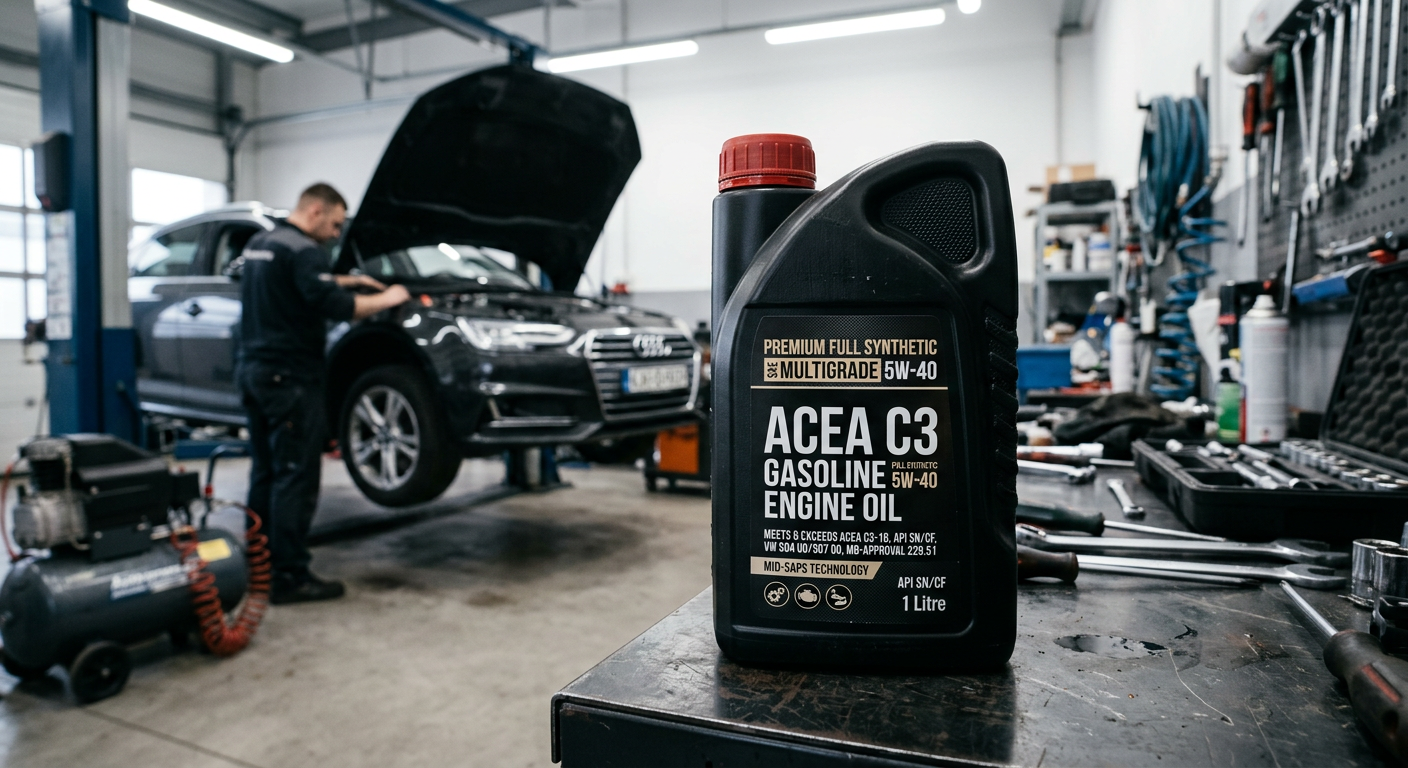
ACEA C3 Gasoline Engine Oil in the United States
Quick Answer

For buyers in the United States, ACEA C3 gasoline engine oil is the right choice when a gasoline engine requires a mid-SAPS lubricant that protects catalytic converters, supports extended drain performance, and aligns with European OEM expectations such as BMW Longlife-04, Mercedes-Benz 229.51 or 229.52, and many Volkswagen applications depending on the exact viscosity and approval set. The most practical suppliers to review first are Mobil, Shell, Castrol, Valvoline, Liqui Moly, and TotalEnergies because they have strong availability across U.S. distribution channels, from major metro markets such as Houston, Los Angeles, Chicago, and New York to import-service hubs near ports and logistics centers like Long Beach, Savannah, and Newark.
For immediate action, buyers should shortlist products by exact viscosity grade, OEM approval, package size, and delivery support rather than by the ACEA claim alone. Independent repair shops and fleet managers should confirm whether the engine truly calls for ACEA C3 rather than ACEA A3/B4, C2, or C5, since the wrong SAPS chemistry can affect emissions-system durability and warranty alignment. In the U.S. aftermarket, Shell Helix, Mobil 1 ESP, Castrol EDGE, Liqui Moly Top Tec, Valvoline European Vehicle formulas, and TotalEnergies Quartz are among the most relevant names for European gasoline vehicles. Qualified international suppliers, including Chinese manufacturers with suitable certifications, documented testing, and strong pre-sales and after-sales support, can also be worth considering because they often provide attractive cost-performance for private label, wholesale, and regional distribution programs.
What ACEA C3 Means for U.S. Buyers

ACEA C3 gasoline engine oil is formulated for modern passenger-car engines that need a mid-SAPS lubricant. Mid-SAPS means controlled sulfated ash, phosphorus, and sulfur levels. In practical terms, this helps protect aftertreatment systems such as catalytic converters and gasoline particulate filters while maintaining a high-temperature high-shear viscosity suitable for durable film strength. For U.S. buyers, that matters most in imported European vehicles and mixed fleets that include BMW, Mercedes-Benz, Volkswagen, Porsche, and some Stellantis models built to European lubrication requirements.
The U.S. market often focuses heavily on API and ILSAC categories, but ACEA C3 remains a critical specification for import specialists, premium quick-lube chains, independent garages, euro-car dealerships, parts wholesalers, and e-commerce sellers serving owners of German and broader European vehicles. It is not merely a branding label. It indicates a distinct balance of piston cleanliness, oxidation resistance, deposit control, wear protection, and emissions-system compatibility. Because many American service providers stock broad-market oils optimized around API SP and ILSAC GF-6, procurement teams need to be deliberate when sourcing true European-formulation ACEA C3 products.
Demand is strongest in metropolitan areas with dense populations of European vehicles, including Miami, Dallas, Atlanta, Seattle, Boston, and Northern New Jersey. It is also notable in logistics corridors where import parts and specialty lubricants move efficiently through bonded warehousing and regional distribution networks. Buyers near the Ports of Los Angeles and Long Beach, the Port of Houston, the Port of Savannah, and the Port of New York and New Jersey often benefit from better access to imported specialty lubricants and private-label replenishment options.
U.S. Market Outlook

The United States remains a large automotive lubricant market, but ACEA C3 occupies a specialized and resilient niche. Its growth comes from three overlapping trends: the sustained presence of European-brand passenger cars on American roads, stricter emissions-system protection requirements, and rising consumer acceptance of premium synthetic oils. While battery electric vehicles reduce long-term passenger-engine oil demand at the margin, the U.S. parc of gasoline-powered European cars remains large enough to support healthy volume through 2026 and beyond. In addition, hybrid vehicles with turbocharged small-displacement engines continue to sustain premium synthetic demand.
Another important market driver is channel specialization. Large national retailers stock some ACEA C3 products, but real growth often comes from import-focused workshops, dealership-independent service networks, digital auto-parts sellers, and B2B warehouse distributors. These buyers increasingly expect technical data sheets, OEM approval references, SDS documentation, stable pallet pricing, and reliable packaging formats from one-liter bottles to drums and totes.
| Market Factor | Impact in the United States | Why It Matters for ACEA C3 | Typical Buyer Response |
|---|---|---|---|
| European vehicle parc | Steady concentration in major metro regions | Creates recurring demand for exact OEM-aligned oils | Stock multiple ACEA C3 viscosities |
| Emissions-system protection | Higher sensitivity in modern turbo engines | Supports need for mid-SAPS formulations | Prioritize approved full synthetics |
| Premiumization | Consumers more willing to pay for specialty oils | Improves margin potential | Offer branded and private-label options |
| E-commerce growth | Specialty lubricants easier to source nationally | Expands access beyond local stores | Use drop-ship and regional warehousing |
| Import repair growth | Independent euro repair shops gaining share | Increases workshop-level repeat purchases | Build B2B service contracts |
| Cost pressure | Price volatility affects distributor margins | Encourages dual-source procurement | Compare domestic and overseas suppliers |
The table above shows why ACEA C3 remains commercially relevant in the United States. Buyers should think of it less as a commodity motor oil and more as a specification-driven category where documentation, channel fit, and application accuracy matter as much as unit price.
Product Types and Viscosity Choices
ACEA C3 gasoline engine oil in the U.S. market is most commonly sold in full synthetic form, although semi-synthetic offerings exist in select channels. The most common viscosity grades are 5W-30 and 5W-40, followed by 0W-30 and 0W-40 depending on OEM approvals. In colder U.S. regions such as Minnesota, Wisconsin, Michigan, and upstate New York, lower winter viscosities may offer a starting advantage, while in warmer markets like Arizona, Texas, Florida, and Southern California, high-temperature stability and volatility control become bigger purchasing priorities.
Buyers should distinguish between ACEA performance level and official OEM approval. A product can be marketed as meeting ACEA C3 performance, but workshop procurement managers often prefer products with formal approvals or clear approval suitability for exact vehicle programs. This is particularly important in dealership-adjacent service environments, warranty-conscious fleets, and premium consumer channels where technical confidence drives repeat business.
| Viscosity Grade | Typical U.S. Use Case | Common Vehicle Fit | Buyer Advantage |
|---|---|---|---|
| 0W-30 | Cold-start focused premium applications | Select BMW, Mercedes-Benz, European imports | Strong low-temperature flow |
| 0W-40 | Performance-oriented gasoline engines | European sporty and luxury vehicles | Wide climate coverage |
| 5W-30 | Mainstream ACEA C3 stocking grade | Mixed European passenger-car parc | Fastest aftermarket turnover |
| 5W-40 | High-load and broad compatibility use | Turbo gasoline and older European engines | Popular with independent workshops |
| 5W-30 OEM-specific | Approval-sensitive service programs | VW, MB, BMW-specific applications | Helps reduce fitment errors |
| Bulk full synthetic | Service bays and fleet maintenance | High-volume workshop consumption | Lowers per-quart handling cost |
This table matters because viscosity selection directly affects inventory efficiency. U.S. distributors who carry too many slow-moving grades tie up working capital, while those who stock only generic grades risk losing professional buyers who require exact OEM alignment.
How to Buy the Right ACEA C3 Oil
The smartest buying process starts with the vehicle requirement, not the brand. Read the owner manual or workshop data, confirm viscosity, ACEA sequence, and any OEM approvals. Then compare packaging format, delivery speed, and total landed cost. A euro-car specialist in Chicago may prioritize one-liter and five-liter retail packs for walk-in customers, while a busy import service center in Houston may need drums or totes with weekly replenishment.
For distributors, label accuracy, barcode management, pallet stability, and packaging durability are just as important as additive chemistry. Leaking caps, inconsistent bottle molding, and incomplete technical documents create expensive channel friction. For brand owners and private-label programs, formulation consistency, blend repeatability, and verified batch control are essential because one labeling mistake or approval mismatch can damage market credibility.
Buyers should also assess supplier support. The best ACEA C3 partners do more than ship oil. They provide TDS and SDS files, application guidance, claims handling, compatibility advice, stock forecasts, and sales training for counter staff. In the U.S. aftermarket, especially in states with strong emissions inspection culture or high populations of imported vehicles, that technical support often influences purchasing decisions more than a small price difference.
Industries and Applications
Although the category name centers on gasoline engines, ACEA C3 products are used across several commercial settings in the United States. Passenger-car dealerships and import-repair workshops are the most obvious channels. However, e-commerce retailers, auto parts chains, used-car reconditioning centers, fleet service providers, and private-label lubricant marketers also participate. The category has cross-functional value wherever European-spec gasoline engine lubrication is needed with emissions-system sensitivity in mind.
Typical applications include turbocharged direct-injection gasoline engines, premium sedans, luxury SUVs, crossover fleets, chauffeured transport vehicles using European brands, and enthusiast vehicles requiring stable full-synthetic protection. In urban markets such as Los Angeles and Miami, high ambient temperatures and stop-and-go driving reinforce the value of oxidation resistance and deposit control. In northern states, winter start-up protection and volatility control become equally important.
| Industry Segment | Common U.S. Locations | How ACEA C3 Is Used | Preferred Pack Format |
|---|---|---|---|
| Import repair shops | Chicago, Atlanta, Seattle | Routine service for European gasoline cars | Drums and small packs |
| Luxury dealerships | New York, Dallas, Los Angeles | Warranty-aligned maintenance programs | Bulk and branded bottles |
| Quick-lube specialists | Florida, Texas, California | Premium upsell for imported vehicles | Bulk tanks |
| Auto parts e-commerce | Nationwide fulfillment hubs | Direct-to-consumer replacement sales | 1L, 5L, case packs |
| Fleet service providers | New Jersey, Ohio, Georgia | Executive transport and mixed fleets | Drums and totes |
| Private-label marketers | Port-linked distribution centers | House-brand European formula programs | Custom retail packaging |
The application mix above shows why a single sales message does not fit every buyer. Workshops want confidence and quick supply; distributors want margin and turnover; private-label customers want manufacturing control and channel exclusivity.
Supplier Landscape in the United States
The U.S. ACEA C3 gasoline engine oil market includes major multinational brands, European specialists, and a growing layer of private-label and import-source suppliers. Large brands usually offer the best consumer trust and nationwide availability. European specialists often perform strongly in the enthusiast and workshop segments. Private-label suppliers can create strong distributor economics if product quality, approval support, and supply reliability are documented clearly.
| Company | Service Region in the United States | Core Strengths | Key Offerings Relevant to ACEA C3 |
|---|---|---|---|
| ExxonMobil | Nationwide | Strong technical credibility, broad distribution, OEM-aligned premium lines | Mobil 1 ESP formulations, workshop and retail channels |
| Shell | Nationwide with strong port-linked logistics | Brand recognition, large supply network, premium synthetic lineup | Shell Helix and Pennzoil-linked distribution capabilities |
| Castrol | Nationwide, strong retail and installer presence | High visibility in premium passenger-car oils | Castrol EDGE European formulas |
| Valvoline | Nationwide with strong installer network | Excellent service-channel penetration in the U.S. | European Vehicle full synthetic products |
| Liqui Moly | Strong in metro import-service markets | European brand identity, workshop loyalty, broad specialist range | Top Tec series for European gasoline vehicles |
| TotalEnergies | National B2B coverage, stronger in industrial trade hubs | European OEM relevance and commercial channel experience | Quartz range with ACEA and OEM-focused options |
| Fuchs | Selective U.S. specialty distribution | Engineering reputation, niche technical positioning | Titan-branded European engine oils |
| Motul | Strong enthusiast and performance markets | Performance positioning and import-car loyalty | Specific and X-clean product families |
This supplier comparison is useful because it separates mass-market accessibility from technical specialization. For example, a national chain may favor ExxonMobil or Valvoline for replenishment ease, while an independent euro-car workshop may prefer Liqui Moly or Motul to match customer expectations.
Detailed Supplier Comparison
ExxonMobil and Shell remain top options for buyers who need broad U.S. availability, strong documentation, and high trust among both retail consumers and professional installers. Castrol performs especially well where vehicle owners associate the brand with European performance. Valvoline has a major advantage in domestic service-channel reach, making it practical for regional maintenance programs that need recurring stock and simple account management.
Liqui Moly, Fuchs, and Motul are especially compelling for specialist shops that serve BMW, Mercedes-Benz, Audi, Volkswagen, Mini, and Porsche owners. These brands often benefit from strong enthusiast recognition and a perception of European authenticity. TotalEnergies fits well in industrial and distributor-oriented channels where technical professionalism and B2B logistics matter.
At the same time, international OEM and private-label manufacturers are becoming more relevant. Their value is strongest when they can show tested formulations, stable manufacturing systems, export experience, and local-market support in the United States. This is especially attractive to distributors that want margin differentiation instead of competing only on globally famous brands.
Buying Advice for Distributors, Workshops, and Brand Owners
Distributors in the United States should evaluate ACEA C3 suppliers using four filters: technical compliance, channel fit, logistics performance, and commercial flexibility. Technical compliance includes not only the ACEA claim but also whether the product aligns with the expected European approvals for target vehicles. Channel fit means choosing bottle size, carton design, and price band that match the intended route to market. Logistics performance means lead times, minimum order quantity, warehouse availability, and claim response speed. Commercial flexibility includes promotional support, mixed-container programs, and territory protection where appropriate.
Workshops should prioritize application accuracy and packaging efficiency. A busy service center can lose time if the oil program includes too many similar SKUs with overlapping claims. The better model is usually a compact matrix: one broad-coverage ACEA C3 5W-30, one ACEA C3 5W-40, and one low-viscosity specialist grade if local vehicle mix justifies it. Shops that serve performance imports may want one additional premium product for enthusiast customers.
Brand owners exploring private label should look beyond price per liter. They should inspect blending controls, additive sourcing discipline, packaging quality, export records, documentation standards, and after-sales responsiveness. A lower initial price is not attractive if stockouts, inconsistent batches, or unclear labeling disrupt market launch.
Case Studies from the U.S. Market
An independent European repair network in the Chicago metro area moved from multiple niche oil SKUs to a simplified ACEA C3-centered stocking strategy. By consolidating purchases around two main viscosities supported by accurate fitment tools, the company reduced dead inventory and improved technician speed. Customer satisfaction improved because service advisors could clearly explain why a mid-SAPS full synthetic mattered for catalytic-converter protection and turbocharger cleanliness.
In Houston, a multi-bay workshop serving German luxury vehicles switched from an inconsistent importer to a structured distributor with weekly replenishment and technical hotline support. The result was fewer emergency orders and stronger gross margin due to better packaging economics on drum purchases. The real benefit was operational reliability: no missed service appointments because the required European oil was out of stock.
In Southern California, an e-commerce auto parts seller grew sales by creating educational content around ACEA C3 versus generic API-only oils. The company found that informed owners of Audi, BMW, and Mercedes-Benz vehicles were willing to pay more for exact-fit lubrication when the listing showed clear viscosity, approvals, and practical application guidance. This is a useful lesson for online sellers across the United States: clarity sells specialty oil.
In New Jersey, a regional distributor near the Port of Newark tested a private-label European formula line for independent garages. The key to adoption was not low price alone, but strong labeling, SDS and TDS access, and dependable reorder cycles. Garages accepted the brand because it behaved like a professional program rather than a bargain substitute.
Local Suppliers and Where They Win
Local and regional suppliers in the United States often succeed by offering faster delivery, technical accessibility, and account-level flexibility. A buyer in Atlanta may prefer a regional warehouse partner that can deliver the same or next day, even if the brand is less globally famous. For ACEA C3, this matters because import-focused service businesses cannot afford downtime while waiting for specialty fluids.
When reviewing local suppliers, buyers should ask for proof of regional inventory, expected lead time, minimum order value, and claim handling process. They should also ask whether the supplier carries supporting products such as transmission fluids, coolants, brake fluids, and gear oils to reduce purchase fragmentation. Cross-category supply can create valuable operational efficiency for workshops and distributors.
| Supplier Type | Best U.S. Regions | Strength | Watchout |
|---|---|---|---|
| National oil major | All 50 states | Reliability and broad stock coverage | Less pricing flexibility |
| European specialty importer | Metro import-car markets | Strong fit for enthusiast and euro-shop channels | May have narrower logistics coverage |
| Regional warehouse distributor | Midwest, Northeast, Southeast | Fast delivery and direct account support | Brand portfolio may be limited |
| Private-label program supplier | Port and industrial hubs | Margin and brand differentiation | Requires stronger technical oversight |
| E-commerce lubricant seller | Nationwide via parcel shipping | Excellent consumer reach | Higher packaging and return sensitivity |
| OEM manufacturer partner | National through distributors | Custom formulas and packaging options | Need to verify long-term support quality |
This table helps buyers choose a sourcing model, not just a product. The best option depends on whether the goal is immediate workshop supply, margin growth, private label expansion, or national multi-state distribution.
Our Company
For U.S. buyers seeking an international supply partner beyond the usual retail brands, Feller presents a practical option because its engine oil portfolio is built around internationally recognized standards including API, ILSAC, and ACEA, backed by ISO 9001 and ISO 14001 systems, advanced nitrogen-protected blending technology designed to improve oxidation stability, and documented batch consistency supported by a 99.99% pass rate, which gives distributors and workshops confidence that a European-spec gasoline formula can be supplied with repeatable quality. On the commercial side, the company supports multiple cooperation models for the U.S. market, serving end users, distributors, dealers, lubricant brand owners, and private buyers through wholesale supply, OEM and ODM manufacturing, private-label packaging, regional distribution partnerships, and flexible pack formats ranging from retail bottles to bulk containers; buyers exploring these options can review the broader range through its product catalog. In terms of local service assurance, Feller has already built export experience across more than 60 countries and relies on integrated refining, blending, filling, warehousing, and a 72-hour shipping mechanism to support timely replenishment, while its technical documentation package covering COA, SDS, TDS, and compliance support strengthens buyer protection before and after purchase; for U.S. distributors, service centers, and brand owners wanting a long-term operating partner rather than a distant trader, that combination of manufacturing scale, documented standards, and responsive account support matters, and additional background is available on the company’s about page or through direct commercial contact on the contact page.
Comparison of Supplier Models and Product Positioning
Not every buyer needs the same supplier profile. The chart below compares realistic scoring factors across common supply options in the U.S. ACEA C3 market. Higher scores indicate stronger relative positioning for that criterion.
2026 Trends: Technology, Policy, and Sustainability
Looking toward 2026, ACEA C3 gasoline engine oil in the United States will be shaped by three major developments. The first is engine technology. Downsized turbocharged gasoline engines, stricter thermal loads, and wider use of gasoline particulate filters in global vehicle platforms will reinforce demand for balanced low-emissions formulations with strong deposit control. The second is policy and compliance. While the United States does not use ACEA as its core domestic classification framework, imported vehicle service standards and warranty practices will keep ACEA C3 relevant, especially as workshops become more careful about specification accuracy in an increasingly data-driven service environment.
The third trend is sustainability. Buyers are asking more questions about drain interval optimization, packaging waste, supply-chain resilience, and manufacturing discipline. This does not mean the lowest-viscosity oil always wins. It means the total operating case must make sense: durable synthetic base stocks, reliable additive performance, fewer service errors, lower inventory waste, and more efficient logistics. Suppliers that can show formulation stability, strong packaging recyclability, and transparent documentation will gain ground.
There is also a digital trend. By 2026, more lubricant purchasing decisions in the U.S. will be influenced by online fitment search, QR-accessible technical documents, B2B portal ordering, and digital maintenance records. ACEA C3 suppliers that present clean, specific, machine-readable product data will outperform those relying only on brand heritage.
Common Mistakes to Avoid
A major mistake is assuming every European full synthetic is interchangeable with ACEA C3. It is not. Another common issue is selecting the right ACEA category but the wrong viscosity. A third mistake is buying oil based only on label front-panel claims without verifying the detailed product data sheet. For distributors, another error is launching a private-label line without application support or local stock planning. In the U.S. specialty-lubricant market, reputation is easier to lose than to build.
Workshops also make mistakes when they stock too many close substitutes. That confuses technicians and increases the risk of misapplication. A better strategy is to design a small, logical matrix that covers the actual vehicles serviced most often. E-commerce sellers should avoid vague listings and instead display exact technical compatibility language that helps owners of BMW, Audi, Volkswagen, Mercedes-Benz, and Mini vehicles buy with confidence.
Frequently Asked Questions
What is the main benefit of ACEA C3 gasoline engine oil?
It provides a mid-SAPS balance that helps protect emissions systems while maintaining strong wear control and oxidation resistance for engines that require this European specification.
Is ACEA C3 common in the United States?
It is a specialized category rather than a mass-market one, but it is widely used in the service and maintenance of European gasoline vehicles across major U.S. metro areas.
Can I replace ACEA C3 with a regular API SP oil?
Only if the vehicle manufacturer explicitly allows it. Many imported European engines require the exact ACEA and OEM approval profile, so substitution can be risky.
Which viscosity sells fastest in the U.S. aftermarket?
For ACEA C3, 5W-30 and 5W-40 are typically the fastest-moving grades, though local vehicle mix can shift demand toward 0W-30 or 0W-40.
Who should consider private-label ACEA C3 products?
Regional distributors, auto parts chains, workshop groups, and lubricant brand owners that want better margin control and differentiated branding should consider private-label programs with technically verified suppliers.
Are overseas suppliers realistic for the U.S. market?
Yes, especially for wholesale, OEM, and private-label buyers. The key is to verify testing, documentation, packaging quality, logistics capability, and pre-sales and after-sales support.
What documents should I request before buying?
Ask for TDS, SDS, COA procedures, packaging specifications, viscosity details, claimed ACEA category, relevant OEM approval information, and lead-time commitments.
How should a workshop stock ACEA C3 efficiently?
Most import-focused shops do well with one core 5W-30, one 5W-40, and one specialty low-temperature or approval-specific SKU, depending on local car parc and service mix.
Final Takeaway
ACEA C3 gasoline engine oil is an essential specialty category in the United States for servicing modern European gasoline engines that require mid-SAPS, full-synthetic protection and emissions-system compatibility. The best buying strategy is to match exact specification needs with a supplier model that fits your business: national brands for broad trust and easy replenishment, specialist European brands for premium workshop positioning, or qualified international OEM manufacturers for stronger customization and margin potential. In cities and trade hubs from Los Angeles and Houston to Chicago, Miami, and Newark, the winning buyers are the ones who treat ACEA C3 as a technical solution rather than a generic oil label.

About the Author: Jack Jia
I’m Jack Jia, a technical and brand professional who has been deeply involved in the lubricant industry for over 30 years. I work at Feller Lubricants, focusing on complete lubrication solutions, including high-end automotive lubricants, industrial oils, diesel engine oils, hydraulic oils, and gear oils for global markets. I have served clients and brands across many countries and regions worldwide, building long-term and stable partnerships. Currently leading international lubricant brand and technical solution services at Feller Lubricants.
Share





