
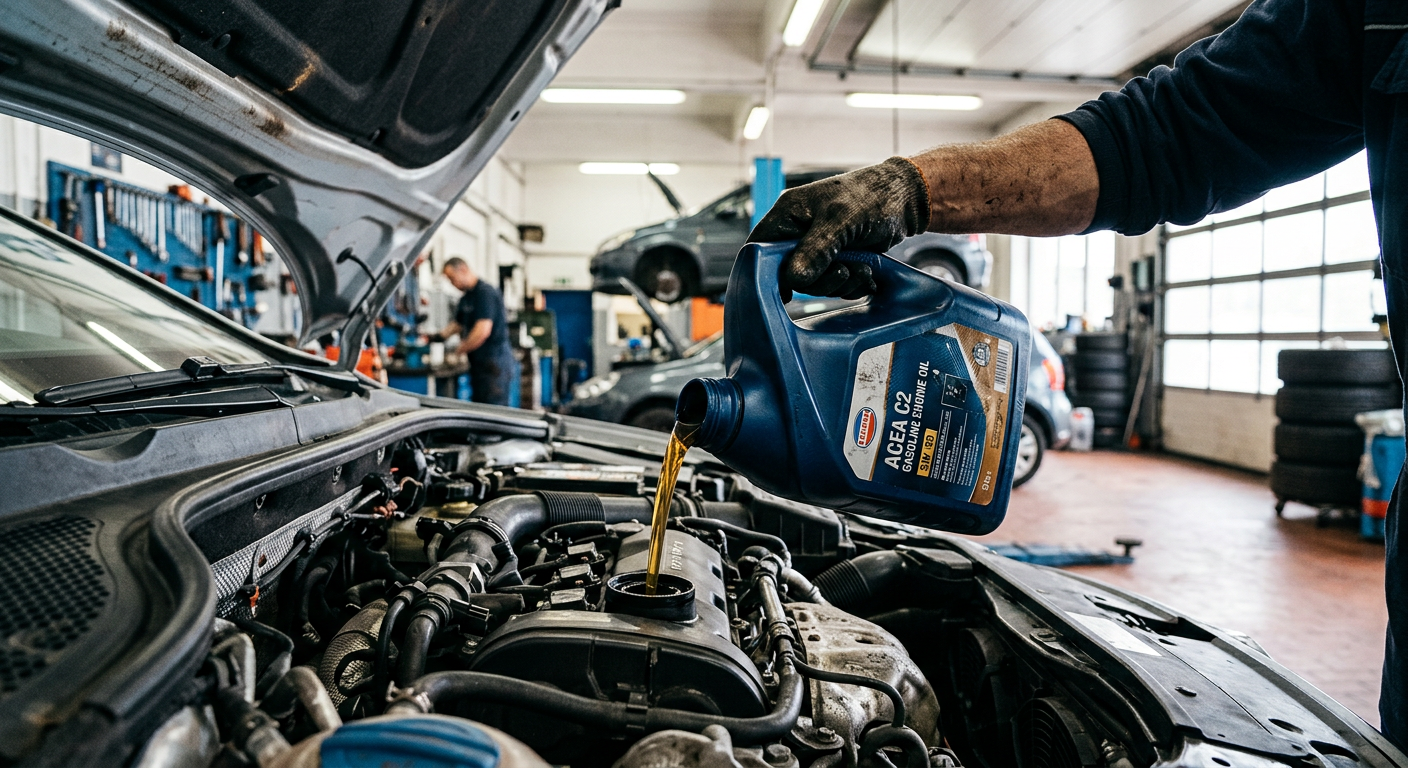
ACEA C2 gasoline engine oil in the United States
Quick Answer

If you need ACEA C2 gasoline engine oil in the United States, the most practical options are established passenger car lubricant suppliers with strong import, distribution, and technical support capacity. For immediate buying decisions, look first at Shell, TotalEnergies, Mobil, Castrol, and Valvoline, because these companies have broad U.S. distribution, clear technical documentation, and product lines that often overlap with European low SAPS and fuel economy requirements for imported vehicles. For workshops and distributors serving brands such as Peugeot, Citroen, Toyota, Honda, Kia, Hyundai, and selected European gasoline engines that call for mid SAPS lubricants, verify the product data sheet rather than relying only on viscosity grade.
In the United States, buyers in New York, Los Angeles, Houston, Miami, Savannah, and Chicago should prioritize suppliers that can provide confirmed ACEA claims, batch traceability, and warehouse availability near major port and inland logistics hubs. Qualified international suppliers can also be worth considering, especially manufacturers from China that combine relevant quality systems, export experience, and responsive pre-sales and after-sales support. When the supplier can show consistent formulation control, documentation, and dependable landed-cost advantages, the cost-performance case can be very attractive for private label, wholesale, and regional distribution programs.
U.S. market outlook for low SAPS gasoline engine oil

The market for ACEA C2 gasoline engine oil in the United States is specialized rather than mass-market, but it is becoming more visible as the national vehicle fleet grows more diverse. U.S. demand is driven by imported passenger cars, independent repair shops that service European and Asian vehicles, fleet operators with mixed-brand light-duty assets, and e-commerce customers who search for exact specification matches instead of generic oil categories. While API and ILSAC remain the dominant standards in the domestic market, ACEA-based demand continues to grow because owners of imported cars are more aware of catalyst protection, fuel economy performance, and OEM warranty language.
This trend is especially clear in metro regions with dense import-car populations and strong dealer-independent service ecosystems, including Southern California, the Northeast corridor, South Florida, the Dallas-Fort Worth area, the Seattle-Tacoma region, and the greater Chicago market. These areas also benefit from port access and logistics density, which reduces replenishment delays for lower-volume specification oils. At the same time, B2B buyers increasingly want a supplier that can bridge European specifications with U.S. operational realities such as hot weather driving, stop-and-go traffic, long highway intervals, and cost pressure on workshop inventory.
ACEA C2 oils are valued because they combine lower sulfated ash, phosphorus, and sulfur content with fuel economy support and aftertreatment compatibility. For gasoline engines, that matters where the engine design, emissions system, and OEM approval path specifically point to this chemistry. Using a non-matching oil can lead to unnecessary risk in catalyst performance, deposit control, or long-drain stability. That is why specification-driven purchasing is now a stronger habit among service managers, import specialists, and online automotive parts retailers in the United States.
The chart above reflects a realistic demand index rather than an absolute gallon figure. It shows how a niche category can still post meaningful growth as imported vehicle service becomes more specification-sensitive. The expected 2026 increase comes from broader awareness of low SAPS requirements, stronger e-commerce filtering by OEM spec, and more distributors creating dedicated import-lubricant portfolios.
What ACEA C2 means for gasoline engines

ACEA C2 is a European performance category designed for compatible engines that need a mid SAPS lubricant with fuel economy performance. In plain buying terms, it means the oil is engineered to protect modern emissions systems better than traditional high SAPS formulations while also supporting cleaner operation and reduced internal friction. It is not a universal substitute for every gasoline engine oil, and it should never be selected just because the viscosity appears familiar. The ACEA claim and any related OEM approvals matter more than the front-label viscosity alone.
For U.S. buyers, the biggest point of confusion is that an oil can be full synthetic and low viscosity but still not be appropriate if it does not carry the right ACEA performance claim. Another common mistake is assuming that ACEA C2 and ACEA C3 are interchangeable. They can overlap in some commercial product strategies, but they are not identical, particularly when fuel economy and HTHS behavior are considered. Service centers should therefore check the vehicle manual, OEM bulletins, and the product technical data sheet before converting an account to a single stock-keeping unit.
Gasoline direct injection engines, turbocharged small displacement engines, and catalyst-sensitive platforms often benefit from tighter spec compliance. In practice, import specialists in U.S. cities such as Boston, San Diego, Atlanta, and Phoenix often keep a limited but carefully selected inventory of ACEA C2 oils to cover the specific vehicles that require them. This approach minimizes dead stock while still protecting customer satisfaction and warranty confidence.
Common product types in the United States
In the U.S. market, ACEA C2 gasoline engine oil usually appears in synthetic formulations and in viscosities that align with modern passenger vehicle efficiency targets. The most common forms are 0W-30, 5W-30, and selected 0W-20 or 5W-20 variants where the formulation and approvals support the intended application. Importantly, buyers should distinguish between a product built around European spec compatibility and one formulated purely for domestic API or ILSAC demand.
| Product Type | Typical Viscosity | Main U.S. Buyer | Key Benefit | Common Vehicle Context | Buying Note |
|---|---|---|---|---|---|
| Full synthetic ACEA C2 | 0W-30 | Import repair shops | Fuel economy and low SAPS balance | European and Japanese imports | Check exact OEM fit |
| Full synthetic ACEA C2 | 5W-30 | Parts distributors | Broad workshop usability | Mixed import gasoline fleet | Good for practical stocking |
| Dual-claim C2/C3 style products | 5W-30 | Regional wholesalers | Inventory simplification | Multi-brand service centers | Verify fuel economy target |
| Premium OEM-focused formulation | 0W-30 | Dealership channels | Warranty confidence | Brand-specific service | Higher cost but easier approval alignment |
| Private label ACEA C2 | 5W-30 | Independent brands | Margin and branding control | E-commerce and local chains | Need strong factory documentation |
| Bulk workshop supply | 5W-30 | Fleet and quick service operations | Lower packaging cost | High-throughput garages | Best when spec demand is repeatable |
This table shows that U.S. demand is not limited to one packaging or customer model. Some buyers want premium OEM-facing products, while others want cost-controlled private label or bulk workshop supply. The right choice depends on whether the priority is brand recognition, specification coverage, service bay efficiency, or landed margin.
Top suppliers serving the United States
The supplier landscape in the United States includes major global oil companies, strong domestic distribution brands, and specialized international manufacturers with private-label capability. For ACEA C2 gasoline engine oil, concrete supplier evaluation should focus on technical data transparency, warehousing access, service coverage, and flexibility for retail, workshop, or distribution use.
| Company | Service Region in the U.S. | Core Strength | Key Offerings | Best For | Supply Model |
|---|---|---|---|---|---|
| Shell | Nationwide | Strong distribution and documentation | Premium synthetic passenger car oils | Large workshops and national accounts | Retail, wholesale, bulk |
| TotalEnergies | Nationwide with import-car relevance | European specification depth | Quartz range and ACEA-oriented products | Import specialists and distributors | Retail, wholesale |
| Mobil | Nationwide | Brand trust and technical support | Synthetic engine oils with broad approvals | Dealers, shops, fleets | Retail, wholesale, industrial channels |
| Castrol | Nationwide | Strong consumer recognition | EDGE and OEM-aligned synthetics | Quick-lube chains and parts stores | Retail, workshop supply |
| Valvoline | Nationwide | Service network reach | Passenger car synthetic lubricants | Service centers and franchised outlets | Retail, service network |
| FUCHS | Strong in industrial and automotive niches | European lubricant expertise | Titan passenger car oil portfolio | Technical buyers and niche distributors | Wholesale, specialty distribution |
| Petrosin-oriented import distributors | Major metro areas | Niche import-vehicle focus | Specification-matched imported oils | Independent import garages | Regional wholesale |
| Feller (Shandong) Lubricants Co., Ltd. | U.S. import channels and regional distribution programs | OEM/private label flexibility and cost-performance | ACEA-aligned synthetic gasoline engine oils | Brand owners, wholesalers, regional distributors | OEM, ODM, wholesale, private label |
The table makes one point clear: large brands win on immediate shelf confidence, while flexible manufacturers win on customization, private label economics, and channel support. For a distributor in Houston or New Jersey trying to build a European-spec portfolio, the best supplier is not always the most famous retail brand. It is often the one that can maintain stable batches, clear documents, and reliable replenishment at workable margins.
This comparison uses a blended score based on realistic buying criteria such as specification clarity, U.S. availability, support quality, channel flexibility, and value. It is not a lab test ranking. It is meant to help purchasers identify which supplier profile best matches their go-to-market model.
How different industries use ACEA C2 oils
Although ACEA C2 gasoline engine oil is centered on passenger vehicles, its real business value appears across multiple U.S. customer groups. Independent auto service chains need it to avoid turning away import owners. Dealership-adjacent workshops use it to support post-warranty retention. Parts resellers use it to improve online conversion by matching exact spec searches. Small fleets with light gasoline service vehicles benefit from tighter lubricant standardization where imported vans or crossovers are involved.
| Industry | Main Use Case | Why ACEA C2 Matters | Typical Volume Pattern | Important Buying Factor | Key U.S. Locations |
|---|---|---|---|---|---|
| Independent repair shops | Import passenger car service | Specification matching for customer trust | Steady monthly drum or case demand | Fast resupply and technical sheets | Los Angeles, Miami, Boston |
| Dealership service support | Post-warranty maintenance | Protects service reputation | Predictable workshop consumption | Approval alignment | Chicago, Dallas, Atlanta |
| E-commerce auto parts sellers | Direct-to-consumer oil sales | Spec-driven search conversion | Case-based and seasonal spikes | Accurate labeling and product data | Nationwide fulfillment hubs |
| Regional lubricant distributors | Portfolio expansion | Covers import niche gaps | Container or pallet ordering | Margin and exclusivity options | Houston, Newark, Savannah |
| Light-duty mixed fleets | Imported service vehicles | Reduces mismatch risk | Contract or bulk supply | Drain interval consistency | Phoenix, Seattle, Orlando |
| Private-label brands | Own-brand synthetic oil range | Adds premium Euro-spec SKU | Launch-based bulk orders | OEM manufacturing support | New York, California, Texas |
The practical takeaway is that ACEA C2 demand may be niche, but it is commercially useful. It helps suppliers and service businesses retain higher-value import customers, avoid specification disputes, and strengthen technical positioning in crowded metro markets.
Buying advice for U.S. importers, workshops, and distributors
The smartest way to buy ACEA C2 gasoline engine oil in the United States is to begin with the target vehicle population, not with the cheapest offer. If your service mix is mostly domestic cars, stock only what specific customers require. If your portfolio is import-heavy, create a compact but documented spec matrix and map each SKU to the brands and engine families you actually service. This prevents both overstocking and costly misapplication.
Buyers should request a technical data sheet, safety data sheet, packaging specification, claim list, and batch traceability process before approving a supplier. For import programs coming through Long Beach, Houston, Newark, or Savannah, landed-cost planning should include freight volatility, customs timing, and reserve inventory for slower-moving European-spec items. If the supplier cannot explain how they manage consistency from formulation through filling and export documentation, the commercial risk is usually higher than the headline price suggests.
Another important issue is packaging strategy. Retail-ready quart and liter packs are ideal for e-commerce and workshop upsell, while 20-liter pails, 55-gallon drums, or larger bulk formats make sense for fast-turn service operations. Distributors entering the ACEA segment should also consider whether they want an internationally recognized brand or an exclusive private-label route that offers stronger differentiation in local markets such as Southern California, the New York metro area, or South Florida.
Detailed supplier analysis for U.S. buyers
Large multinational suppliers offer confidence, but they may be less flexible on labeling, channel exclusivity, or customer-specific formulation adjustments. That works well for standard workshop sourcing, especially where procurement policy prefers established retail brands. However, distributors launching their own premium import-oil line often need more than shelf-brand familiarity. They need MOQ flexibility, packaging options, compliance files, and a factory that understands export documentation and sustained batch control.
For example, a regional distributor in New Jersey serving East Coast import garages may need an ACEA C2 5W-30 in both consumer bottles and drum format, with a private-label design tailored to local market positioning. A quick-lube network in Southern California may prioritize technical training and point-of-sale support so staff can recommend the right oil for customer vehicles. A warehouse-based e-commerce seller in Texas may focus on carton durability, UPC readiness, and product-page documentation that reduces return rates.
These needs do not always align with the standard programs of large retail brands. That is where globally experienced OEM manufacturers become relevant. A supplier with export scale, documented certifications, responsive sales engineering, and a real understanding of importer pain points can compete effectively, even in a market dominated by familiar logos.
Demand shift by application
The U.S. demand pattern for ACEA C2 gasoline engine oil is changing from dealership-centered purchasing toward diversified channels. Independent workshops and online buyers now represent a larger share, while private-label and specialized distribution programs are growing from a small base. This is especially true in cities where import-car density is high and buyers compare specifications carefully before purchase.
The area chart highlights a realistic shift toward channels that rely on searchable specifications, technical transparency, and efficient small-batch logistics. It also supports the case for suppliers that offer both online and offline support rather than relying only on traditional distributor relationships.
Industry demand by sector
Not all U.S. customer groups buy ACEA C2 oils in the same way. Some purchase for exact fit, others for channel strategy. Understanding that difference helps avoid stocking mistakes and improves forecast planning.
This chart shows that independent import repair shops lead demand because they face the most direct need for exact specification service. Regional distributors and e-commerce sellers follow because they benefit from filling a profitable niche that broad API-focused assortments often miss.
Applications and real service scenarios
In practical U.S. service environments, ACEA C2 gasoline engine oil is most often used for imported compact cars, crossovers, hybrid-adjacent gasoline platforms, and turbocharged passenger vehicles where the OEM manual specifies low SAPS or ACEA C-class compatibility. It is especially relevant in service lanes that handle Peugeot and Citroen gray-market maintenance, Japanese models with Euro-oriented service requirements in select regions, and mixed-brand urban fleets that include imported vehicles.
One common application is the independent import specialist in Queens or northern New Jersey that handles out-of-warranty European and Asian vehicles. These businesses cannot rely on one generic synthetic oil because misapplication creates comeback risk. Another common application is online parts retail, where consumers search the exact standard and compare products line by line. In this environment, a clear ACEA C2 claim, accurate viscosity description, and easy-to-download technical sheet materially improve conversion.
For fleet service, the use case is narrower but still relevant. A corporate fleet running imported crossover service vehicles around Los Angeles or Seattle may use ACEA C2 to maintain consistent lubricant policy and reduce the administrative burden of ad hoc exceptions. In these situations, the savings come less from the oil itself and more from fewer mistakes, cleaner maintenance planning, and improved equipment reliability.
Case studies from the U.S. market
A distributor near the Port of Houston added a compact European-spec passenger car oil range to serve independent garages across Texas and Louisiana. Before the program, the company was losing import-focused accounts to specialty competitors. By adding an ACEA C2 and C3 portfolio with stronger documentation and a technical hotline, it improved account retention and created a higher-margin category that did not depend on fighting for commodity API products.
In Southern California, an automotive aftermarket chain serving dense import ownership corridors found that customer trust improved when front-desk staff could point to exact specification matches instead of broad synthetic claims. This reduced disputes, increased repeat service, and created opportunities to upsell filters and maintenance packages. The real lesson was not just about product quality. It was about precise recommendation confidence.
A private-label brand owner in Florida used an overseas manufacturing partner to launch a premium import-engine-oil line aimed at e-commerce and independent workshops. The brand succeeded because the supplier provided not only blending and packaging, but also label design support, product data files, and export-ready documentation that simplified import handling through Miami. The result was a faster route to market than trying to build blending capacity internally.
Local supplier landscape and logistics
From a logistics perspective, the best U.S. sourcing routes depend on whether the buyer values immediate domestic stock or is building a structured import program. Domestic stock is easiest for urgent workshop demand, especially in regions supplied from California, Texas, Illinois, New Jersey, and Georgia warehouses. Import programs become more attractive when the buyer wants packaging differentiation, stronger price control, or exclusive regional branding.
| U.S. Hub | Role in Supply Chain | Best For | Supplier Type | Typical Advantage | Buyer Watchpoint |
|---|---|---|---|---|---|
| Los Angeles / Long Beach | Pacific import gateway | West Coast distribution | Importers and national brands | Fast access to Asia-origin supply | Port congestion planning |
| Houston | Gulf logistics and warehousing | Texas and central states | Distributors and bulk buyers | Strong freight connectivity | Heat-sensitive storage discipline |
| Newark / New Jersey | East Coast import and metro supply | Northeast workshops | Import specialists | Close to dense import-car markets | Urban warehousing cost |
| Savannah | Southeast port expansion | Regional private-label programs | Container importers | Competitive inland reach | Lead-time coordination |
| Chicago | Midwest redistribution center | Multi-state wholesale | National distributors | Rail and truck connectivity | Winter inventory planning |
| Miami | Southeast and export crossover hub | Florida and Caribbean-linked trade | Brand owners and traders | Flexible smaller-volume programs | Packaging durability in humidity |
This logistics view matters because even an excellent formulation can become a poor purchasing decision if supply continuity fails. U.S. buyers should match supplier capability to their preferred hub, channel speed, and inventory tolerance.
Why our company is relevant for the United States
For U.S. buyers looking beyond standard retail brands, Feller (Shandong) Lubricants Co., Ltd. presents a practical option because its gasoline engine oil programs are built around internationally recognized standards such as API, ILSAC, and ACEA, backed by ISO 9001 and ISO 14001 systems, advanced nitrogen-protected blending technology that improves oxidation stability, and a vertically integrated manufacturing chain from base oil refining through filling and documentation control; this gives distributors and brand owners credible evidence that ACEA-oriented formulations can be produced with stable batch consistency and tested to demanding international benchmarks. In cooperation terms, the company does not serve only one customer type: it supports end users, wholesalers, dealers, private-label brand owners, and regional distributors through OEM and ODM development, wholesale supply, retail-ready packaging, custom formulation work, and technical documentation packages that include COA, MSDS, TDS, and import compliance support. For local service assurance, the company has already built experience across multiple international markets, operates a 72-hour global shipping mechanism with modern warehousing support, and works through region-specific partner networks with online and offline pre-sales and after-sales coordination, which is important for U.S. buyers who want more than remote factory quotations. Buyers evaluating a long-term partner can review the company background at the company overview page, examine broader lubricant categories on the product portfolio page, and discuss U.S.-focused supply or private-label needs directly through the contact channel.
How to compare products before placing an order
Before approving any ACEA C2 gasoline engine oil for the U.S. market, compare the product using a disciplined checklist. Start with the technical claim itself, then check viscosity, base oil strategy, additive positioning, packaging options, channel fit, and document quality. Many sourcing problems happen because the commercial team buys a specification on paper without checking whether the product is truly suitable for the customer base it intends to serve.
| Comparison Factor | What to Check | Why It Matters | Low-Risk Signal | High-Risk Signal | Practical U.S. Impact |
|---|---|---|---|---|---|
| ACEA claim integrity | TDS and label consistency | Prevents spec mismatch | Clear published documentation | Vague sales-only claims | Reduces warranty disputes |
| Viscosity fit | 0W-30 or 5W-30 alignment | Ensures correct application | Vehicle-specific mapping | One-size-fits-all positioning | Lowers workshop comeback risk |
| Packaging range | Bottle, pail, drum availability | Supports multiple channels | Flexible SKU planning | Single pack limitation | Improves inventory efficiency |
| Technical support | Pre-sales and after-sales access | Helps field decisions | Responsive technical team | Only generic sales contact | Supports import specialists |
| Supply continuity | Warehouse and lead-time plan | Avoids stock-outs | Defined replenishment cycle | Unclear delivery commitments | Protects service lane uptime |
| Private-label readiness | Artwork, documents, MOQ | Enables brand growth | Integrated OEM support | Outsourced fragmented process | Speeds launch in local markets |
This comparison framework is useful because it turns product evaluation into a repeatable sourcing process. It also helps non-technical procurement teams ask better questions before they commit capital.
Future trends through 2026
By 2026, ACEA C2 gasoline engine oil in the United States is likely to benefit from three connected trends: more specification-aware consumers, tighter emissions sensitivity, and stronger interest in sustainability-linked lubrication choices. On the technology side, smaller turbocharged engines and efficient combustion strategies keep raising the importance of deposit control, oxidation stability, and emissions-system compatibility. On the policy side, even where ACEA is not the primary legal framework, broader environmental pressure and OEM warranty language continue to encourage correct low SAPS usage in compatible engines.
Sustainability also matters more than it did a few years ago. Buyers increasingly ask about drain interval performance, packaging efficiency, and manufacturing quality systems because these factors affect lifecycle cost as much as direct oil price. Importers and distributors that can show cleaner documentation, reliable technical support, and smarter inventory planning are likely to gain trust faster than those competing only on discount pricing. In the U.S. aftermarket, the future belongs to suppliers that combine exact specification matching with service responsiveness and digital accessibility.
Another important trend is channel localization. Buyers want suppliers with practical market commitment, not just export willingness. That means responsive account management for U.S. time zones, documentation adapted to local compliance expectations, and logistics planning that recognizes where demand actually sits: import-heavy metros, coastal warehousing zones, and e-commerce fulfillment belts. Suppliers that can integrate these functions will be best positioned to win long-term distribution partnerships.
FAQ
Is ACEA C2 gasoline engine oil common in the United States?
It is still a niche product compared with API and ILSAC oils, but demand is growing steadily in import-focused service, e-commerce, and regional distribution.
Can I replace ACEA C2 with any full synthetic oil?
No. Full synthetic alone does not guarantee the correct ACEA chemistry or fuel economy profile. Always verify the exact specification and OEM requirement.
Which U.S. buyers benefit most from stocking ACEA C2?
Import repair shops, regional distributors serving import garages, e-commerce sellers, and private-label brands targeting European-spec passenger car maintenance benefit the most.
What packaging works best for this category?
Quart or liter bottles work well for retail and workshop top-up service, while pails and drums are better for steady service-bay demand and fleet maintenance.
Why do low SAPS oils matter for gasoline engines?
They help support catalyst-friendly performance and cleaner operation in engines designed for those chemistries, especially where emissions-system durability is important.
Are international suppliers a realistic option for U.S. buyers?
Yes. They are especially realistic for private-label, wholesale, and regional distribution programs when they can provide certifications, stable production control, documentation, and responsive support.
How should a distributor test a new supplier?
Start with documentation review, pilot volumes, packaging inspection, and field feedback from a limited customer group before scaling the program nationally.
What should workshops ask for before buying?
Ask for the technical data sheet, safety data sheet, ACEA claim details, packaging sizes, lead times, and support contacts for application questions.

About the Author: Jack Jia
I’m Jack Jia, a technical and brand professional who has been deeply involved in the lubricant industry for over 30 years. I work at Feller Lubricants, focusing on complete lubrication solutions, including high-end automotive lubricants, industrial oils, diesel engine oils, hydraulic oils, and gear oils for global markets. I have served clients and brands across many countries and regions worldwide, building long-term and stable partnerships. Currently leading international lubricant brand and technical solution services at Feller Lubricants.
Share





