
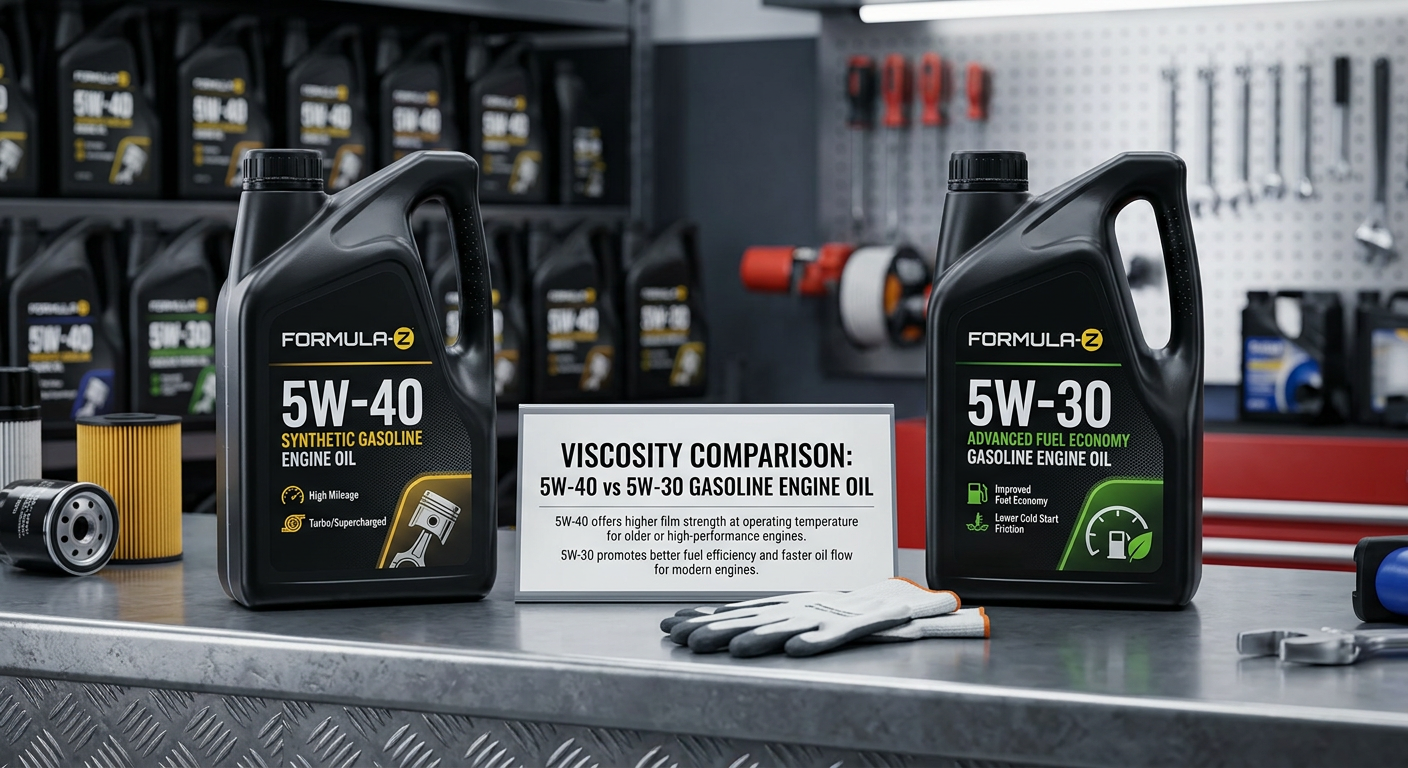
5W-40 vs 5W-30 Gasoline Engine Oil in the United States
Quick Answer

For most gasoline passenger vehicles in the United States, 5W-30 is the better default choice because it is widely specified by automakers, supports fuel economy, flows quickly at cold start, and suits daily driving from Chicago winters to Atlanta commutes. Choose 5W-40 when the owner’s manual allows it and the vehicle operates under heavier thermal stress, such as turbocharged engines, repeated high-speed highway use, mountain driving, desert heat in Arizona or Nevada, towing, spirited driving, or higher-mileage engines that benefit from a slightly thicker oil film at operating temperature.
In practical terms, 5W-30 usually fits modern sedans, crossovers, compact SUVs, and many light-duty gasoline pickups. 5W-40 is often favored in performance-oriented gasoline engines, some European vehicles, older engines with wear, and applications where maintaining viscosity at high temperature matters more than maximizing fuel economy. If the manufacturer specifically calls for API SP or ILSAC GF-6A 5W-30, follow that recommendation first. If the engine manual lists multiple acceptable grades, climate, load, and driving pattern should guide the final choice.
U.S. buyers should compare local supply, technical approvals, and after-sales support from established brands such as Mobil, Valvoline, Castrol, Shell, Pennzoil, and AMSOIL. At the same time, qualified international suppliers can also be worth considering, especially Chinese manufacturers that provide API-aligned products, stable OEM or private-label supply, complete technical documentation, and responsive pre-sale and after-sale support, since they may deliver a strong cost-performance advantage for distributors, workshops, and fleet buyers.
Direct Comparison

The difference between 5W-40 and 5W-30 starts with viscosity behavior. Both oils share the same winter rating, which means they are designed to perform similarly during cold starts. The key difference is the second number: 40 remains thicker at operating temperature than 30. That extra thickness can improve film strength under high load and high heat, but it may also increase pumping losses slightly and reduce fuel efficiency in engines optimized for thinner oil.
For a commuter in New York, Seattle, or Columbus using a late-model gasoline car, 5W-30 is generally the safer mainstream option because U.S. automakers commonly calibrate engine clearances, variable valve timing systems, and fuel economy targets around it. For a driver in Phoenix, Las Vegas, inland Southern California, or parts of Texas where ambient heat and long highway runs are common, 5W-40 can make sense when approved by the engine manufacturer, especially in turbo gasoline engines or performance vehicles.
| Comparison Point | 5W-30 | 5W-40 | What It Means for U.S. Buyers |
|---|---|---|---|
| Cold start behavior | Fast flow in winter | Fast flow in winter | Both are suitable for broad U.S. winter conditions because the 5W rating is the same |
| Hot operating viscosity | Thinner at temperature | Thicker at temperature | 5W-40 offers a stronger oil film in hotter or heavier-load driving |
| Fuel economy | Usually better | Usually slightly lower | 5W-30 is often preferred for daily commuting and OEM fuel economy targets |
| Turbo and high-load use | Good when specified | Often stronger reserve | 5W-40 can help where heat and shear are sustained, if approved by the manual |
| High-mileage engines | Good for many engines | Often helpful for worn engines | 5W-40 may reduce consumption in some older gasoline engines |
| Mainstream U.S. availability | Very high | High but more niche | 5W-30 is easier to source in retail chains and service shops nationwide |
| Typical fit | Modern daily drivers | Performance, heat, load | Application fit matters more than simple preference |
This comparison shows why there is no universal winner. The right grade depends on the engine design, manufacturer approval, local climate, and how the vehicle is used. In the United States, interstate travel, stop-and-go congestion, regional heat extremes, and long oil change intervals all shape the decision.
U.S. Market Overview

The U.S. gasoline engine oil market remains highly specification-driven. Consumers and professional service centers increasingly look for API SP, ILSAC GF-6A, dexos approvals, and robust oxidation control for turbocharged gasoline direct injection engines. In major automotive hubs such as Los Angeles, Houston, Dallas, Chicago, Atlanta, Miami, and the Northeast corridor, product mix is shaped by a wide vehicle parc that includes Japanese, American, Korean, and European gasoline vehicles. Retail demand is strongest in 5W-30, 0W-20, and 5W-20, but 5W-40 retains a stable share among Euro applications, performance cars, and demanding service environments.
Distribution in the United States also follows clear trade patterns. Imported packaged lubricants and additive components often move through gateways such as Los Angeles/Long Beach, Houston, Savannah, New York/New Jersey, and Seattle/Tacoma. Buyers in the Midwest and Southeast usually prioritize dependable regional warehousing, while West Coast buyers often focus on lead time and private-label flexibility. That makes supplier reliability almost as important as brand recognition, especially for workshop groups, auto parts chains, and e-commerce sellers.
The line chart reflects a realistic direction for premium gasoline engine oil demand in the United States. Growth is supported by longer vehicle ownership cycles, a larger population of turbocharged engines, and consumer willingness to pay for synthetic products that improve engine cleanliness and durability.
How Viscosity Affects Real-World Performance
When American drivers ask whether 5W-40 is better than 5W-30, they are usually asking about four real-world outcomes: startup protection, fuel economy, oil consumption, and protection under heat. Because both grades start with 5W, cold-start pumpability is broadly similar. This matters in states with winter conditions such as Minnesota, Michigan, Wisconsin, Pennsylvania, and upstate New York. Where the grades diverge is after the engine warms up.
At highway temperature, 5W-40 stays thicker. This can be useful for sustained interstate cruising in summer, stop-and-go rideshare duty, track-day use, or driving in high ambient heat across the Southwest. The thicker film may reduce metal-to-metal contact under severe stress and can help control oil consumption in some worn engines. However, the tradeoff is that a thicker oil can slightly reduce efficiency and may not align with the engineering targets of engines designed around lighter viscosity.
For most newer gasoline cars sold in the U.S., automakers optimize lubrication systems around lower-viscosity oils to support fuel economy, emissions system durability, and cold-flow performance. That is why many manuals specify 5W-30 or even 0W-20 instead of 5W-40. The best rule is simple: use the grade and approval listed in the manual first, then choose among permitted grades based on climate and duty cycle.
Product Types and Specification Levels
Not all 5W-30 or 5W-40 oils are the same. Base oil quality, additive chemistry, volatility control, detergent systems, and approvals matter as much as the viscosity label. In the U.S. market, buyers typically compare conventional, synthetic blend, full synthetic, and high-mileage products.
| Product Type | Common Grades | Main Strength | Typical U.S. User | Limitations |
|---|---|---|---|---|
| Conventional mineral oil | 5W-30, 10W-30 | Low upfront cost | Older vehicles, budget maintenance | Shorter drain intervals and lower thermal stability |
| Synthetic blend | 5W-30, 5W-40 | Balanced cost and protection | Daily drivers, service centers | Less extreme-temperature performance than full synthetic |
| Full synthetic | 5W-30, 5W-40 | Best oxidation and deposit control | Modern engines, turbo gasoline vehicles | Higher purchase price |
| High-mileage oil | 5W-30, 5W-40 | Seal conditioning and wear support | Vehicles above 75,000 miles | Not a fix for mechanical damage |
| Euro formula synthetic | 5W-40 mainly | Higher HTHS and OEM approvals | BMW, Mercedes-Benz, VW, Audi owners | May exceed needs of mainstream U.S. vehicles |
| Resource-conserving synthetic | 5W-30 mainly | Fuel economy and emissions compatibility | Late-model Japanese, American, Korean cars | Not always the best fit for severe heat if not approved |
This table matters because many buyers compare only the viscosity numbers and overlook approvals. In reality, an API SP full synthetic 5W-30 from a reputable brand may protect better than a lower-grade 5W-40 in many gasoline engines. Specification quality can outweigh simple thickness.
Buying Advice for U.S. Drivers and Businesses
For individual motorists, the first checkpoint is the owner’s manual. If it specifies only 5W-30, use 5W-30. If it allows both 5W-30 and 5W-40, think about region and usage. A commuter in Boston or Portland with normal service intervals generally gains little from 5W-40. A driver in Houston who tows a small trailer, deals with long summer idling, and drives a turbocharged engine may prefer 5W-40 if approved.
For workshops, fleets, and distributors, the question extends beyond performance to inventory efficiency. Stocking the right mix of 5W-30 and 5W-40 helps reduce SKU sprawl. In most U.S. retail and service environments, 5W-30 moves faster, but 5W-40 can deliver strong margins in European-car service, performance shops, and hot-climate markets. Regional warehouse access, packaging sizes, technical training, and claims support are all important in supplier selection.
Buyers sourcing in volume should look for clear Technical Data Sheets, Safety Data Sheets, batch traceability, and proof of production consistency. That applies whether the supplier is a major U.S. brand, an independent blender, or an international manufacturer entering the U.S. market through distributors.
Industry Demand by Use Case
Demand for 5W-30 and 5W-40 differs by industry. Consumer retail channels lean heavily toward 5W-30, while performance tuning shops, import specialists, and some mixed fleets create stronger demand for 5W-40. Areas such as Southern California, South Florida, Arizona, Texas, and parts of the Mountain West often see higher interest in oils with stronger high-temperature retention.
The bar chart shows how 5W-40 is a niche but important product in the United States. Mainstream channels remain centered on 5W-30, but specialized channels can show strong pull for 5W-40 because they service engines that run hotter, have higher output, or carry European approvals.
Applications Across Vehicle Segments
Application fit is the most useful way to decide between 5W-40 and 5W-30. Compact sedans, family crossovers, and many naturally aspirated gasoline engines are usually well served by 5W-30. Turbocharged direct-injection engines often remain on 5W-30 if specified, but under harder use some manufacturer-approved 5W-40 products may offer more thermal reserve. For sports cars, tuned street vehicles, and European gasoline engines operated in heat or under load, 5W-40 is frequently a practical option.
U.S. fleet buyers should be especially careful not to overgeneralize. A municipal fleet in Denver, a contractor fleet in Dallas, and an airport support fleet in Orlando can have very different operating cycles. Idling, towing, ambient heat, and maintenance discipline all influence the choice.
| Vehicle or Application | Usually Better Fit | Reason | Typical U.S. Scenario |
|---|---|---|---|
| Late-model commuter sedan | 5W-30 | Matches common OEM specifications and fuel economy goals | Daily driving in Chicago, Charlotte, or Sacramento |
| Compact SUV or crossover | 5W-30 | Balanced cold-flow and efficiency for family use | Suburban driving with occasional highway trips |
| Turbo gasoline crossover | Depends on manual | Turbo heat load may justify 5W-40 if approved | Hot-climate commuting and long highway stretches in Texas |
| European gasoline car | Often 5W-40 | Many Euro specs prefer higher HTHS oils | Service shops in Miami or Los Angeles |
| Performance car | Often 5W-40 | Better hot-film strength under aggressive use | Track days, canyon driving, summer events |
| High-mileage gasoline engine | Often 5W-40 if permitted | May reduce consumption and noise in worn engines | Older SUVs, aging pickups, long-distance interstate driving |
| Mixed rideshare use | 5W-30 or 5W-40 | Depends on idle hours, engine heat, and approval | Urban stop-and-go in Atlanta, Phoenix, or Las Vegas |
This application table helps buyers make a more grounded decision than simply asking which grade is “better.” Better for what is the real question.
Case Studies from the U.S. Market
A repair shop in Phoenix serving turbocharged gasoline crossovers found that customers driving long freeway distances in summer were more likely to ask about oil consumption and oxidation resistance. Where the manufacturer allowed both grades, the shop saw stable results using premium full synthetic 5W-40 in severe-service cases, while continuing to use 5W-30 for normal commuters. The shop avoided blanket recommendations and tied each selection to OEM approvals.
In the Chicago metro area, a quick-lube operator serving mostly Japanese and domestic vehicles found that 5W-30 remained the best-selling grade because customers cared about warranty compliance, fuel economy, and affordability. Their inventory analysis showed that adding too many 5W-40 SKUs slowed turnover, so they limited 5W-40 mainly to full synthetic European formulas and performance applications.
A South Florida independent garage focused on BMW, Volkswagen, Audi, and Mercedes-Benz gasoline vehicles reported stronger demand for 5W-40 because many customer vehicles required ACEA and OEM-aligned higher-temperature performance. In that market, the viscosity decision was driven less by weather alone and more by manufacturer specifications and the vehicle mix.
These cases show that local climate matters, but vehicle population and service model matter just as much. A broad national recommendation will never be as reliable as a local, application-based recommendation.
Local and National Suppliers in the United States
The supplier landscape in the United States includes integrated oil majors, specialty synthetic brands, private-label manufacturers, and international exporters working through regional partners. Buyers should judge suppliers not only by brand familiarity but also by approvals, packaging options, warehouse coverage, technical support, and consistency of supply.
| Company | Service Regions | Core Strengths | Key Offerings Relevant to 5W-30 and 5W-40 |
|---|---|---|---|
| ExxonMobil | Nationwide U.S. | Strong OEM relationships, broad retail and commercial reach | Mobil 1 5W-30, Mobil 1 FS 5W-40, synthetic passenger car motor oils |
| Valvoline | Nationwide U.S. | Strong installer network and consumer trust | Advanced Full Synthetic 5W-30, European Vehicle 5W-40, quick-lube channel support |
| Castrol | Nationwide U.S. | Strong European-car presence and retail visibility | EDGE 5W-30, EDGE 5W-40, performance and Euro formulas |
| Shell Pennzoil | Nationwide U.S. | Gas-to-liquid synthetic branding, wide distribution | Pennzoil Platinum 5W-30, Shell Helix and Pennzoil synthetic ranges |
| AMSOIL | Nationwide with dealer model | High-performance synthetic focus and enthusiast following | Signature Series 5W-30, European Formula 5W-40, extended-drain positioning |
| Phillips 66 Kendall | Nationwide with strong regional channels | Commercial and installer relationships | GT-1 5W-30, Euro and synthetic passenger car products |
| LIQUI MOLY USA | Nationwide with import-car focus | Strong German-brand recognition in specialty service | Leichtlauf and Top Tec variants including 5W-30 and 5W-40 |
This supplier table is useful because it separates brand awareness from actual buying fit. For example, a quick-lube chain may value nationwide installer support more than enthusiast reputation, while a European specialist may prioritize approval coverage and premium 5W-40 options.
Supplier Comparison for Professional Buyers
The comparison chart summarizes the buying criteria that matter most in the U.S. market. Retail access tends to be strongest among household brands, while private-label flexibility and distributor value can be stronger in manufacturer-direct or international supply partnerships.
Trend Shift in U.S. Viscosity Preference
The U.S. market continues to favor lower-viscosity oils for mainstream passenger cars, but there is still a durable niche for 5W-40 in specific gasoline applications. That niche is supported by the growth of turbocharged engines, high-mileage vehicles staying in service longer, and stable demand from import performance and European service channels.
The area chart shows a realistic pattern: 5W-30 retains the larger mainstream position, while 5W-40 grows gradually in specialty and severe-service gasoline segments. This is not a zero-sum contest. The market is becoming more segmented by engine technology and use case.
How to Evaluate Oil Quality Beyond Viscosity
U.S. buyers should evaluate several technical markers beyond the viscosity grade. API SP is important for modern gasoline engines because it addresses oxidation, wear, deposit control, and low-speed pre-ignition protection in turbocharged direct-injection applications. ILSAC GF-6A matters for fuel economy and modern compatibility in many mainstream vehicles. For European gasoline engines, ACEA and OEM approvals can be just as important as API claims.
No matter whether the bottle says 5W-30 or 5W-40, the product should come from a manufacturer with consistent blending quality, strong contamination control, and reliable packaging traceability. Service centers should ask for TDS and SDS documents, while distributors should verify fill-line capability, packaging range, lead times, and claim response procedures.
Industries and Commercial Use Cases
Although this comparison centers on gasoline engine oil, the decision between 5W-30 and 5W-40 also matters commercially. Rental fleets, auto auction reconditioning centers, used-car retailers, regional delivery fleets, municipal service departments, and multi-bay repair groups all face oil standardization decisions. In these environments, the wrong viscosity strategy can increase inventory complexity or create warranty risk.
For example, a used-car chain in the Southeast may standardize on 5W-30 for fast turnover inventory because it matches the broadest section of the car parc. By contrast, a European-focused service group in New Jersey or South Florida may deliberately build a stronger 5W-40 range because the vehicles they see require it more often. A Southwest fleet supporting long idle hours and heat exposure may also lean toward heavier operating-temperature viscosity where manuals permit.
| Buyer Type | Primary Need | Recommended Approach | Best Fit Grade Tendency |
|---|---|---|---|
| Independent repair shop | Coverage across many makes | Keep high-turn 5W-30 and selected Euro 5W-40 | Mostly 5W-30 with targeted 5W-40 |
| Quick-lube chain | Fast inventory turnover | Center on OEM-common grades and synthetic upsell | Strongly 5W-30 |
| European specialist garage | Approval-specific servicing | Prioritize OEM and ACEA-aligned formulations | Higher 5W-40 share |
| Performance tuning shop | Heat and stress resistance | Stock premium full synthetics with higher hot viscosity options | Often 5W-40 |
| Used car dealer service bay | Cost control and broad fit | Use common grades that match manuals and turnover needs | Mainly 5W-30 |
| Regional distributor | Margin and assortment strategy | Balance volume 5W-30 with profitable specialty 5W-40 lines | Mixed, channel dependent |
This table turns the technical viscosity question into a practical purchasing framework for business buyers in the United States. The right answer depends heavily on customer mix and service model.
Our Company
For U.S. buyers seeking a manufacturer-direct partner rather than only a shelf brand, Feller offers a practical model built on measurable production and compliance capability. The company manufactures gasoline engine oils across economy, semi-synthetic, and full synthetic tiers, including modern low-viscosity and high-temperature formulations, and it operates under ISO 9001 and ISO 14001 systems with documented batch consistency, advanced nitrogen-protected blending technology, and technical documentation support such as TDS, SDS, and certification files that help products align with international benchmarks including API, ILSAC, and ACEA where applicable. For cooperation, Feller supports wholesale supply, OEM and private-label production, regional distribution, and tailored packaging for distributors, brand owners, workshop chains, fleet buyers, and end users, making it relevant both for established U.S. lubricant marketers and companies launching their own lines. From a service perspective, the company’s global export experience across more than 60 countries, its 72-hour shipping mechanism, broad packaging capability, and partner-oriented account support provide tangible assurance for U.S. importers that need stable replenishment and responsive pre-sale and after-sale coordination; buyers exploring manufacturing partnership options can review its business background on the company page, browse the product range, or request technical and commercial support through the U.S. inquiry contact page.
What U.S. Buyers Should Ask Suppliers
Before purchasing 5W-30 or 5W-40 in volume, ask direct questions. Which approvals are formal and which are self-claimed? What is the base oil and additive supply stability? Are packaged goods warehoused on the U.S. coast or shipped order by order through ports such as Los Angeles, Houston, Savannah, or New York? How quickly are claims handled? Can the supplier support bulk, drum, pail, and quart packaging? Are label compliance and SDS files ready for U.S. distribution?
These questions are especially important for distributors and workshop groups evaluating international sourcing. A lower ex-factory price means little if lead times are unstable or technical support is weak. By contrast, a supplier with dependable documentation, stable production, and active service support can improve profitability even in a competitive market.
2026 Trends
Looking toward 2026, the U.S. market for gasoline engine oil will continue evolving in three directions: technology, policy, and sustainability. On the technology side, more turbocharged and direct-injection gasoline engines will keep pressure on formulators to improve oxidation resistance, piston cleanliness, timing-chain wear control, and protection against low-speed pre-ignition. That supports ongoing demand for higher-performance synthetic 5W-30 products and preserves a role for premium 5W-40 oils in severe service and specialty applications.
On the policy side, fuel economy pressure and emissions-related durability will continue favoring lower-viscosity oils in mainstream vehicles, but not at the expense of manufacturer approval. Buyers should expect continued emphasis on specification compliance rather than generic viscosity selling. Sustainability will also influence procurement, with more workshops and fleets asking about longer drain intervals where appropriate, packaging efficiency, reduced waste, and supply-chain resilience. This is where large-scale blenders with modern plants, traceability, and flexible logistics may become more attractive partners for U.S. distributors.
Another likely 2026 trend is stronger segmentation. Mainstream quick-service channels will remain heavily weighted to 5W-30 and lighter grades, while premium installer networks and specialty import channels continue to maintain a meaningful 5W-40 business. E-commerce will also make product education more important, because informed buyers increasingly shop by approval code, engine type, and duty cycle rather than by viscosity alone.
FAQ
Is 5W-40 better than 5W-30 for summer in the United States?
Not automatically. If the owner’s manual allows both, 5W-40 can be beneficial in hot regions such as Arizona, Nevada, inland California, or Texas when the vehicle sees heavy load or sustained high temperature. If the manual specifies only 5W-30, stick with 5W-30.
Will 5W-40 protect a high-mileage gasoline engine better?
In some cases, yes. A thicker operating-temperature viscosity can help reduce oil consumption and noise in worn engines, but it is not a universal solution. The engine design and approved viscosity range still come first.
Does 5W-30 improve fuel economy?
Usually yes, compared with 5W-40, because it creates less internal drag at operating temperature. This is one reason it is so common across the U.S. passenger car market.
Can I switch from 5W-30 to 5W-40?
Only if the vehicle manufacturer permits it. Check the owner’s manual or the OEM oil approval list. Switching without approval can affect warranty compliance, emissions-system durability, or variable valve timing performance.
Which grade is more common in U.S. stores?
5W-30 is more common by far. It is widely stocked in auto parts stores, mass retail, dealership service departments, and quick-lube chains across the country.
Is full synthetic necessary for both grades?
For modern gasoline engines, especially turbocharged engines, full synthetic is often the best choice because it handles heat, oxidation, and deposits better. In the U.S. market, premium 5W-30 and 5W-40 products are commonly sold as full synthetic.
What matters more, viscosity or approval?
Approval matters at least as much as viscosity. A high-quality API SP or OEM-approved 5W-30 is usually the better choice than an unproven 5W-40 with weaker technical credentials.
What should distributors and workshops prioritize when sourcing?
They should prioritize approval coverage, packaging flexibility, lead time, documentation, batch consistency, and technical support. These factors directly affect profitability and customer confidence in the United States.
Final Takeaway
For most U.S. gasoline vehicles, 5W-30 remains the best all-around choice because it matches common automaker recommendations, supports fuel economy, and fits the largest share of the American vehicle parc. 5W-40 becomes the smarter option only when the engine manufacturer allows it and the operating conditions justify the added hot-temperature viscosity, such as performance driving, high ambient heat, towing, or higher-mileage wear. For individual drivers, that means following the manual first. For businesses, it means building a sourcing and inventory strategy around approvals, climate, customer mix, and dependable supplier support rather than choosing by viscosity label alone.

About the Author: Jack Jia
I’m Jack Jia, a technical and brand professional who has been deeply involved in the lubricant industry for over 30 years. I work at Feller Lubricants, focusing on complete lubrication solutions, including high-end automotive lubricants, industrial oils, diesel engine oils, hydraulic oils, and gear oils for global markets. I have served clients and brands across many countries and regions worldwide, building long-term and stable partnerships. Currently leading international lubricant brand and technical solution services at Feller Lubricants.
Share





