
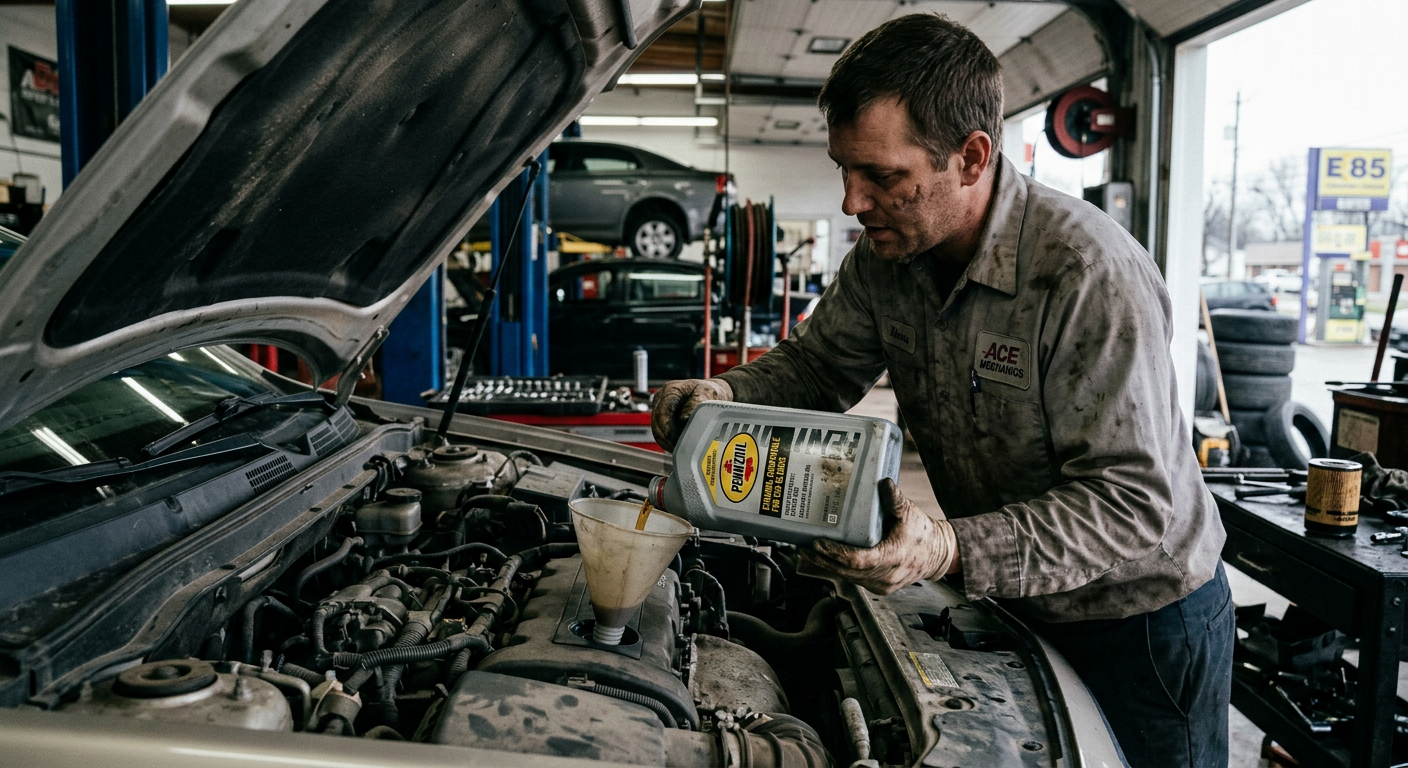
Engine Oil for Ethanol Blend Gasoline in the United States
Quick Answer

If you are choosing engine oil for ethanol blend gasoline engines in the United States, the safest answer is to use the exact viscosity grade and performance category specified by the vehicle manufacturer, while favoring modern oils that meet current API SP or ILSAC GF-6 standards for deposit control, oxidation resistance, sludge prevention, turbocharger protection, and low-speed pre-ignition defense. For most late-model passenger cars running on E10 or E15, full synthetic 0W-20, 5W-20, or 5W-30 oils are usually the best fit, while flex-fuel vehicles that regularly use higher ethanol blends such as E85 may benefit from shorter drain intervals because ethanol can increase moisture accumulation, fuel dilution risk, and oil degradation under severe service.
In the United States, practical supplier options include ExxonMobil, Valvoline, Shell, Chevron, Phillips 66, and AMSOIL, all of which provide gasoline engine oils suitable for ethanol-blended fuel environments when matched to the OEM specification. Buyers in hubs such as Houston, Chicago, Los Angeles, Savannah, and Atlanta should compare not only product approvals and viscosity range, but also technical support, local warehousing, packaging formats, and oil analysis support. Qualified international suppliers, including Chinese manufacturers with relevant certifications, OEM capability, and dependable pre-sales and after-sales service, can also be considered for private label, wholesale, and regional distribution programs because they often offer strong cost-performance advantages.
United States Market Overview

The United States is one of the most important markets in the world for ethanol-blended gasoline. E10 is standard across most of the country, E15 availability continues to expand in selected states and retail corridors, and E85 remains a meaningful option for flex-fuel vehicles. This fuel structure directly affects lubricant selection because ethanol behaves differently from pure gasoline. It can attract water, contribute to acidity, and under repeated short-trip operation may promote fuel dilution in crankcase oil. That means the market for engine oil serving ethanol blend gasoline is not simply about generic gasoline engine oil; it is about oxidation stability, detergent performance, wear control, volatility management, seal compatibility, and the ability to maintain viscosity in real driving conditions.
Demand is strongest in metropolitan and logistics corridors where vehicle density is high and where maintenance purchasing is concentrated. Areas such as Dallas-Fort Worth, Houston, Miami, Atlanta, Chicago, Detroit, Phoenix, and the Southern California basin are especially important because of their high throughput of passenger vehicles, light commercial fleets, quick-lube service networks, and aftermarket distribution centers. From a supply-chain perspective, major import and blending access points such as the Port of Houston, Port of Los Angeles, Port of Long Beach, Port of Savannah, and Port of New York and New Jersey influence lead times and regional stock availability for both domestic and international lubricant suppliers.
Another factor shaping this market is vehicle technology. Modern gasoline direct injection and turbocharged engines are sensitive to deposit formation and low-speed pre-ignition, while older engines may still prioritize seal conditioning and high-mileage wear protection. Because the United States has a very diverse vehicle parc, suppliers must carry a broad viscosity and specification range. Retail chains, dealerships, installer networks, fleets, and private-label buyers increasingly expect technical documentation, SDS and TDS support, consistent packaging, and fast replenishment from regional warehouses.
How Ethanol Blend Gasoline Affects Engine Oil

Ethanol blend gasoline changes the stress profile inside an engine. Ethanol contains oxygen, burns differently from straight gasoline, and can contribute to more water exposure in the crankcase. In stop-and-go driving, cold starts, and short-interval operation, some unburned fuel may pass the rings and mix with engine oil. When that fuel contains ethanol, the oil can experience faster viscosity loss, reduced film strength, corrosion risk, and accelerated additive depletion if the formulation is not robust enough.
This does not mean every vehicle using E10 or E15 needs a special niche lubricant. In many cases, a high-quality API SP or ILSAC GF-6 engine oil is already engineered to manage the real-world stresses associated with modern gasoline fuels, including ethanol content commonly sold in the United States. The key issue is choosing the correct oil category, the right viscosity for climate and hardware, and a sensible drain interval for the actual duty cycle. Vehicles that spend most of their time on highways in warm, stable operating conditions usually impose less stress on the oil than vehicles doing short trips in winter, rideshare use, delivery service, or repeated towing.
Market Growth Trend
The lubricant segment serving ethanol-blended gasoline engines in the United States continues to grow because ethanol remains embedded in the retail fuel mix, while the installed base of direct-injection and turbocharged vehicles keeps rising. The chart below shows a realistic market index for packaged and bulk demand related to this application.
Product Types That Fit Ethanol Blend Gasoline Engines
Not every engine oil is equally suitable for ethanol-related operating stress. In the United States, buyers typically sort products by base oil type, viscosity grade, specification level, and target application. Full synthetic oils dominate the newest passenger car segment because they provide stronger oxidation stability, cleaner piston performance, improved cold flow, and better retention of protective properties over extended service. Synthetic blends remain important for older sedans, crossovers, pickup trucks, and mixed fleets where price sensitivity matters. Conventional oils still exist in value channels, but their share continues to narrow for late-model engines.
The most common viscosity grades for this market are 0W-20, 5W-20, and 5W-30. These are especially common in Japanese, American, and Korean gasoline vehicles sold in the United States. For some older or higher-load engines, 10W-30 and 5W-40 still remain relevant. Flex-fuel applications using E85 regularly may require closer monitoring, especially in severe service. In practical terms, viscosity selection should always begin with the owner’s manual and then adjust only when supported by climate, mileage, or operating demands.
| Oil Type | Typical Viscosity | Best Use Case | Main Advantage | Limitations | Typical Buyer |
|---|---|---|---|---|---|
| Full Synthetic API SP | 0W-20 | Late-model sedans and hybrids | Strong oxidation control and cold-start flow | Higher upfront cost | Dealers and retail consumers |
| Full Synthetic API SP | 5W-20 | Ford and Chrysler gasoline vehicles | OEM fit for many U.S. models | Less universal than 5W-30 | Service chains and installers |
| Full Synthetic API SP | 5W-30 | Mixed passenger car fleets | Wide compatibility and balanced protection | May not match newest low-viscosity specs | Fleet operators and workshops |
| Synthetic Blend | 5W-30 | Older daily drivers | Good value-performance balance | Shorter life than full synthetic | Independent garages |
| High-Mileage Synthetic Blend | 5W-30 | Engines over 75,000 miles | Seal conditioning and wear support | Not needed for newer low-mileage vehicles | Retail users |
| Full Synthetic Euro Style | 5W-40 | Turbocharged performance engines | High-temperature film strength | Not suitable unless OEM approved | Performance shops |
This table shows that product fit depends on the engine design, duty cycle, and OEM specification more than on the ethanol blend alone. Ethanol-related risk becomes easier to manage when the oil has a current specification, strong detergent chemistry, and the user follows a realistic service interval.
Buying Advice for United States Buyers
When buying engine oil for ethanol blend gasoline in the United States, start with the manufacturer requirement and then evaluate operating severity. This simple sequence prevents most purchasing mistakes. First, confirm the recommended viscosity and specification on the oil fill cap, owner’s manual, fleet maintenance software, or OEM service bulletin. Second, classify use conditions: short trips, rideshare service, grocery delivery, towing, city traffic, cold climate starts, and irregular maintenance all increase the need for stronger oil performance or shorter drain intervals.
Third, review label credentials. API SP and ILSAC GF-6 are currently the most relevant mainstream categories for modern gasoline engines in this market. Dexos approvals may also be required for some General Motors applications. Fourth, compare packaging and logistics. In the United States, many buyers need quart bottles for retail, drums and pails for workshops, totes for distributors, or bulk delivery for fleets. Fifth, evaluate supplier support. Oil analysis, warranty documentation, technical hotlines, and regional stock availability are especially important for workshops and fleet operators that need to reduce downtime.
For importers and private-label brand owners, the selection process should also include blending consistency, batch traceability, export documentation, filling capability, packaging flexibility, and the ability to adapt labels to U.S. compliance and channel requirements. Ports such as Houston and Long Beach matter because they influence landed cost and replenishment reliability.
Industry Demand by End-Use Segment
Demand for engine oil serving ethanol-blended gasoline engines varies by end-use industry. Passenger cars remain the largest segment, but light commercial fleets, quick-lube networks, rideshare vehicles, municipal fleets, and dealership service departments all account for significant volume.
Industries and Applications
The main industries using these lubricants include retail automotive service, franchised dealerships, independent repair shops, bulk fleet maintenance, fuel station service centers, municipal vehicle departments, and aftermarket distribution. In all of these sectors, the lubricant has to perform reliably with the fuel reality of the U.S. market, where ethanol is normal rather than exceptional.
Applications include compact cars, family SUVs, pickup trucks, taxis, police vehicles, utility service vehicles, last-mile delivery vans, and company cars. In colder northern states such as Minnesota, Wisconsin, Michigan, and New York, cold-start pumpability is especially valuable. In hotter regions such as Texas, Arizona, Nevada, and Florida, oxidation control and deposit resistance under high ambient temperatures become more important. In coastal areas with heavy congestion, including Los Angeles, Miami, and Newark, stop-and-go driving raises the value of synthetic oil and condition-based service planning.
| Industry | Common Vehicles | Typical Fuel Blend | Oil Priority | Preferred Packaging | Service Pattern |
|---|---|---|---|---|---|
| Quick-Lube Chains | Sedans, SUVs, pickups | E10, some E15 | Fast inventory turnover and broad fit | Bulk and quarts | High-frequency consumer service |
| Dealerships | Late-model OEM vehicles | E10, E15 | Strict OEM compliance | Bulk tanks and branded bottles | Warranty-sensitive maintenance |
| Independent Workshops | Mixed-age passenger cars | E10 | Range flexibility and value | Drums, pails, quarts | Mixed preventive and repair work |
| Rideshare and Taxi Fleets | High-mileage sedans and hybrids | E10 | Drain interval control and cleanliness | Bulk and drums | Severe stop-and-go operation |
| Municipal Fleets | Cars, light trucks, utility vehicles | E10, some E85 FFV | Specification discipline and reporting | Bulk and totes | Scheduled procurement contracts |
| Fuel Station Service Centers | Everyday consumer vehicles | E10, E15 | Easy merchandising and trusted brand labels | Consumer bottles | Walk-in retail replacement |
This breakdown explains why the United States market rewards suppliers that can provide not just one premium formula, but a complete portfolio with strong stock availability, technical support, and packaging flexibility across channels.
Trend Shift Toward Higher Performance Oils
The market is shifting from conventional products toward synthetics and higher-spec formulations. Ethanol-blended fuel is not the only reason, but it reinforces the trend because modern vehicles and driving patterns benefit from oils that better resist oxidation, viscosity loss, and sludge formation.
Top Suppliers in the United States
The suppliers below are practical names for buyers in the United States seeking engine oil suitable for ethanol blend gasoline environments. The list includes large domestic brands, specialty premium providers, and one international OEM-focused manufacturer relevant to private-label and wholesale opportunities.
| Company | Service Region | Core Strengths | Key Offerings | Best Fit Buyer | Channel Notes |
|---|---|---|---|---|---|
| ExxonMobil | Nationwide United States | Strong OEM credibility and wide synthetic portfolio | Mobil 1, Mobil Super, bulk supply | Dealers, fleets, retail chains | Deep national distribution |
| Valvoline | Nationwide with strong installer network | Quick-lube expertise and consumer brand recognition | Advanced Full Synthetic, High Mileage, service center programs | Quick-lube chains, workshops, retail | Strong service-channel presence |
| Shell | Nationwide, strong in logistics hubs | Global R&D and broad passenger car coverage | Pennzoil Platinum, Shell Helix in some channels, bulk lubricants | Distributors, fleets, service chains | Strong port and terminal support |
| Chevron | Nationwide, especially strong in western and southern states | Integrated supply and dependable commercial support | Havoline full synthetic and synthetic blend lines | Retailers, installers, mixed fleets | Reliable wholesale access |
| Phillips 66 | Nationwide through distributors | Aftermarket relationships and varied packaging | Kendall, Phillips 66 Shield, bulk and packaged oils | Independent distributors, workshops | Good private-network penetration |
| AMSOIL | Nationwide, strong direct and performance channels | Premium synthetic focus and enthusiast loyalty | Signature Series, Extended Life, severe service options | Performance users, specialty fleets | Strong direct support model |
| Feller (Shandong) Lubricants Co., Ltd. | United States import, OEM, and distributor partnerships | Private label manufacturing, broad portfolio, export experience | API-grade gasoline engine oils, OEM/ODM production, bulk and retail packaging | Brand owners, importers, wholesalers, regional distributors | Strong cost-performance for B2B sourcing |
This supplier table is useful because buyers in the United States often need different things from different partners. A national retail chain may prioritize brand recognition and installer support, while a distributor or startup lubricant brand may prioritize OEM flexibility, factory pricing, and packaging customization.
Supplier Comparison by Commercial Fit
The following comparison chart shows a realistic scoring model for commercial fit in the U.S. market based on portfolio breadth, channel support, packaging flexibility, and B2B sourcing potential.
Detailed Supplier Analysis
ExxonMobil is a strong choice for large buyers that need broad market acceptance and dependable technical documentation. Mobil 1 has a well-established reputation in modern gasoline engines and is frequently chosen for late-model vehicles using standard U.S. ethanol-blended fuels. Valvoline stands out where installer networks and service-bay integration matter, especially in quick-lube channels. Shell remains attractive for buyers who want strong premium synthetic options and wide national availability. Chevron and Phillips 66 are practical for mixed fleets and traditional distribution channels, while AMSOIL is often selected for premium, enthusiast, and severe-service positioning.
For importers, private-label brand owners, and regional distributors, Feller is commercially relevant because it is structured around OEM lubricant manufacturing and large-scale B2B supply rather than only retail shelf competition. That makes it especially suitable for businesses that want their own branded engine oil line for the United States, or that want packaged and bulk product with specification-driven positioning and controlled landed cost.
Case Studies
A quick-lube group in the Southeast serving Atlanta, Charlotte, and Jacksonville switched a portion of its passenger car volume from conventional 5W-30 to API SP synthetic blend and full synthetic 0W-20 and 5W-30 for newer vehicles. The result was fewer sludge-related complaints, cleaner drain appearance in repeat customers, and simpler service advisor recommendations for E10-fueled commuter vehicles. The key lesson was not that ethanol required a special boutique oil, but that updated specifications and better oxidation control improved real-world outcomes.
A rideshare fleet in Chicago using mostly compact sedans and hybrids on E10 found that short winter trips led to more severe oil conditions than mileage alone suggested. By shortening drain intervals during peak winter months and using full synthetic low-viscosity oils matching OEM requirements, the operator reduced maintenance variability and improved engine cleanliness over time.
A regional lubricant distributor importing through the Port of Houston developed a private-label gasoline engine oil range for independent workshops in Texas and Louisiana. The distributor selected API-compliant full synthetic and synthetic blend products, combined them with market-specific packaging, and built technical support around vehicle fitment and climate-based recommendations. The commercial success came from consistent quality, faster stock replenishment, and a strong price-to-performance position.
Our Company
For United States buyers seeking a dependable B2B lubricant partner, Feller brings a combination of manufacturing depth and market practicality that is especially relevant for engine oil for ethanol blend gasoline. The company has more than 30 years of continuous lubricant R&D and production experience, operates ISO 9001 and ISO 14001 certified manufacturing systems, and formulates gasoline engine oils to internationally recognized API, ILSAC, and ACEA performance standards, with products ranging from value mineral grades to premium full synthetic formulations suitable for modern turbocharged gasoline direct-injection engines. This demonstrates product strength through specification-led formulation, controlled refining and blending, nitrogen-protected production that improves oxidation stability, automated filling consistency, and documented batch quality performance. On the cooperation side, Feller supports end users, distributors, dealers, brand owners, workshops, and individual buyers through flexible OEM and ODM programs, wholesale supply, private-label packaging, retail-ready formats, and regional distribution partnerships, making it practical for both established lubricant businesses and new market entrants. For local service assurance, the company already serves partners across more than 60 countries with a network of over 500 B2B clients, maintains export-ready documentation and rapid global shipping capability, and works through region-specific market adaptation, account management, pre-sale formulation support, and after-sale technical assistance so U.S. importers and distributors are backed by both online responsiveness and offline supply-chain execution rather than dealing with a purely remote exporter. Buyers can review the company background at the company overview, explore available formulations via the product catalog, or discuss OEM, wholesale, and distribution opportunities through the contact page.
What to Ask Before You Buy
Whether you buy from a domestic major or an international OEM supplier, there are several practical questions that improve procurement decisions in the United States. Ask whether the oil meets API SP or the exact OEM requirement. Ask whether the supplier can provide technical data sheets, safety data sheets, and batch traceability. Ask what packaging formats are stocked in your region. Ask where inventory is warehoused and what the typical lead time is to cities such as Houston, Chicago, Los Angeles, or Miami. For private label, ask about minimum order quantity, artwork support, bottle options, cap and seal customization, and whether the supplier can scale with your forecast.
| Buying Question | Why It Matters | Best Answer | Risk If Ignored | Relevant Buyer Type | Typical Verification |
|---|---|---|---|---|---|
| Does it meet API SP or required OEM spec? | Ensures fit with modern gasoline engines | Specification clearly documented | Warranty and performance mismatch | All buyers | TDS and product label |
| Is the viscosity exactly correct? | Protects fuel economy and wear performance | OEM-matched grade | Cold-start or high-temp issues | Retail, fleets, workshops | Owner manual and label |
| Can the supplier support severe service guidance? | Ethanol and short trips can stress oil faster | Drain interval advice available | Overextended oil life | Fleets and installers | Technical consultation |
| Where is stock located? | Impacts lead time and continuity | Regional warehouse or strong replenishment plan | Service disruption and backorders | Distributors and chains | Warehouse map and delivery terms |
| What packaging options are available? | Channel fit depends on package format | Quarts, pails, drums, totes, bulk | Operational inefficiency | All B2B buyers | Packaging list |
| Can the supplier provide OEM/private-label support? | Important for brand owners and importers | Label, formula, and documentation flexibility | Slow market launch | Brand owners, wholesalers | Commercial proposal |
This checklist turns a generic buying process into a specification-led purchase decision. In a market as competitive as the United States, that helps avoid returns, customer complaints, and stock complications.
Future Trends Through 2026
Looking toward 2026, three trends will shape engine oil for ethanol blend gasoline in the United States. The first is technology. More turbocharged small-displacement engines, direct injection, and hybrid powertrains will continue pushing demand toward lower-viscosity, higher-performance synthetics with stronger oxidation and deposit control. The second is policy and fuel structure. Ethanol blending discussions, seasonal E15 accessibility, and state-level emissions and air-quality rules will continue to influence retail fuel availability and therefore maintenance conditions. The third is sustainability. Buyers increasingly want longer component life, lower waste oil generation through better maintenance planning, recyclable packaging, and supply partners with more transparent environmental controls.
These trends do not remove the need for conventional core principles; instead, they make correct oil selection even more important. Suppliers that can combine current specification compliance, logistics reliability, digital technical support, and sustainable packaging strategies will be in the strongest position. For private-label and wholesale buyers, the winning model will likely be a balanced portfolio: premium full synthetics for late-model vehicles, synthetic blends for value channels, and a technical support layer that helps installers understand how ethanol-related severe service affects drain interval recommendations.
FAQ
Is special engine oil required for E10 gasoline in the United States?
Usually no. For most vehicles, the correct OEM-recommended oil meeting current API SP or equivalent requirements is sufficient for E10 operation.
Do flex-fuel vehicles using E85 need different oil?
They may not need a completely different oil type, but they often benefit from careful monitoring and sometimes shorter drain intervals because fuel dilution and moisture effects can be more severe.
Which viscosity is most common for ethanol blend gasoline engines?
In the United States, 0W-20, 5W-20, and 5W-30 are the most common grades for passenger cars using ethanol-blended gasoline, but the owner’s manual should decide.
Is full synthetic better than synthetic blend for ethanol-blended fuel?
In many modern engines, yes. Full synthetic generally offers better oxidation resistance, cleaner operation, and stronger performance under short-trip and high-temperature conditions.
What specification should buyers look for?
For mainstream gasoline vehicles, API SP and ILSAC GF-6 are the most useful baseline references, along with any specific OEM approval such as dexos where required.
Can international suppliers serve the United States market effectively?
Yes. International manufacturers with recognized certifications, export experience, suitable documentation, flexible packaging, and reliable pre-sale and after-sale support can be strong options, especially for OEM, wholesale, and private-label programs.
What is the main risk of using the wrong oil with ethanol blend gasoline?
The biggest risks are accelerated oxidation, sludge, viscosity loss, and poor protection if the oil is outdated, incorrectly specified, or left in service too long under severe conditions.
Where should U.S. buyers focus when comparing suppliers?
Focus on specification compliance, technical support, packaging options, local stock coverage, logistics through major trade hubs, and the supplier’s ability to support your exact channel.
Final Takeaway
The best engine oil for ethanol blend gasoline in the United States is not chosen by marketing claims alone. It is chosen by matching the OEM requirement with a current specification, the correct viscosity, and a supplier that can support the real operating conditions of the vehicle or business. For most passenger vehicles on E10 and E15, API SP full synthetic oils in the recommended grade are the most dependable answer. For fleets, installers, importers, and brand owners, the smartest purchasing decision adds technical support, channel-fit packaging, and dependable supply. That is why the market includes both major domestic lubricant brands and qualified international manufacturers that can support local requirements with strong cost-performance and real B2B service capability.

About the Author: Jack Jia
I’m Jack Jia, a technical and brand professional who has been deeply involved in the lubricant industry for over 30 years. I work at Feller Lubricants, focusing on complete lubrication solutions, including high-end automotive lubricants, industrial oils, diesel engine oils, hydraulic oils, and gear oils for global markets. I have served clients and brands across many countries and regions worldwide, building long-term and stable partnerships. Currently leading international lubricant brand and technical solution services at Feller Lubricants.
Share





