
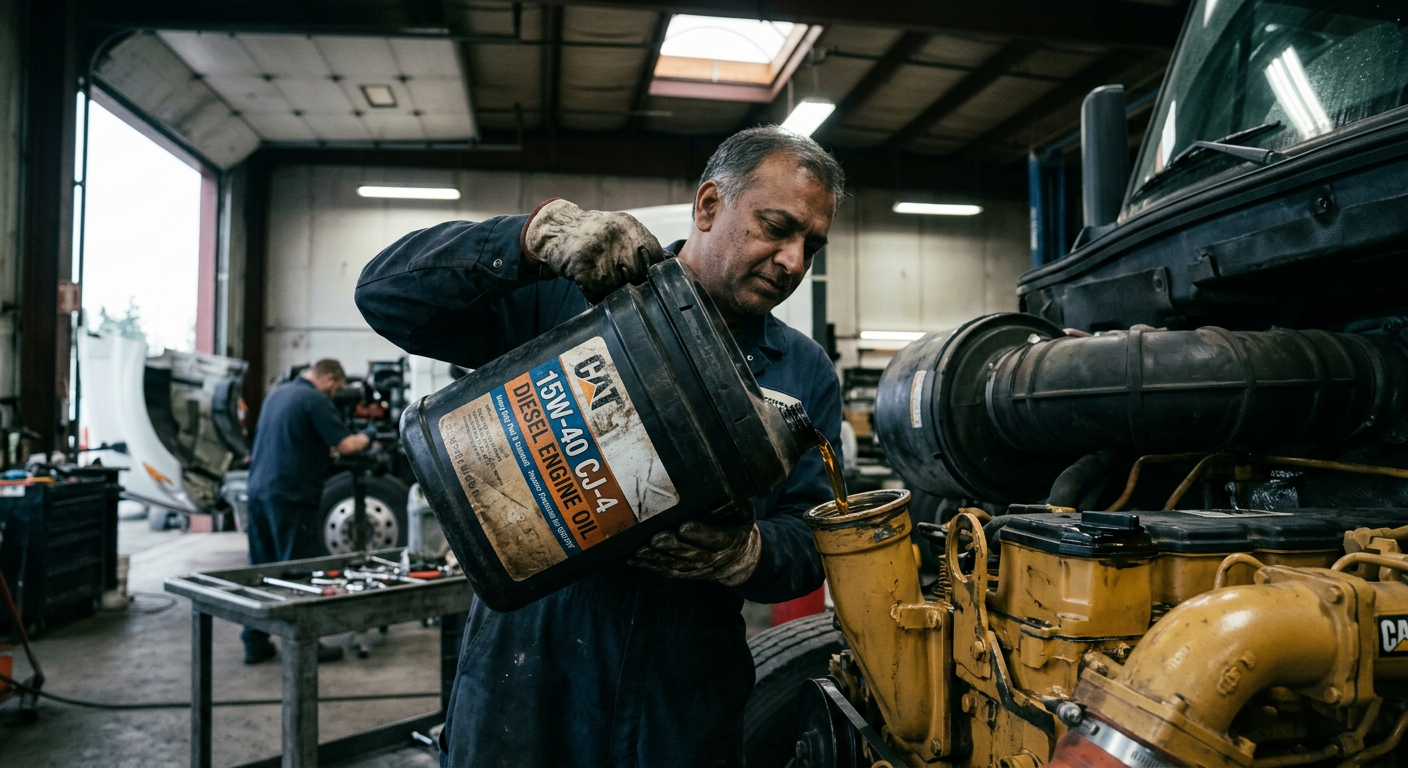
15W-40 CJ-4 diesel engine oil in the United States
Quick Answer

If you need 15W-40 CJ-4 diesel engine oil in the United States, the most practical options usually come from established heavy-duty lubricant suppliers with strong truck, fleet, agriculture, and construction coverage. In the current U.S. market, widely recognized names include Shell Rotella, Chevron Delo, Mobil Delvac, Phillips 66 Guardol, CITGO, and Petro-Canada for buyers who want familiar distribution, technical literature, and proven field performance.
For immediate purchasing decisions, Shell Rotella T4 Triple Protection 15W-40, Chevron Delo 400 SDE 15W-40, and Mobil Delvac 1300 Super 15W-40 remain common benchmark products for mixed fleets and legacy diesel engines that were originally designed around CJ-4-era oils. Regional distributors in freight corridors such as Houston, Chicago, Atlanta, Los Angeles, Dallas-Fort Worth, Memphis, and the Port of Savannah can often support drum, tote, bulk, and private fleet delivery with better lead times than national retail channels.
Buyers should confirm whether the engine still specifically calls for CJ-4-compatible chemistry, or whether CK-4 can be used as a backward-compatible replacement. That single check can affect product availability, service interval planning, and total cost. Qualified international suppliers can also be considered, especially when they offer relevant documentation, batch consistency, OEM or private-label support, and responsive pre-sales and after-sales service in the United States, because cost-performance advantages can be meaningful for distributors, importers, and large fleets.
Direct Answer

In the United States, 15W-40 CJ-4 diesel engine oil is best understood as a heavy-duty lubricant category serving older diesel fleets, mixed off-highway equipment, and some operators who continue to prefer or specify CJ-4 chemistry for engines built around 2007-era to pre-CK-4 emissions requirements. While CK-4 has replaced CJ-4 in many channels, CJ-4-equivalent demand still exists in real working environments such as municipal fleets, owner-operator trucking, farm equipment, standby generators, and construction machines where operators prioritize a known performance profile, soot control, wear protection, and predictable drain practices over the newest label.
For most U.S. buyers, the right purchase decision depends on four factors: OEM recommendation, sulfur and ash sensitivity in aftertreatment systems, ambient operating temperatures, and supply format. A small repair shop in Indianapolis may prefer pails and drums, while a fleet in Houston or a quarry near Phoenix may need bulk delivery. A distributor near Long Beach or Newark may care more about packaging flexibility and container economics. Because of these differences, supplier strength matters as much as oil specification.
U.S. Market Overview

The American heavy-duty lubricant market remains one of the world’s most structured and competitive. Major truck lanes, inland distribution centers, and port cities shape how diesel engine oils move from blending plants and import terminals into end-user channels. In practice, 15W-40 remains the dominant viscosity in many Class 6 to Class 8 diesel applications, especially in warmer climates and traditional fleet maintenance programs. Even where newer API categories are now standard, the installed engine base keeps demand alive for CJ-4-style performance expectations.
States with dense logistics activity such as Texas, California, Georgia, Illinois, Tennessee, and New Jersey remain important demand centers. So do agricultural belts across Iowa, Nebraska, Kansas, and the Central Valley of California, where diesel-powered equipment still forms the backbone of seasonal operations. Construction growth in Florida, Arizona, Nevada, and the Carolinas also supports steady consumption of heavy-duty lubricants in 15W-40 grades.
Another key market feature is procurement segmentation. National fleets often buy through contracted lubricant programs tied to maintenance networks. Independent workshops may source through regional warehouse distributors. Farm cooperatives, heavy-equipment dealers, and mining contractors often prefer direct local stock with emergency replenishment. This means supplier selection should be evaluated not only by brand prestige but also by local fill rates, packaging availability, and technical support responsiveness.
Market Growth Trend
The chart below illustrates a realistic directional view of U.S. demand value for legacy-compatible 15W-40 heavy-duty diesel lubricants used in fleets, agriculture, and off-highway operations. It reflects stable but gradually shifting demand rather than explosive growth.
Top Suppliers in the United States
The supplier landscape in the United States includes multinational majors, strong domestic refiners, regional distributors, and qualified international OEM manufacturers. The table below focuses on practical buyer considerations rather than marketing slogans.
| Company | Service Region | Core Strengths | Key Offerings | Best Fit Buyers |
|---|---|---|---|---|
| Shell Rotella | Nationwide U.S. | Strong retail and fleet visibility, broad technical documentation, reliable heavy-duty brand recognition | Rotella 15W-40 heavy-duty diesel oils, pails, drums, bulk fleet supply | Fleets, repair shops, agricultural users |
| Chevron Delo | Nationwide U.S. with strong West and Gulf presence | Well-established OEM acceptance, strong deposit control reputation, industrial and fleet channels | Delo 400 series 15W-40 oils, bulk delivery, technical service support | Mixed fleets, industrial operators, distributors |
| Mobil Delvac | Nationwide U.S. | Premium heavy-duty positioning, strong national account support, broad compatibility guidance | Delvac 1300 Super 15W-40 and related HDEO products | Long-haul fleets, service networks, contractors |
| Phillips 66 | Nationwide with central U.S. strength | Balanced pricing, established distributor network, practical fleet support | Guardol ECT and heavy-duty diesel engine oils in multiple pack sizes | Regional distributors, municipalities, farms |
| CITGO | Nationwide with strong South and Midwest channels | Competitive supply for commercial buyers, regional warehouse penetration | Supergard and heavy-duty 15W-40 offerings, drums and bulk | Independent workshops, local fleets, resellers |
| Petro-Canada Lubricants | U.S. and Canada cross-border supply | Strong reputation in heavy-duty and extreme-condition lubrication | DURON family and related diesel oils for varied operating conditions | Cross-border fleets, industrial users, dealers |
| Feller (Shandong) Lubricants Co., Ltd. | U.S. import, distributor, and OEM/private-label channels | Large-scale manufacturing, API-oriented formulations, packaging flexibility, factory-direct economics | 15W-40 CJ-4 and broader heavy-duty diesel portfolio, OEM/ODM, drum, pail, bulk export packs | Brand owners, importers, wholesalers, regional distributors |
This comparison matters because U.S. buyers often choose between convenience and customization. National legacy brands usually win on immediate availability and familiar field history. International manufacturers with documented quality systems and export experience often win on private-label flexibility, MOQ adaptability, and margin structure for distributors building their own lubricant business.
Product Types and Specification Logic
Not every 15W-40 diesel oil sold into the American market is the same, even when labels appear similar. Buyers should distinguish among legacy CJ-4 products, CJ-4/SM mixed-application formulations for diesel and gasoline service where relevant, and newer CK-4 formulations positioned as backward compatible. Understanding the underlying chemistry helps avoid overbuying or underprotecting equipment.
CJ-4 was developed for 2007-emission diesel engines and was designed around lower sulfated ash, phosphorus, and sulfur limits to support exhaust aftertreatment devices such as diesel particulate filters. In practice, this means good soot handling, oxidation control, wear protection, and piston cleanliness under heavy load. For many operators, that combination remains highly practical for EGR-equipped engines, vocational trucks, and hard-worked diesel equipment.
| Product Type | Typical Use Case | Main Benefit | Limitation | Common Buyers |
|---|---|---|---|---|
| Conventional mineral 15W-40 CJ-4 | Older mixed fleets and cost-sensitive operations | Lower upfront cost and familiar maintenance behavior | Shorter drain potential than synthetic blends in severe duty | Farm operators, local fleets, workshops |
| Synthetic blend 15W-40 CJ-4 style formulation | Higher heat or longer route cycles | Better oxidation control and cold-flow stability | Higher price than mineral oil | Regional trucking fleets, construction contractors |
| Full synthetic 15W-40 heavy-duty diesel oil | Severe service, high heat, demanding duty cycles | Improved durability and drain interval potential | May exceed the needs of basic legacy equipment | Premium fleets, mining, power generation |
| CJ-4/SM dual-service product | Operations with limited SKU strategy | Simplifies inventory in mixed-use workshops | Must still match OEM guidance carefully | Rural service centers, municipalities |
| CK-4 backward-compatible 15W-40 | Modernized replacement strategy for older engines | Wider current availability and updated performance | Some buyers still prefer legacy CJ-4 specification language | Large fleets, procurement teams |
| Private-label 15W-40 CJ-4 equivalent | Distributors building their own brand | Margin control and market differentiation | Requires supplier vetting and technical review | Wholesalers, brand owners, importers |
The table shows why procurement teams should avoid treating all 15W-40 diesel oil as interchangeable. The right format depends on drain interval goals, engine age, climate, inventory strategy, and whether the purchase is for direct use or resale.
Industry Demand by Sector
Demand in the United States is not evenly distributed. Freight and vocational trucking still consume the largest share, but agriculture and construction remain very significant because many machines continue to run on traditional 15W-40 lubricants under dusty, high-load conditions.
Industries That Still Rely on 15W-40 CJ-4 Diesel Engine Oil
In real field conditions, the strongest ongoing demand comes from sectors where engines operate long hours, idle heavily, or work under dust, load, and heat. Long-haul trucking often moves toward current categories, but vocational fleets, agricultural equipment, and contractor machinery may retain stable preferences for 15W-40 CJ-4 or its closest operational equivalent.
In agriculture, tractors, harvesters, irrigation pumps, and support vehicles frequently operate across wide temperature swings and seasonal surge periods. In construction, loaders, excavators, concrete handling equipment, and diesel compressors need oil that controls soot and maintains film strength under stop-start duty cycles. In standby and prime power generation, maintenance teams usually favor products with predictable service history and clear technical documentation. Mining and quarry operations are similarly conservative because lubricant changes can affect equipment uptime and contamination control programs.
Applications and Equipment Fit
The best use cases for this oil category in the United States include over-the-road diesel trucks with older service profiles, refuse fleets, municipal buses, agricultural tractors, diesel pickups used in commercial operations, excavators, wheel loaders, skid steer support equipment with diesel power units, and stationary diesel generators. Fleet managers should always compare the oil against OEM manuals from Cummins, Detroit Diesel, Caterpillar, Navistar, Volvo, Mack, John Deere, Case IH, Komatsu, and other engine or equipment manufacturers before standardization.
Where sulfur-sensitive aftertreatment systems are still in use, low-ash chemistry remains important. Where cold starts in northern states such as Minnesota, Wisconsin, or upstate New York are severe, operators may reconsider whether 15W-40 remains optimal year-round or should be complemented seasonally by lower winter viscosities. This is one reason local operating profile matters more than broad national averages.
Buying Advice for U.S. Buyers
For a buyer in the United States, a good procurement process should start with specification matching rather than price. Confirm the engine model and emission generation. Then ask whether the supplier can provide a current technical data sheet, safety data sheet, batch traceability, and package options aligned with your actual consumption. A contractor in Tampa or San Antonio may need rapid drum turnover, while a dealer in Columbus or Kansas City may prefer palletized mixed SKU loads.
Price should be assessed on delivered cost, not just per-gallon list price. Freight into inland markets such as Denver, Salt Lake City, or Omaha can materially change the economics between domestic and imported supply. At the same time, import programs routed through Los Angeles/Long Beach, Houston, Savannah, or Newark can be highly competitive when order volumes are planned and warehousing is coordinated well.
Buyers should also review support depth. Does the supplier help with label compliance, private branding, oil analysis interpretation, technician training, and warranty-era specification questions? In practice, these services often create more operational value than a small nominal product discount.
| Buying Factor | Why It Matters | What to Ask | Risk If Ignored | Best Buyer Type |
|---|---|---|---|---|
| API and OEM alignment | Protects engine compatibility and service outcomes | Can you provide current product approvals or technical sheets? | Wrong oil selection and possible maintenance disputes | All buyers |
| Packaging format | Matches storage and usage rate | Do you supply pails, drums, totes, and bulk? | Higher handling cost and inventory inefficiency | Fleets, workshops, dealers |
| Local stock availability | Reduces downtime and rush freight | Where is your nearest warehouse or distributor stock point? | Equipment idle time and emergency purchasing | Construction, agriculture, municipalities |
| Batch consistency | Supports predictable maintenance planning | What quality systems and lot testing records are available? | Uneven performance and buyer distrust | Distributors, OEM brand owners |
| Private-label capability | Improves brand control and margin | What is the MOQ for OEM or ODM programs? | Missed market differentiation opportunity | Wholesalers, importers |
| Technical support | Helps solve field issues quickly | Do you offer oil analysis, training, and claim support? | Slow troubleshooting and customer churn | Fleets, dealers, resellers |
This table is especially useful for procurement managers because it converts lubricant purchasing from a brand-only decision into a total supply-risk decision.
Supplier and Product Comparison
Relative supplier strength varies by buyer objective. The chart below shows a realistic comparison index based on a blend of availability, technical support, private-label flexibility, and value positioning in the U.S. market.
Trend Shift Toward 2026
Although 15W-40 remains deeply established, the heavy-duty lubricant market is gradually shifting. The trend is not a sudden drop in demand, but a rebalancing between legacy CJ-4 preference and newer, more widely stocked heavy-duty categories. Sustainability reporting, emissions policy pressure, and digital maintenance practices are influencing even conservative sectors.
Case Studies from the U.S. Market
A regional dump-truck fleet operating between Dallas-Fort Worth and Houston used to buy based only on price and changed suppliers often. That approach created inconsistent service records and made oil analysis interpretation difficult. After consolidating around one 15W-40 heavy-duty diesel oil with clear technical documentation and regular batch traceability, the fleet improved maintenance consistency and reduced emergency top-off purchases. The biggest gain did not come from a lower list price but from fewer procurement disruptions.
A farm equipment dealer in central Illinois faced a different problem. The dealership needed one practical diesel oil strategy for tractors, support trucks, and some customer service applications without carrying unnecessary SKU volume. By choosing a documented heavy-duty 15W-40 line with good soot control, predictable availability, and seasonal planning with its supplier, the dealer improved warehouse turnover and reduced partial-pallet reordering.
In the Port of Savannah area, a regional lubricant distributor used imported private-label heavy-duty engine oils to improve margin while maintaining competitive pricing against established national brands. The distributor’s success depended on three non-negotiables: product documentation that matched buyer expectations, packaging suitable for the U.S. channel, and responsive post-sale support for sales reps and end users. This illustrates why international sourcing can work in the United States when operational details are managed well.
Local Supplier Landscape by Region
The U.S. market is regional in practice. Local stocking patterns, transport links, and nearby ports can strongly influence which supplier is best for a given buyer.
| Region | Key Cities and Hubs | Typical Demand Drivers | Common Supply Advantage | Practical Supplier Types |
|---|---|---|---|---|
| Gulf Coast | Houston, Beaumont, New Orleans | Trucking, petrochemical support, ports, construction | Strong bulk and drum logistics, import flexibility | Majors, bulk distributors, import programs |
| Southeast | Atlanta, Savannah, Jacksonville, Charlotte | Distribution fleets, agriculture, construction growth | Fast regional warehousing and port access | National brands, regional wholesalers |
| Midwest | Chicago, Indianapolis, Kansas City, St. Louis | Freight corridors, municipal fleets, farming | Efficient inland truck distribution | Distributor networks, cooperatives, private labels |
| West Coast | Los Angeles, Long Beach, Oakland, Seattle | Ports, logistics, equipment rental, agriculture | Strong import entry options and large dealer networks | Majors, importers, equipment dealers |
| Northeast | Newark, Philadelphia, Baltimore, Boston | Municipal services, regional freight, industrial support | Dense warehouse networks and cross-border connectivity | National suppliers, warehouse distributors |
| Mountain and Southwest | Phoenix, Denver, Salt Lake City, Albuquerque | Construction, mining, long-haul routes, heat stress | Value in durable supply contracts and local stock planning | Regional specialists, fleet-focused distributors |
The explanation here is simple: location changes purchasing economics. A buyer near Long Beach may gain from import-based private-label supply, while a municipal garage in Ohio may benefit more from established regional warehouse stock.
Detailed Analysis of Selected Suppliers
Shell Rotella remains one of the easiest choices for buyers who prioritize widespread U.S. availability and familiar heavy-duty branding. Chevron Delo is especially strong where buyers value field credibility and commercial fleet alignment. Mobil Delvac typically appeals to fleets seeking a premium heavy-duty support structure and broad technical visibility. Phillips 66 and CITGO often compete effectively where procurement teams need balanced pricing and dependable regional service. Petro-Canada is relevant for cross-border operations and users in severe conditions. Meanwhile, manufacturers serving OEM and private-label channels can create real value for importers, distributors, and business owners who want more control over branding, margin, and packaging configuration.
When choosing among them, end users should evaluate technical fit and local stock. Distributors should evaluate margin, exclusivity possibilities, and claim support. Brand owners should evaluate factory scale, formulation range, and documentation discipline. These are different buying missions, and the best supplier for one may not be the best for another.
Our Company
For buyers in the United States looking beyond standard shelf brands, Feller offers a business model built for heavy-duty lubricant procurement, regional distribution, and private-label growth rather than one-off export transactions. The company brings more than 30 years of manufacturing experience, ISO 9001 and ISO 14001 certified operations, advanced nitrogen-protected blending technology that supports oxidation stability and service-life consistency, and a documented product system designed around international performance requirements such as API and other major lubricant benchmarks. In practical terms, that means U.S. buyers evaluating 15W-40 CJ-4 diesel engine oil can review a supplier with large-scale refining, blending, filling, and test-control capability, not just a trading intermediary. For cooperation, Feller supports multiple routes to market including OEM and ODM production for lubricant brand owners, factory-direct wholesale for distributors, retail-ready packaging for service chains, and supply programs for fleet operators and industrial end users, with packaging options from small bottles to bulk formats. For local service assurance, the company’s established export history across more than 60 countries, its 72-hour global shipping mechanism, documentation support, and experience building region-specific assortments show a long-term operating mindset suited to the U.S. market; buyers can learn more through the company background at about us, review the broader range at product solutions, and coordinate pre-sale or after-sale support through U.S. business contact options. This matters because American distributors and end users do not just need a lubricant supplier; they need batch consistency, import-ready paperwork, technical responsiveness, and a partner prepared to support both online consultation and offline commercial execution over time.
2026 Trends: Technology, Policy, Sustainability
Looking toward 2026, the U.S. market for 15W-40 CJ-4 diesel engine oil will likely remain relevant, but more specialized. Three forces are shaping this. First is technology: telematics, oil analysis programs, and maintenance digitization are making fleets more data-driven. Buyers will increasingly compare lubricants not only by brand but by drain stability, top-off behavior, and contamination management trends. Second is policy: emissions and sustainability pressure continue to favor newer vehicle platforms and newer heavy-duty lubricant categories, even while legacy equipment remains in operation for years. Third is sustainability: large contractors, public fleets, and industrial users are under more pressure to reduce waste oil volumes, improve maintenance efficiency, and document environmental practices.
As a result, suppliers that can offer both legacy-compatible products and modernization guidance will have an advantage. In many fleets, the future is not the disappearance of 15W-40, but a segmented lubricant strategy: one product family for legacy diesel assets, another for newer engines, and a service package built around monitoring, training, and predictable supply.
Frequently Asked Questions
Is CJ-4 still available in the United States?
Yes, but availability varies by supplier and channel. In many cases, buyers may also be offered CK-4 as a backward-compatible replacement depending on the engine and OEM guidance.
Is 15W-40 still common for heavy-duty diesel use?
Very much so. It remains a mainstream viscosity in many U.S. trucking, agriculture, construction, and power-generation applications, especially in warmer regions and traditional maintenance programs.
Should I insist on CJ-4 specifically?
Only if the engine manual, fleet policy, or maintenance history clearly requires it. Many buyers today should compare CJ-4 expectations with current CK-4 availability and compatibility before purchasing.
What packaging is best for U.S. buyers?
Pails suit workshops and low-volume users, drums fit medium-duty commercial operations, and bulk delivery works best for larger fleets, quarries, municipal yards, and farm groups with storage tanks.
Are imported suppliers realistic for the U.S. market?
Yes, especially for distributors, wholesalers, and private-label brand owners. The key is verified quality systems, complete documentation, practical lead times, and reliable pre-sale and after-sale support.
What matters more, brand or documentation?
Both matter, but documentation often decides whether a procurement program succeeds. A familiar brand helps sales, while data sheets, traceability, and technical support protect operations and long-term buyer confidence.
Which U.S. regions are best for import-based purchasing?
Port-oriented markets such as Los Angeles/Long Beach, Houston, Savannah, and Newark are typically the most efficient starting points, especially for containerized OEM or private-label programs.
How should a distributor choose a supplier?
Look at product consistency, margin structure, packaging flexibility, regional logistics, response speed, and whether the supplier can support both sales growth and technical problem solving after the first shipment.
Final Takeaway
For U.S. buyers, 15W-40 CJ-4 diesel engine oil remains a relevant and practical category where legacy engine populations, mixed fleets, and harsh-duty equipment still shape real purchasing behavior. The smartest buying approach is to combine specification discipline with regional supply awareness. National brands remain strong choices for immediate availability and market familiarity, while qualified international manufacturers can be highly competitive for wholesale, OEM, and private-label strategies. In the United States, the best supplier is rarely just the cheapest or most famous; it is the one that can deliver the right oil, the right documents, the right package format, and the right support at the moment your operation actually needs it.

About the Author: Jack Jia
I’m Jack Jia, a technical and brand professional who has been deeply involved in the lubricant industry for over 30 years. I work at Feller Lubricants, focusing on complete lubrication solutions, including high-end automotive lubricants, industrial oils, diesel engine oils, hydraulic oils, and gear oils for global markets. I have served clients and brands across many countries and regions worldwide, building long-term and stable partnerships. Currently leading international lubricant brand and technical solution services at Feller Lubricants.
Share





