Diesel Engine Oil vs Gear Oil in the United States
Quick Answer

Diesel engine oil and gear oil are not interchangeable. Diesel engine oil is designed to lubricate, cool, clean, and protect internal combustion engine parts such as pistons, rings, cams, and bearings, while gear oil is formulated mainly for transmissions, differentials, transfer cases, and industrial gear sets that operate under very high sliding pressure. In practical terms, diesel engine oil focuses on soot handling, oxidation control, detergency, and engine wear protection, whereas gear oil focuses on extreme-pressure protection, shear stability, anti-scuff performance, and load-carrying capability. If a fleet, workshop, farm, or industrial operator in the United States uses the wrong oil, the result can be poor shifting, seal issues, accelerated wear, overheating, sludge formation, or outright component failure.
For buyers in the United States, well-known lubricant suppliers with strong local availability include Shell, ExxonMobil, Chevron, Valvoline, Phillips 66, and AMSOIL. These brands supply both heavy-duty diesel engine oils and gear lubricants across major logistics and industrial hubs such as Houston, Chicago, Los Angeles, Savannah, and New Jersey. Qualified international suppliers can also be considered when they hold relevant certifications, provide stable batch quality, and support customers with responsive pre-sales and after-sales service. This is especially true for cost-sensitive distributors, private-label buyers, and regional wholesalers seeking better cost-performance without sacrificing technical compliance.
Why These Two Oils Are Different

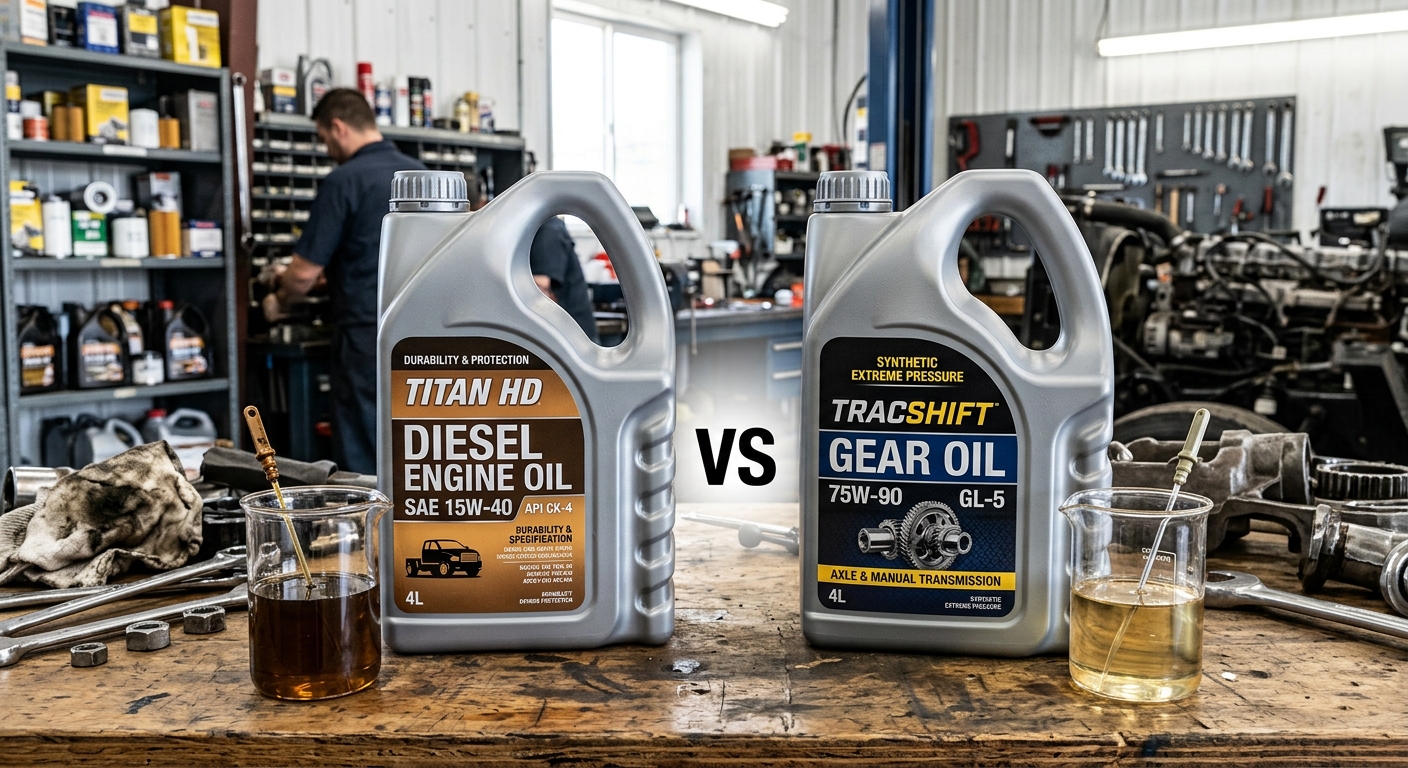
The confusion around diesel engine oil vs gear oil often begins with viscosity numbers. A diesel engine oil might be labeled 15W-40, while a gear oil might be labeled 75W-90 or 80W-90, leading some buyers to assume the products are similar because the numbers appear close. They are not. Engine oil and gear oil follow different viscosity grading systems, different additive strategies, and different equipment requirements. A heavy-duty diesel oil must survive combustion byproducts, soot loading, fuel dilution, acid formation, and thermal cycling. A gear lubricant, by contrast, must protect metal tooth surfaces under heavy contact stress and often under shock loading in axles, industrial reducers, and manual gearboxes.
Another critical difference is additive chemistry. Diesel engine oils commonly contain detergents, dispersants, anti-wear chemistry, oxidation inhibitors, corrosion inhibitors, and total base reserve for acid neutralization. Gear oils usually rely much more on extreme-pressure chemistry for hypoid gears and heavily loaded gear tooth interfaces. That is why a product that performs well in a diesel crankcase may be the wrong solution for an axle or gearbox. The lubricant is engineered around the machine’s tribological environment, not just around a thickness number.
United States Market Context

In the United States, the distinction matters across long-haul trucking, agriculture, construction, mining, manufacturing, inland marine, and power generation. Freight corridors linking Texas, California, Illinois, Georgia, and the Mid-Atlantic region create strong demand for heavy-duty diesel engine oils. At the same time, logistics yards, industrial plants, off-highway fleets, and agricultural operations across Iowa, Nebraska, Kansas, Pennsylvania, and the Southeast consume large volumes of gear oil for transmissions, final drives, and enclosed gear systems. The U.S. market also places increasing emphasis on drain interval optimization, used oil analysis, emissions system compatibility, and procurement efficiency.
Ports such as Houston, Long Beach, Los Angeles, Savannah, Norfolk, and Newark play a major role in lubricant distribution. These trade hubs support domestic blending, imports, packaging supply, and regional warehousing. Buyers often prioritize technical documentation, OEM alignment, dependable fill consistency, and multi-state delivery coverage. For fleets and distributors, a lubricant partner’s ability to deliver quickly and support warranty-sensitive applications is often as important as price per gallon.
The chart above illustrates a realistic upward trend in U.S. heavy-duty lubricant demand, driven by freight activity, infrastructure spending, agriculture, and industrial maintenance. While electric mobility affects some light-duty segments, diesel fleets and geared industrial equipment remain central to the U.S. economy, particularly in the Midwest, Gulf Coast, and Southeast.
Core Technical Differences
| Factor | Diesel Engine Oil | Gear Oil | Why It Matters |
|---|---|---|---|
| Main purpose | Lubricates and protects diesel engine internals | Protects gears, bearings, and tooth surfaces | Each oil is built around a different machine environment |
| Typical applications | Heavy-duty trucks, buses, farm tractors, generators | Axles, differentials, manual transmissions, reducers | Using the wrong oil can damage components quickly |
| Additive focus | Detergents, dispersants, anti-wear, oxidation control | Extreme-pressure, anti-scuff, rust and foam control | Additives are tuned to very different operating stresses |
| Contaminant handling | Designed to manage soot and combustion acids | Not intended to manage soot from combustion | Engine cleanliness depends on this capability |
| Load environment | Mixed hydrodynamic and boundary engine lubrication | High sliding pressure and shock loads on gear teeth | Gear contacts need stronger EP protection |
| Viscosity system | SAE engine oil grades such as 10W-30, 15W-40 | SAE gear grades such as 75W-90, 80W-90, 85W-140 | Similar numbers do not mean similar thickness in service |
| Common standards | API CK-4, CJ-4, FA-4 and OEM engine specs | API GL-4, GL-5, MT-1 and OEM gear specs | Correct spec alignment protects equipment warranty |
This comparison table shows why diesel engine oil vs gear oil should never be reduced to a simple “thicker vs thinner” discussion. The real issue is function, chemistry, and application. Buyers in the United States should always confirm the OEM manual before consolidating lubricants across a fleet or plant.
How Diesel Engine Oil Works
Diesel engine oil does far more than lubricate. Inside a diesel engine, it forms a film on bearings, cam lobes, valve train components, and cylinder walls. It also carries heat away from critical areas, suspends soot, neutralizes acids formed during combustion, and helps keep piston rings and turbochargers clean. In modern U.S. on-road fleets, engine oil must also support aftertreatment durability, especially in vehicles equipped with diesel particulate filters, exhaust gas recirculation systems, and selective catalytic reduction systems.
For example, a fleet operating across Dallas, Memphis, Atlanta, and Columbus may choose a CK-4 15W-40 for conventional long-haul tractors or a lower-viscosity heavy-duty oil in newer fuel-efficiency-focused units. In agriculture, buyers may prefer robust diesel engine oils that cope with dust, load swings, idling, and seasonal temperature extremes. In standby power generation, oxidation stability and long service life become more important than fuel-economy optimization.
How Gear Oil Works
Gear oil is primarily about film strength under concentrated pressure. In hypoid differentials, spiral bevel gears, and industrial enclosed gear drives, metal surfaces experience high sliding contact and extreme localized stress. That is why gear lubricants often use extreme-pressure additive systems that react at contact points to reduce welding, scuffing, and pitting. Gear oil also needs strong shear stability, resistance to foaming, and dependable rust protection, especially in equipment exposed to moisture, contamination, or thermal cycling.
In the United States, gear oil demand is especially strong in Class 8 axles, farm equipment final drives, quarry machinery, manufacturing plants, marine drives, and industrial reducers used in cement, aggregate, steel, paper, and food processing. A warehouse conveyor gearbox in Ohio, a grain operation in Kansas, and a construction fleet in Arizona may all require gear lubricants, but the exact product grade and specification can differ widely based on speed, load, metallurgy, and ambient temperature.
Common Product Types in the U.S. Market
| Category | Typical Grade | Common Standard | Common U.S. Use |
|---|---|---|---|
| Conventional diesel engine oil | 15W-40 | API CK-4 | Long-haul trucks, mixed fleets, construction equipment |
| Synthetic blend diesel engine oil | 10W-30 | API CK-4 | Fuel-conscious regional fleets and vocational trucks |
| Full synthetic diesel engine oil | 5W-40 | API CK-4 | Cold climates, severe service, extended drains |
| Manual transmission fluid | 50 or dedicated MTF | OEM specific | Heavy-duty manual gearboxes |
| Automotive gear oil | 75W-90 | API GL-5 | Differentials, axles, light and heavy vehicles |
| Heavy-load gear oil | 80W-90 or 85W-140 | API GL-5 | Off-highway axles, farm equipment, severe haul cycles |
| Industrial gear oil | ISO VG 220 / 320 / 460 | DIN / AGMA aligned | Reducers, gearboxes, mills, conveyors |
The table above shows that the buying decision in the United States often starts with equipment type and OEM requirement, not with brand preference alone. Buyers should verify whether they are selecting an engine lubricant, a manual transmission fluid, an axle fluid, or an industrial gear lubricant because these products are not automatically interchangeable even when operating in the same vehicle or machine.
Where Buyers Make Mistakes
A frequent mistake is assuming that any heavy oil can protect heavily loaded gears. Another is assuming that all manual transmissions use standard gear oil. Some heavy-duty manual gearboxes in North America require dedicated transmission fluids rather than conventional GL-5 gear oil because synchronizer materials and shift feel can be affected. In off-highway operations, another common error is trying to simplify inventory by using one lubricant across engine, gearbox, hydraulic system, and differential applications without confirming compatibility.
There are some specialized universal tractor transmission oils and combined drivetrain-hydraulic fluids in agriculture and construction, but they are purpose-built products and not a substitute for checking the OEM manual. When buyers in the United States consolidate lubricants too aggressively, the short-term warehousing benefit can be outweighed by repair costs and downtime.
Industry Demand in the United States
This bar chart highlights why the diesel engine oil vs gear oil discussion is especially relevant in trucking, agriculture, construction, and manufacturing. These sectors often consume both product families in high volumes. A single fleet may purchase diesel engine oil for engines, gear oil for differentials, and specialized transmission fluids for gearboxes, making procurement accuracy essential.
Buying Advice for U.S. Fleets, Dealers, and Distributors
For end users, the first rule is to follow the OEM specification and application manual. For distributors and dealers, the priority is stocking the grades most demanded by local sectors. In the Midwest, agricultural and industrial gear lubricants may move strongly alongside diesel engine oil. In the Gulf Coast, marine, industrial, and trucking applications add more diversity. In California and the Northeast, emission-system sensitivity and lower-viscosity trends may influence engine oil demand patterns more strongly.
Used oil analysis is a valuable tool in the United States because it turns lubricant purchasing into a data-driven process. Fleets can track wear metals, oxidation, nitration, soot, water, viscosity shift, and contamination levels. Industrial operators can use the same approach to detect bearing distress, ingress, and additive depletion in gearboxes. Rather than choosing solely on price, professional buyers evaluate drain interval stability, maintenance labor savings, downtime reduction, seal compatibility, and total lifecycle cost.
| Buyer Type | Main Concern | Recommended Focus | Typical Purchase Pattern |
|---|---|---|---|
| Long-haul truck fleet | Drain interval, engine protection, fuel economy | API-compliant diesel engine oil and axle fluids | Bulk or tote contracts with scheduled delivery |
| Farm operation | Seasonality, mixed equipment, inventory simplicity | Correct engine oils, gear oils, and tractor fluids | Seasonal stocking through local dealer or co-op |
| Construction contractor | Dust, shock loads, downtime risk | Heavy-duty engine oils and severe-service gear lubricants | Case-based and bulk replenishment by project cycle |
| Industrial plant | Reliability and predictive maintenance | Industrial gear oils with oil analysis support | Contracted deliveries and PM-linked replenishment |
| Lubricant distributor | Margin, assortment depth, stable supply | Multi-grade portfolio and documentation quality | Container, pallet, or OEM/private-label orders |
| Retail workshop | Fast-moving SKUs and technician confidence | Popular truck grades and differential fluids | Regional wholesale or direct local delivery |
The table shows that buying strategy should reflect operational reality. A distributor serving Tulsa, Kansas City, and St. Louis may need a different stock mix than a marine-heavy supplier near Houston or Jacksonville. Matching lubricant type to end-market demand is often more profitable than simply chasing the lowest upfront cost.
Applications by Industry
In trucking, diesel engine oil protects engines that run long hours under thermal stress, while gear oil protects drive axles and differentials from load and heat. In agriculture, tractors, combines, and harvesters may use diesel engine oils in engines and gear lubricants in final drives or axle systems. In construction, dozers, loaders, dump trucks, and excavator support units may use several lubricant families simultaneously. In manufacturing, enclosed industrial gearboxes depend on properly selected gear oils, while onsite backup generators rely on diesel engine oils. Marine operations along the Gulf Coast and inland waterways can also require both engine and gear protection, depending on vessel systems.
Case Studies from Common U.S. Scenarios
A regional trucking fleet operating between Chicago, Indianapolis, and Atlanta switched from a basic procurement approach to a specification-driven one. The fleet kept using a compliant CK-4 diesel engine oil for its tractors but corrected axle fluid selection in several older units that had been topped off with non-matching fluids. Over two maintenance cycles, differential noise complaints dropped, oil analysis improved, and unscheduled driveline service events were reduced.
An agricultural dealer network in Iowa and Nebraska reduced customer confusion by separating engine oil, gear oil, and multifunction tractor fluid recommendations more clearly at point of sale. This led to fewer product returns and fewer lubrication-related service disputes during planting and harvest season. The dealer found that education improved both customer satisfaction and lubricant sales mix.
A food processing plant near St. Louis reviewed its industrial gearbox program after repeated overheating in a conveyor reducer. The issue was not oil quantity alone but grade and oxidation life under continuous load. After moving to a better-matched industrial gear lubricant and implementing routine sampling, the plant improved gearbox temperature stability and reduced maintenance intervention frequency.
Top Lubricant Suppliers Relevant to the United States
| Company | Service Region | Core Strengths | Key Offerings |
|---|---|---|---|
| Shell | Nationwide United States | Large distribution network, strong OEM relationships, premium heavy-duty lineup | Rotella diesel engine oils, Spirax gear oils, industrial lubricants |
| ExxonMobil | Nationwide United States | Broad industrial and transport coverage, strong synthetic portfolio | Mobil Delvac diesel engine oils, Mobilgear industrial and automotive gear oils |
| Chevron | United States with strong West and Gulf presence | Heavy-duty engine protection, transport and off-highway expertise | Delo diesel engine oils, gear lubricants, drivetrain fluids |
| Valvoline | Nationwide through retail and commercial channels | Strong aftermarket reach, fast service channels, recognizable branding | Premium Blue, heavy-duty engine oils, gear oils, service center products |
| Phillips 66 | United States industrial and transport markets | Commercial fleet focus, industrial support, broad product range | Guardol diesel engine oils, gear oils, industrial lubricants |
| AMSOIL | United States and regional distribution networks | Synthetic specialization, severe-service positioning, enthusiast and fleet appeal | Synthetic diesel oils, severe-gear lubricants, extended-drain options |
| Fuchs Lubricants | United States industrial and specialty sectors | Industrial application depth, specialty engineering support | Industrial gear oils, specialty driveline fluids, plant lubrication products |
This supplier table is practical for U.S. buyers because it distinguishes between broad national brands and suppliers that are especially strong in industrial or niche channels. Buyers comparing diesel engine oil vs gear oil programs should assess whether a supplier is stronger in over-the-road fleets, industrial maintenance, agriculture, or retail service networks.
How Supplier Positioning Is Shifting
The area chart reflects a realistic market shift toward synthetic and premium lubricant adoption in the United States. This trend affects both diesel engine oils and gear oils, especially where fleets pursue longer drains, cold-start performance, thermal stability, and lower maintenance risk. By 2026, premium product penetration is expected to rise further as maintenance teams focus on total cost rather than shelf price alone.
Supplier and Product Comparison Factors
This comparison chart summarizes common buying criteria used by U.S. procurement teams. Established multinational brands tend to score strongly in specification coverage and distribution reach, while flexible OEM-oriented manufacturers may stand out in private-label flexibility and cost-performance. That distinction matters for distributors, regional dealers, and brand owners exploring alternative sourcing models.
What to Ask Before You Buy
Before selecting a lubricant supplier in the United States, buyers should request the technical data sheet, safety documentation, application list, and any relevant API or OEM claim support. For diesel engine oil, buyers should ask whether the product is appropriate for the engine generation, emissions hardware, drain strategy, and climate. For gear oil, they should verify axle, gearbox, synchronizer, and industrial gear compatibility, as well as EP performance and seal behavior.
Distributors should also ask practical commercial questions: Is stock held near major hubs such as Houston, Chicago, Los Angeles, or Savannah? What are the lead times? Can the supplier support drums, pails, totes, and private-label packaging? Is field troubleshooting available? Does the supplier offer used oil analysis or failure investigation support? These questions often separate a transactional vendor from a reliable long-term lubricant partner.
Our Company
For buyers in the United States seeking a dependable additional source beyond the biggest domestic names, Feller brings a globally established manufacturing base with more than 30 years of lubricant production experience and a broad portfolio that includes diesel engine oils, automotive and industrial gear oils, transmission fluids, hydraulic oils, and specialty lubricants. Its product strength rests on ISO 9001 and ISO 14001 certified operations, vertically integrated base oil refining and blending, nitrogen-protected blending technology that improves oxidation stability, and documented manufacturing consistency supported by a 99.99% batch pass rate, with formulations aligned to international benchmarks such as API, ILSAC, and ACEA where applicable. The company supports multiple cooperation models for U.S. market participants, serving end users, distributors, dealers, private-label brand owners, and wholesalers through OEM and ODM development, factory-direct bulk supply, retail-ready packaging, and regional distribution partnerships. Through its export experience across more than 60 countries, rapid 72-hour shipping framework, complete documentation support, and responsive technical assistance before and after sale, Feller operates as a practical long-term partner rather than a distant spot exporter; buyers can review its manufacturing background on the company overview page, explore the wider lubricant range on the product catalog, and discuss U.S.-focused supply needs through the contact channel.
How to Match the Right Product to the Right Job
If the equipment has a crankcase and burns diesel fuel, start by evaluating diesel engine oil. If the equipment has a gearbox, differential, transfer case, reducer, or enclosed gear set, start by evaluating gear oil or a dedicated transmission fluid. Then work outward from the equipment manual to the operating environment. In northern states such as Minnesota or North Dakota, cold flow can influence grade choice more strongly. In Texas, Arizona, and inland California, high ambient temperature and dust may shape a different decision. In industrial settings, duty cycle and contamination exposure often outweigh brand familiarity.
For mixed fleets, the smartest approach is usually not “one oil for everything” but “the fewest oils that still maintain compliance.” That means rationalizing inventory without violating engine, axle, transmission, or gearbox requirements. This approach often lowers procurement complexity while protecting equipment life.
2026 Trends to Watch
Looking toward 2026, several trends will shape diesel engine oil and gear oil buying in the United States. First, fleets will continue pursuing higher fuel efficiency and lower maintenance cost, increasing demand for premium synthetic and semi-synthetic products. Second, sustainability goals will push buyers to seek longer drain intervals, lower waste generation, and better used oil monitoring. Third, policy and emissions considerations will keep pressure on engine oil formulations that protect modern aftertreatment systems. Fourth, digital maintenance practices will expand, with more fleets and plants using oil analysis dashboards, predictive maintenance tools, and QR-based traceability for lubricant inventory.
In industrial applications, energy-efficient gear lubricants and cleaner-operating formulations are likely to gain more traction, especially in facilities facing uptime pressure and ESG reporting requirements. For distributors and private-label buyers, supply chain resilience will remain a major issue, encouraging diversification beyond a single domestic source. That is one reason qualified international suppliers with proven certifications, technical support, and stable export execution are gaining interest in the U.S. market.
FAQ
Can diesel engine oil be used as gear oil?
Usually no. Diesel engine oil lacks the specific extreme-pressure performance required for many gear sets, especially hypoid gears and heavily loaded axles. Always follow the OEM requirement.
Can gear oil be used in a diesel engine?
No. Gear oil does not provide the detergent, dispersant, soot handling, and acid-neutralizing performance needed in diesel engines.
Why do viscosity numbers look confusing?
Engine oils and gear oils use different SAE grading systems. A 75W-90 gear oil is not directly comparable to a 15W-40 engine oil just because the numbers appear similar.
What matters more, brand or specification?
Specification matters first. Brand matters after that for distribution reliability, technical support, consistency, and commercial value.
Do U.S. fleets commonly use synthetic options?
Yes, especially where cold starts, long drains, fuel efficiency, or severe service make synthetic or semi-synthetic products economically attractive.
Are international suppliers realistic for U.S. buyers?
Yes, if they provide clear technical documentation, quality certifications, stable batch consistency, and responsive service support. This is especially relevant for distributors, private-label buyers, and cost-conscious commercial users.
Final Takeaway
The simplest answer to diesel engine oil vs gear oil is that they serve different machines, different stresses, and different chemical demands. Diesel engine oil protects the engine from heat, soot, acids, and wear. Gear oil protects gear teeth and bearings from extreme pressure and scuffing. In the United States, where fleets, farms, factories, and construction companies often rely on both product families every day, correct selection is not a minor technical detail; it is a direct driver of uptime, warranty compliance, and operating cost. Buyers who pair the right specification with the right supplier, supported by documentation and technical service, will consistently get better results than those who choose by price alone.

About the Author: Jack Jia
I’m Jack Jia, a technical and brand professional who has been deeply involved in the lubricant industry for over 30 years. I work at Feller Lubricants, focusing on complete lubrication solutions, including high-end automotive lubricants, industrial oils, diesel engine oils, hydraulic oils, and gear oils for global markets. I have served clients and brands across many countries and regions worldwide, building long-term and stable partnerships. Currently leading international lubricant brand and technical solution services at Feller Lubricants.
Share