Gasoline Engine Oil vs Transmission Fluid in the United States
Quick Answer

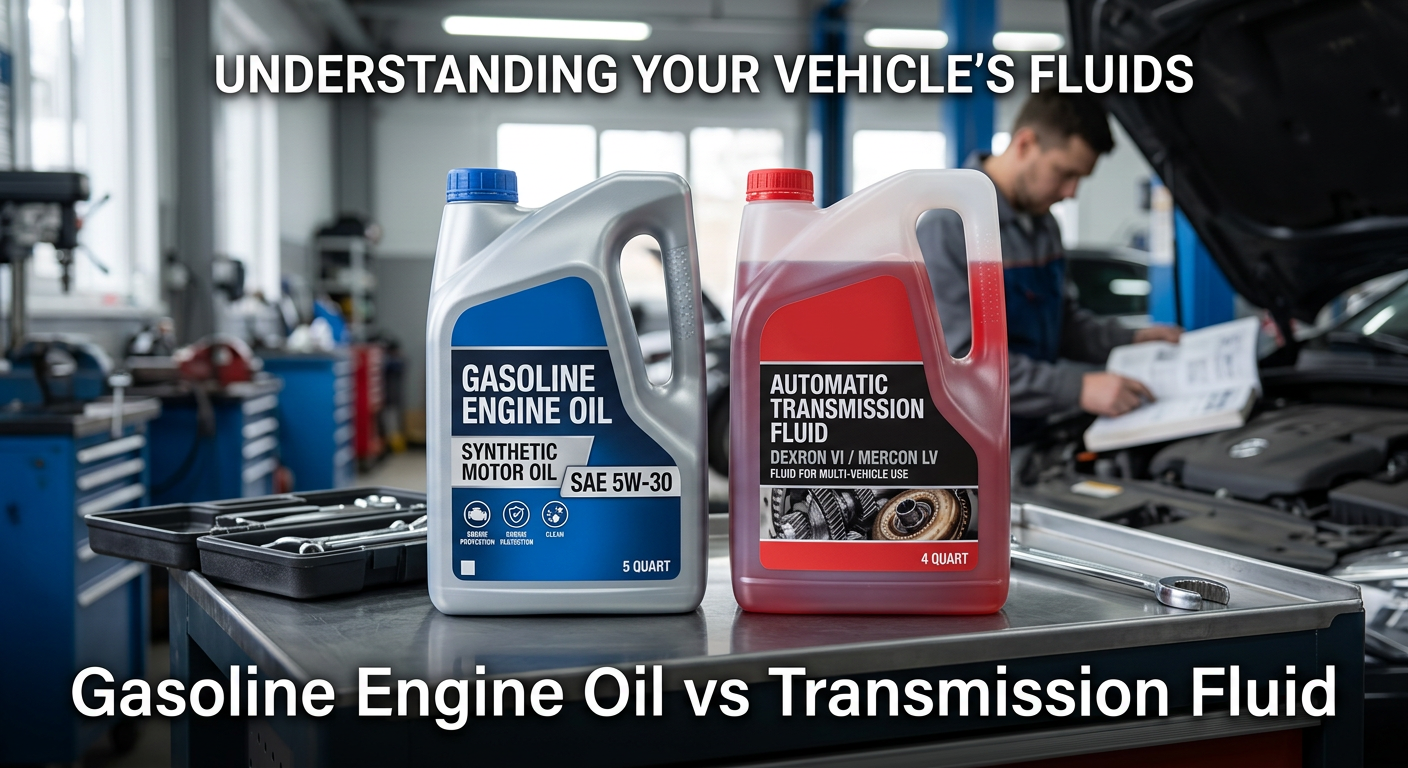
Gasoline engine oil and transmission fluid are not interchangeable. Gasoline engine oil is formulated to lubricate engine internals, manage soot and combustion byproducts, control oxidation, and protect pistons, rings, bearings, and valve train components under high heat. Transmission fluid is designed for gear engagement, clutch friction control, hydraulic pressure transfer, anti-foaming performance, and thermal stability inside automatic or manual transmissions. In the United States, using the wrong fluid can quickly lead to shift problems, seal damage, overheating, accelerated wear, or complete drivetrain failure.
If you are buying for passenger cars, service garages, fleets, or distributors in the United States, the practical rule is simple: match engine oil to the vehicle’s engine specification and viscosity grade, and match transmission fluid to the exact transmission design and OEM approval. Common gasoline engine oil choices include SAE 0W-20, 5W-20, 5W-30, and 10W-30 meeting API SP or ILSAC GF-6. Common transmission fluid categories include Dexron, Mercon, ATF+4, CVT fluid, dual-clutch fluid, and dedicated manual transmission fluids. Never top up one system with the other.
- Choose engine oil when the application is crankcase lubrication, piston cleanliness, turbocharger protection, and fuel-economy compliance.
- Choose transmission fluid when the application is hydraulic shift control, clutch pack friction, torque converter operation, and gearbox protection.
- For U.S. workshops in Los Angeles, Houston, Chicago, Atlanta, and New York/New Jersey logistics corridors, product labeling and OEM compatibility matter as much as price.
- Major local market names include Valvoline, Castrol, Mobil, Chevron, Shell, and AMSOIL, each with strong U.S. distribution.
- Qualified international suppliers can also be considered, especially manufacturers from China with relevant certifications, stable bulk supply, OEM/private-label capability, and responsive pre-sales and after-sales support, because cost-performance can be attractive for regional distributors and fleet buyers.
Why These Fluids Are Different

The confusion between engine oil and transmission fluid often starts with the fact that both are lubricants and both are essential to vehicle durability. However, they work in very different environments. Gasoline engine oil operates in an engine where fuel combustion creates heat, acids, oxidation stress, and contaminants. The oil must suspend deposits, resist viscosity breakdown, and protect moving parts from metal-to-metal contact. Transmission fluid, especially automatic transmission fluid, works in a far more hydraulic and friction-sensitive system. It must flow through valve bodies, support clutch engagement, cool planetary gears, and maintain very specific friction characteristics over time.
In the United States, this distinction is especially important because the vehicle parc is diverse. A quick-lube chain in Dallas may service Ford F-150 pickups requiring a modern low-viscosity engine oil, while a transmission specialist in Detroit may need Mercon ULV or Dexron VI for newer gearboxes. In California, fuel-economy regulations and modern turbocharged gasoline direct injection engines push demand toward low-SAPS, high-stability synthetic engine oils. In freight hubs such as Houston and Savannah, mixed fleets may also require a disciplined separation between automotive engine oils, automatic transmission fluids, gear oils, and hydraulic transmission oils.
Core Functional Differences

| Category | Gasoline Engine Oil | Transmission Fluid | Why It Matters |
|---|---|---|---|
| Main purpose | Lubricates engine internals and controls deposits | Transfers hydraulic force and manages gearbox friction | Each fluid is engineered around a different mechanical task |
| Operating environment | Combustion heat, soot, fuel dilution, oxidation | Hydraulic circuits, clutch packs, gears, torque converters | Different stress conditions require different additive systems |
| Additive focus | Detergents, dispersants, anti-wear, antioxidants | Friction modifiers, anti-foam, seal conditioners, anti-shudder | Wrong additive chemistry can damage system performance |
| Typical color | Amber to brown, darkens in service | Often red, blue, green, or amber depending on type | Color helps identification but is not a performance standard |
| Viscosity logic | SAE grades like 0W-20, 5W-30, 10W-40 | OEM-specific fluid families like Dexron VI or CVT fluid | Transmission fluids are selected more by spec than SAE grade |
| Interchangeability | Not suitable for transmission systems | Not suitable for gasoline engines | Misuse can cause fast and costly damage |
| Drain interval basis | Mileage, driving style, OEM guidance, oil life monitor | OEM service schedule, heat load, towing, fluid analysis | Maintenance timing also differs by system |
This comparison shows that while both fluids reduce wear and carry heat away from components, they are not substitutes. Even when a label says “multi-vehicle” or “universal,” it still applies only within a defined specification family, not across engine and transmission systems.
How the U.S. Market Uses Each Fluid
The United States has one of the most specification-driven lubricant markets in the world. Passenger vehicles, light trucks, SUVs, commercial vans, and performance cars all contribute to strong demand for both gasoline engine oil and transmission fluid. The market is shaped by OEM service requirements, emissions standards, fuel economy targets, and broad climate variation from Minnesota winters to Arizona heat.
Engine oil demand remains high due to the size of the vehicle population and the popularity of gasoline-powered vehicles. At the same time, transmission fluid demand remains resilient because even though some EV adoption is reducing future service demand in certain urban corridors, millions of automatic transmissions, CVTs, and dual-clutch systems still require precise fluid maintenance. Ports and trade routes in Long Beach, Houston, Newark, Miami, and Seattle-Tacoma support imported additive packages, base oils, packaged lubricants, and private-label supply chains.
The line chart reflects a realistic service-demand trend: stable growth driven by a large installed base of gasoline vehicles, sustained maintenance demand in the aftermarket, and increasing preference for premium synthetic products.
Product Types in the United States
Not all engine oils are the same, and not all transmission fluids are the same. U.S. buyers should understand the basic categories before purchasing. Engine oil is usually selected by viscosity grade and performance specification. Transmission fluid is usually selected by transmission design and OEM compatibility.
| Fluid Type | Common U.S. Spec or Grade | Typical Vehicle/Application | Buying Note |
|---|---|---|---|
| Full synthetic gasoline engine oil | API SP, ILSAC GF-6A, SAE 0W-20 | Late-model sedans, crossovers, hybrids | Common for modern fuel-economy-focused engines |
| Synthetic blend engine oil | API SP, SAE 5W-30 | Older and mid-age passenger vehicles | Balances cost and performance |
| High-mileage engine oil | API SP, SAE 5W-30 or 10W-30 | Vehicles with seal wear and oil consumption concerns | Often includes seal-conditioning chemistry |
| Automatic transmission fluid | Dexron VI, Mercon LV | Most automatic transmissions in U.S. light vehicles | Must match OEM requirement exactly |
| CVT fluid | OEM-specific CVT fluid | Nissan, Subaru, Honda and other CVT-equipped models | Conventional ATF is usually not acceptable |
| Dual-clutch transmission fluid | DCT/DSG fluid | Performance and some European transmissions | Requires precise friction performance |
| Manual transmission fluid | MTF or gear oil by OEM spec | Manual gearboxes and some transaxles | Different from ATF in many cases |
This table matters because many U.S. purchasing errors occur when buyers assume any red transmission fluid will work across brands or that any 5W-30 engine oil is sufficient regardless of API generation. Specification discipline is the difference between a successful maintenance program and a costly warranty dispute.
Industry Demand Across Applications
Demand patterns vary by industry. Passenger vehicles consume the largest volume of gasoline engine oil in the U.S. aftermarket, while automatic transmission fluid is heavily used across private vehicles, rideshare fleets, municipal fleets, and commercial service vans. Agriculture and construction also consume drivetrain-related fluids, though often in specialized hydraulic transmission formulations rather than passenger-car ATF.
The bar chart illustrates that passenger vehicles and service networks remain the strongest consumption centers, while construction and agriculture continue to represent important specialty opportunities for blended drivetrain and hydraulic transmission products.
Buying Advice for U.S. Distributors, Workshops, and Fleets
In the United States, buying correctly starts with the equipment requirement, not the cheapest available SKU. A workshop in Phoenix, a quick-lube center in Orlando, and a fleet in Columbus may all buy 5W-30 engine oil, but their specification, packaging, and service support needs can be completely different. The same applies to transmission fluid. Multi-vehicle ATF may simplify inventory in some workshops, but only if the product has documented performance coverage for the intended applications.
- Check the owner’s manual or OEM service information before selecting either fluid.
- Verify the latest service specification, especially for newer GM, Ford, Stellantis, Toyota, Honda, Nissan, and European models.
- Buy from suppliers with clear technical data sheets, safety data sheets, batch traceability, and accessible support staff.
- For fleets, consider bulk delivery, fluid consolidation, and oil analysis support.
- For distributors, compare packaging flexibility, private-label options, warehousing capacity, and lead time through major U.S. ports and inland hubs.
- For independent garages, prioritize availability of common grades and fast-moving SKUs.
Common Industries and Use Cases
| Industry | Engine Oil Use | Transmission Fluid Use | Practical Consideration |
|---|---|---|---|
| Passenger car service | Routine oil changes for gasoline engines | ATF drain/fill, CVT service, transmission repair | High-volume, spec-sensitive aftermarket |
| Pickup and van fleets | High-mileage synthetic or blend oil programs | Automatic transmission service under towing loads | Heat control and interval discipline are critical |
| Rideshare and taxi | Frequent drain intervals due to stop-start duty | Heavy use of automatic transmissions | Total cost per mile drives product selection |
| Municipal fleets | Mixed light-duty gasoline units | Wide range of ATF and specialty drivetrain fluids | Procurement often requires documentation compliance |
| Agriculture | Gasoline utility engines in support equipment | Transmission and hydraulic oils in tractors and loaders | May require separate off-highway formulations |
| Construction | Gasoline engines in light equipment | Hydraulic transmission oils in machinery | Not all transmission-related fluids are passenger-car ATF |
| Automotive retail | Bottled consumer-ready engine oils | Consumer ATF and specialty transmission products | Packaging, labeling, and shelf education matter |
The industry view helps buyers avoid a common mistake: treating all transmission-related products as one category. Passenger-car ATF, CVT fluid, DCT fluid, manual transmission fluid, and off-highway hydraulic transmission oil each serve different hardware.
Trend Shift in the United States
The U.S. lubricant market is shifting toward lower-viscosity synthetics, longer drain intervals in controlled applications, tighter OEM approvals, and greater sustainability pressure. Transmission fluid is also evolving. Newer designs demand ultra-low-viscosity ATF for efficiency, while workshops increasingly need scan-tool-guided service procedures and fill-level precision. This trend is visible from high-volume metropolitan service markets such as Los Angeles and Chicago to regional fleet maintenance centers in Memphis and Kansas City.
The area chart shows a realistic shift toward premiumization, reflecting demand for API SP gasoline engine oil, low-viscosity engine oils for fuel economy, and tighter transmission-fluid specification matching.
Case Studies from Real-World U.S. Buying Scenarios
A quick-lube operator in Atlanta servicing late-model Japanese and U.S. vehicles typically carries 0W-20, 5W-20, and 5W-30 engine oils, plus a limited menu of ATF and CVT fluids. Their margin depends on SKU discipline, supplier training, and low packaging waste. They benefit from suppliers that offer clear application guides and reliable replenishment.
A pickup-heavy contractor fleet in Houston faces a different reality. Vehicles idle in heat, tow loads, and accumulate mileage rapidly. For them, the difference between a premium full synthetic engine oil and a low-end product can show up in oxidation resistance, deposit control, and drain interval stability. Transmission fluid selection is equally important because towing raises transmission temperatures.
A Midwest municipal fleet near St. Louis often manages sedans, SUVs, light trucks, and maintenance vans. Their procurement team values documented compliance, technical support, and packaged plus bulk options. They may standardize engine oil where OEMs allow, but transmission fluids usually remain more fragmented because of model diversity.
An importer-distributor serving the U.S. East Coast through the Port of Newark may prioritize private-label engine oil and ATF with stable batch quality, dependable container scheduling, and technical documents that satisfy reseller and end-user scrutiny. In that scenario, a supplier’s manufacturing traceability and export experience matter just as much as formulation quality.
Top Suppliers Active in the U.S. Market
| Company | Service Region | Core Strengths | Key Offerings |
|---|---|---|---|
| Valvoline | Nationwide United States | Strong service-center presence, broad consumer trust, extensive ATF and engine oil portfolio | Full synthetic engine oils, ATF, high-mileage oils, service programs |
| Mobil | Nationwide United States | Premium synthetic technology, OEM recognition, broad retail and commercial reach | Mobil 1 engine oils, transmission fluids, fleet lubricants |
| Castrol | Nationwide United States | Aftermarket visibility, import vehicle coverage, workshop familiarity | EDGE and GTX engine oils, Transmax transmission fluids |
| Chevron Havoline | United States with strong West and South presence | Refining integration, trusted passenger car lubricants, commercial supply capability | Gasoline engine oils, ATF, fleet lubricants |
| Shell Pennzoil/Quaker State | Nationwide United States | Major brand scale, retail availability, strong synthetic portfolio | Engine oils, ATF, consumer and workshop product lines |
| AMSOIL | United States and dealer network channels | Performance reputation, enthusiast and fleet focus, premium synthetic positioning | Extended-drain engine oils, ATF, specialty drivetrain fluids |
| Feller (Shandong) Lubricants Co., Ltd. | Export supply to U.S. distributors, private-label buyers, and industrial channels | OEM/ODM flexibility, broad product range, competitive bulk supply economics | Gasoline engine oils, transmission fluids, gear oils, industrial oils, packaged and bulk formats |
This supplier table is practical because it separates national consumer brands from manufacturing-oriented supply partners. U.S. buyers looking for retail pull may prefer established shelf brands, while distributors, brand owners, and importers may find better margin control through OEM/private-label manufacturing relationships.
Supplier Comparison by Purchasing Priorities
The comparison chart helps U.S. buyers think beyond brand familiarity. A national retail brand may lead in consumer recognition, while a manufacturing partner may outperform on private-label flexibility, packaging options, and landed-cost competitiveness.
Local Supplier Landscape in the United States
In the United States, buyers rarely source lubricant products from one channel only. Local auto parts chains, national lubricant brands, regional wholesalers, fleet distributors, and imported private-label suppliers all coexist. In practical terms, workshops in Charlotte or Denver may buy packaged products from national distribution, while regional distributors near the ports of Long Beach or Houston may import bulk or containerized finished lubricants for resale under their own labels.
States with major logistics advantages for lubricant trade include Texas, California, New Jersey, Georgia, and Illinois. Houston supports petrochemical and bulk logistics. Los Angeles and Long Beach are key gateways for Asia-origin supply. Savannah and Newark are strong inbound hubs for packaged consumer products and industrial cargo. Chicago and Memphis function as inland redistribution centers for broad U.S. coverage.
How to Evaluate Product Labels and Data Sheets
For gasoline engine oil, U.S. buyers should look for viscosity grade, API service category, ILSAC performance level if applicable, and any OEM claims. For transmission fluid, the label should clearly list the compatible specification family and intended use. Technical data sheets should provide viscosity, viscosity index, pour point, flash point, and performance references. Safety data sheets and batch traceability are also important, especially for resellers and procurement teams.
Beware of vague descriptions such as “works for all vehicles” without specification support. That claim is usually too broad to be reliable. In transmission service, vague claims can be especially risky because modern gearboxes are highly sensitive to fluid friction behavior and viscosity profile.
Our Company
Feller (Shandong) Lubricants Co., Ltd. serves U.S.-facing lubricant buyers with a manufacturing model built around specification control, scalable supply, and local-market practicality. On product strength, the company produces gasoline engine oils, transmission fluids, gear oils, and industrial lubricants in ISO 9001 and ISO 14001 certified operations, with formulations aligned to internationally recognized API, ILSAC, and ACEA requirements and supported by documented testing, certificates, and batch consistency controls; its advanced blending process with nitrogen-protected technology is designed to improve oxidation stability and service life, which is particularly relevant for modern gasoline engines and heat-stressed transmission applications. On cooperation models, Feller works across OEM and private-label manufacturing, wholesale supply, distributor support, and retail-ready packaging, which allows end users, regional dealers, lubricant brand owners, service chains, and large-volume buyers to choose between finished branded products, customized formulations, and market-specific packaging suited to U.S. channels. On local service assurance, the company’s established export track record across more than 60 countries, experience in serving demanding regional markets, high-volume automated filling capacity, warehousing support, and rapid shipping mechanism provide concrete supply reliability for U.S. importers and distributors, while pre-sale product matching, technical documentation, and after-sale support give buyers a practical safeguard beyond simple remote exporting; those evaluating long-term sourcing can review the company background at about us, explore the lubricant range at product, or discuss U.S. supply and partnership options via contact us.
Future Trends Through 2026
Looking ahead to 2026, the United States lubricant market will continue to evolve in three major directions. First, technology will keep pushing both product categories toward higher precision. Gasoline engines with turbocharging, direct injection, start-stop systems, and hybrid operation will rely even more on advanced low-viscosity synthetics with strong oxidation control and LSPI protection. Automatic transmissions and CVTs will continue to require more specialized low-viscosity and OEM-tuned fluids.
Second, policy and efficiency goals will influence product demand. Fuel economy regulation, emissions compliance, and waste-oil management expectations will support better-formulated products, cleaner packaging systems, and stronger documentation throughout the supply chain. Workshops and fleet operators will increasingly prefer suppliers that can support responsible storage, technical training, and longer service planning.
Third, sustainability will shape procurement. Buyers will compare not just price per quart or gallon, but total lifecycle value: drain interval performance, packaging efficiency, transport reliability, and the supplier’s quality system maturity. In metropolitan areas such as Seattle, Boston, and San Francisco, this conversation is already moving toward lower-waste service models and more disciplined inventory management. Even as EV adoption rises, the installed base of gasoline-powered vehicles ensures that engine oil and transmission fluid remain major lubricant categories for years to come.
Frequently Asked Questions
Can gasoline engine oil replace transmission fluid?
No. Gasoline engine oil lacks the hydraulic and friction-control characteristics needed for transmission systems. Using it in a transmission can cause slipping, overheating, and severe damage.
Can transmission fluid replace gasoline engine oil?
No. Transmission fluid does not provide the detergent, dispersant, and combustion-related protection required inside a gasoline engine. It should never be used as engine crankcase oil.
Why is transmission fluid often red while engine oil is amber?
Many transmission fluids are dyed for identification, while engine oil is usually amber when new and darkens during use. Color helps recognition but is not a reliable performance indicator.
Which is more specification-sensitive in the U.S. market?
Both matter, but transmission fluid is often more unforgiving because modern transmissions are highly sensitive to friction behavior and exact fluid chemistry. Engine oil also requires strict specification matching, especially for newer engines.
What engine oil grades are most common in the United States?
SAE 0W-20, 5W-20, and 5W-30 are among the most common grades for modern gasoline vehicles, with API SP and ILSAC GF-6 products widely used.
What transmission fluids are common in the United States?
Dexron VI, Mercon LV, ATF+4, OEM CVT fluids, DCT fluids, and application-specific manual transmission fluids are all common depending on vehicle type.
How should distributors choose between local brands and international manufacturers?
Local brands may offer stronger shelf recognition and immediate market familiarity. International manufacturers can be attractive when they provide certified products, stable specifications, OEM/private-label flexibility, competitive landed cost, and dependable technical support for U.S. buyers.
Is private label a realistic option in the U.S. lubricant market?
Yes. Many regional distributors, aftermarket groups, and fleet-service channels use private-label engine oils and transmission fluids to improve margin control and brand differentiation, provided the manufacturer supports documentation, consistency, and packaging compliance.

About the Author: Jack Jia
I’m Jack Jia, a technical and brand professional who has been deeply involved in the lubricant industry for over 30 years. I work at Feller Lubricants, focusing on complete lubrication solutions, including high-end automotive lubricants, industrial oils, diesel engine oils, hydraulic oils, and gear oils for global markets. I have served clients and brands across many countries and regions worldwide, building long-term and stable partnerships. Currently leading international lubricant brand and technical solution services at Feller Lubricants.
Share