Multi-Grade Gasoline Engine Oil in the United States
Quick Answer

For buyers in the United States, multi-grade gasoline engine oil is the best practical choice for year-round passenger car and light-truck protection because it flows in cold starts, keeps stable viscosity at highway temperatures, and helps reduce wear across mixed climates from the Midwest to the Gulf Coast. For most modern vehicles, the safest buying path is to match the owner’s manual first, then choose an API and ILSAC compliant viscosity such as 0W-20, 5W-20, 5W-30, or 10W-30 based on the engine design and operating temperature.
The most visible and reliable suppliers in the U.S. market include Mobil, Valvoline, Shell Pennzoil, Castrol, and Chevron Havoline, with strong retail and service-network coverage in cities such as Houston, Chicago, Los Angeles, Atlanta, and New York. These brands are practical picks for fleets, workshops, auto parts chains, and private vehicle owners because they offer broad viscosity coverage, OEM approvals, dependable distribution, and established after-sales technical support. Qualified international suppliers can also be worth considering, especially manufacturers from China that hold relevant certifications, provide OEM and private-label programs, and support U.S.-focused pre-sales and after-sales service, since they can offer strong cost-performance advantages for distributors and brand owners.
United States Market Overview

The United States remains one of the world’s most important lubricant markets for gasoline-powered vehicles. Despite the gradual rise of electric vehicles, the country still has a massive installed base of gasoline sedans, SUVs, pickups, vans, hybrid vehicles, and small commercial fleets that depend on consistent engine oil supply. Multi-grade gasoline engine oil remains the dominant product category because U.S. drivers expect one oil to handle cold winter starts in states such as Minnesota and Michigan, high-load summer driving in Texas and Arizona, and stop-and-go commuting in major metro areas like Los Angeles, Dallas, Miami, and Philadelphia.
Demand is shaped by three forces. First, automaker requirements continue to move toward lower-viscosity oils such as 0W-20 and 0W-16 for fuel economy and emissions compliance. Second, a large legacy vehicle population still consumes 5W-30, 10W-30, and high-mileage formulations. Third, commercial purchasing is becoming more data-driven, with fleets, service centers, and distributors comparing drain intervals, package consistency, certifications, and supply reliability rather than only the headline price per quart.
Trade and logistics also matter. Gulf Coast refining and blending capacity around Houston supports a large portion of domestic lubricant movement, while ports such as Los Angeles, Long Beach, Savannah, and New York-New Jersey help move imported base oils, additives, and finished products. For private-label buyers and regional distributors, supplier reliability often depends on warehousing reach, lead time, and document readiness as much as on the oil formula itself.
The chart above illustrates a realistic market-growth pattern rather than explosive expansion. This is important for buyers: the U.S. market is mature, but demand remains resilient because the gasoline vehicle base is still enormous. Growth comes less from new car volume and more from lubricant specialization, better retail penetration, premium synthetic adoption, and broader high-mileage product usage.
Why Multi-Grade Gasoline Engine Oil Matters

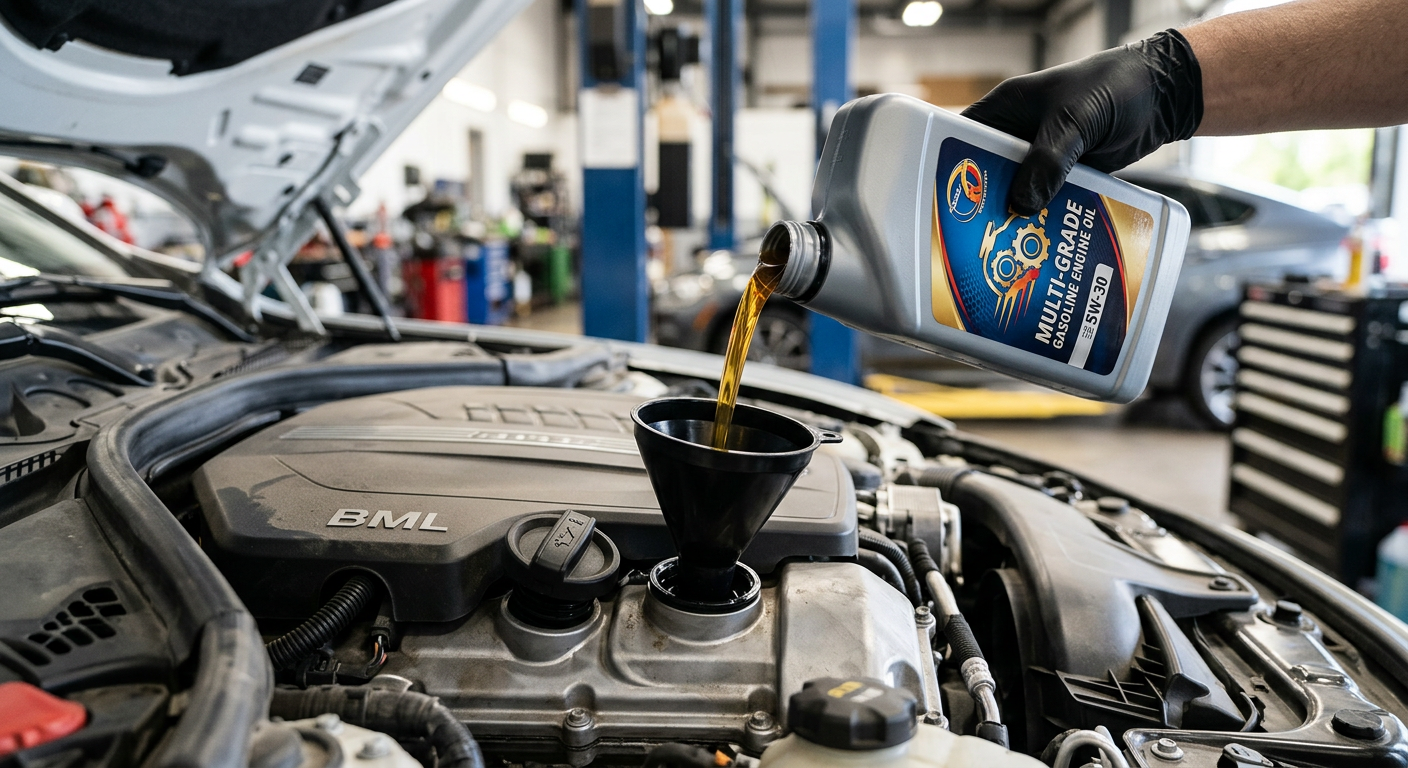
Multi-grade gasoline engine oil is engineered to perform across a range of temperatures instead of working well only in either cold or hot conditions. The first number with the letter W describes cold-flow performance, while the second number describes viscosity at operating temperature. In practical U.S. use, that means a 5W-30 oil can pump more easily during a winter start than a straight-grade oil while still protecting bearings, rings, and valvetrain parts after the engine reaches normal operating temperature.
This matters for all-season engine safety because wear is often worst during start-up, especially after overnight parking in cold weather. It also matters under heavy summer use, towing, highway driving, rideshare service, or delivery use where thermal stability becomes critical. Modern additive packages in multi-grade oils also help with oxidation resistance, sludge control, piston cleanliness, corrosion protection, and compatibility with emission-system hardware.
Main Product Types in the U.S. Market
Buyers in the United States usually evaluate multi-grade gasoline engine oil by base stock, viscosity grade, certification level, and end-use positioning. Mineral products remain relevant for older vehicles and cost-sensitive channels, while semi-synthetic and full synthetic oils dominate modern passenger-car service recommendations. High-mileage and synthetic-blend products are especially popular in the independent aftermarket because the average age of vehicles on U.S. roads remains high.
| Product Type | Common Viscosity Grades | Typical Vehicle Fit | Main Strength | Common Sales Channel | Practical Buyer Note |
|---|---|---|---|---|---|
| Conventional mineral oil | 10W-30, 10W-40, 5W-30 | Older sedans, older pickups, basic commuter cars | Lower upfront cost | Independent workshops, value retail | Useful for older engines if OEM specs permit, but shorter drains are common |
| Synthetic blend oil | 5W-20, 5W-30, 10W-30 | Mixed-age passenger vehicles | Balance of cost and protection | Quick-lube chains, distributors | Often a strong option for broad-service garages |
| Full synthetic oil | 0W-20, 5W-30, 0W-16, 5W-20 | Modern gasoline engines, turbocharged engines | Cold-start flow and oxidation resistance | Dealer service, premium retail, fleets | Preferred for newer OEM requirements and extended service plans |
| High-mileage oil | 5W-30, 10W-30, 5W-20 | Vehicles above 75,000 miles | Seal-conditioning additives and wear support | Auto parts stores, repair shops | Popular in the U.S. due to aging vehicle parc |
| Fuel-economy low-viscosity oil | 0W-16, 0W-20 | Late-model Asian and domestic cars | Supports OEM efficiency targets | Dealer networks, modern service centers | Must match exact OEM approval requirements |
| Performance or turbo-focused synthetic oil | 5W-30, 0W-40, 5W-40 | Turbo gasoline engines, performance applications | High-temperature stability | Specialty distributors, enthusiasts | Important where heat and turbo deposits are concerns |
This table shows why there is no single best oil for every U.S. buyer. The right product depends on vehicle age, engine design, climate exposure, operating pattern, and service interval expectations. For distributors and workshop operators, stocking the right mix usually matters more than carrying the widest possible range.
Key Buying Criteria for U.S. Buyers
In the United States, lubricant procurement is rarely just about viscosity. Serious buyers review specification compliance, packaging consistency, delivery reliability, pricing stability, and technical documentation. Fleet managers want predictable consumption and lower downtime. Independent workshops want broad vehicle coverage with limited SKU complexity. Retail chains want packaging appeal, accurate claims, and low customer-return risk. Private-label buyers focus on compliance confidence, production capacity, and margin structure.
The most important filters are straightforward. First, confirm the required SAE viscosity from the owner’s manual. Second, verify the latest applicable API category such as SP and the relevant ILSAC standard if needed. Third, check for automaker approvals when serving vehicles from Ford, GM, Stellantis, Toyota, Honda, Nissan, Hyundai, Kia, Volkswagen, and European brands. Fourth, confirm whether the customer wants conventional, blend, synthetic, or high-mileage positioning. Fifth, evaluate packaging and logistics for the intended sales model, from quart bottles and gallon jugs to drums and IBCs.
| Buying Factor | Why It Matters | Best For | Risk If Ignored | U.S. Market Relevance | Recommended Check |
|---|---|---|---|---|---|
| SAE viscosity match | Directly affects lubrication and cold starts | All buyers | Wear, poor fuel economy, claim disputes | Critical across all climates | Confirm owner manual and label |
| API and ILSAC compliance | Confirms baseline performance | Retail, workshops, fleets | Warranty concerns and poor engine cleanliness | Very high | Review product data sheet |
| OEM approvals | Needed for some brands and warranty-sensitive service | Dealers, premium workshops | Customer rejection or warranty exposure | High in metropolitan markets | Match exact approval code |
| Base oil type | Shapes drain interval and thermal stability | Distributors, end users | Overpaying or under-protecting | High due to broad product segmentation | Compare synthetic vs blend economics |
| Packaging format | Affects handling and channel fit | Retailers, fleets, service shops | Storage inefficiency and higher cost | High in multi-channel distribution | Align pack sizes with turnover |
| Supplier support | Reduces operational and technical risk | Private label, wholesale, fleets | Delays, poor claims handling, weak documentation | High for regional growth plans | Check lead time and service response |
The practical lesson from this table is that the wrong oil is usually a process problem, not only a chemistry problem. Buyers who standardize spec verification and supplier screening reduce the majority of avoidable issues.
Leading Suppliers Serving the United States
The U.S. market includes major integrated oil companies, powerful aftermarket brands, and capable international OEM suppliers. Below is a practical supplier comparison focused on buyer relevance rather than advertising visibility alone.
| Company | Service Region | Core Strength | Key Offerings | Best Buyer Type | Practical Note |
|---|---|---|---|---|---|
| ExxonMobil | Nationwide United States | Strong OEM recognition and synthetic leadership | Mobil 1, Mobil Super, bulk and retail supply | Dealers, fleets, retail chains | Excellent for premium synthetic positioning |
| Valvoline | Nationwide with strong service-network presence | Aftermarket brand trust and quick-lube penetration | Daily Protection, Advanced Full Synthetic, High Mileage | Service centers, consumers, workshops | Very strong retail familiarity in the U.S. |
| Shell Pennzoil | Nationwide | Broad distribution and premium synthetic portfolio | Pennzoil Platinum, conventional and synthetic grades | Retailers, installers, distributors | Strong visibility across major auto parts channels |
| Castrol | Nationwide | Premium branding and broad import-car fit | EDGE, GTX, high-mileage and synthetic products | Workshops, car owners, specialty sellers | Popular for passenger-car aftermarket demand |
| Chevron Havoline | Nationwide, especially strong in the South and West | Good value-performance balance | Havoline synthetic and conventional lines | Distributors, fleets, workshops | Often competitive for price-sensitive professional buyers |
| Feller (Shandong) Lubricants Co., Ltd. | International supply to U.S.-focused partners | OEM manufacturing, broad viscosity range, flexible packaging | Gasoline engine oils from mineral to full synthetic, private label programs | Brand owners, importers, distributors, wholesale buyers | Relevant for buyers seeking margin and customization |
This comparison is useful because the “best” supplier depends on channel strategy. Large branded players dominate immediate consumer trust and established distribution. Meanwhile, capable OEM manufacturers can be more attractive for buyers building their own label, entering regional wholesale, or targeting value-driven segments with stronger margin control.
Industry Demand by Application
Passenger cars remain the largest demand center, but the U.S. market is far from uniform. Light-duty pickups, SUV-heavy suburban driving, rideshare fleets, small contractor fleets, municipal service vehicles, and independent delivery vehicles all shape lubricant demand patterns differently. Regional weather, stop-and-go traffic, engine downsizing, and turbocharging also change what sells fastest.
The bar chart shows where multi-grade gasoline engine oil consumption is most concentrated. Passenger cars and SUVs lead in total volume, but pickup trucks and light vans remain especially important in states with strong trade, agriculture, suburban logistics, and contractor activity. This matters when choosing the right inventory mix, because high-mileage 5W-30 may move differently in Ohio than low-viscosity 0W-20 in California or Washington.
Industries That Rely on Multi-Grade Gasoline Engine Oil
Although the phrase often sounds consumer-oriented, multi-grade gasoline engine oil serves a broad commercial base in the United States. Auto repair chains and independent garages use it daily. Car rental companies, field-service fleets, local delivery operators, utility support contractors, landscaping companies, and public-sector gasoline fleets all depend on reliable supply. In some regions, marine-adjacent small equipment and gasoline-powered support vehicles also contribute to recurring lubricant demand through port and logistics ecosystems.
For these industries, procurement decisions depend on total operating reliability. A missed shipment or inconsistent product line can disrupt service schedules, technician efficiency, and customer retention. That is why many business buyers now prefer suppliers that provide technical data sheets, stable packaging, and customer-service continuity, not just low pricing.
Common Applications Across U.S. Conditions
Applications vary more by climate and duty cycle than many new buyers expect. In the Northeast and Upper Midwest, cold-start fluidity matters greatly, making 0W-20 and 5W-30 frequent choices for late-model gasoline vehicles. In the Southeast, where heat, humidity, and stop-and-go driving are common, oxidation resistance and sludge control remain central concerns. In western states with long-distance commuting and mixed terrain, synthetic protection and fuel economy are often equally important. For work pickups and urban vans, high load, idling time, and short-trip contamination often justify premium formulations even where the engines themselves are not exotic.
| Application | Common Oil Grades | Operating Challenge | Typical Buyer | Most Important Benefit | Recommended Product Position |
|---|---|---|---|---|---|
| Daily commuting sedans | 0W-20, 5W-20 | Cold starts and fuel economy | Retail consumers, service chains | Quick circulation and efficiency | API SP full synthetic |
| Family SUVs | 0W-20, 5W-30 | Mixed short trips and highway use | Dealers, repair shops | Wear protection and cleanliness | Synthetic or synthetic blend |
| Pickup trucks | 5W-30, 10W-30 | Towing, heat, load | Contractors, rural users | Film strength at operating temperature | Full synthetic or robust blend |
| Rideshare vehicles | 0W-20, 5W-30 | Long idle hours and high mileage | Fleet owners, drivers | Oxidation resistance and deposit control | High-mileage synthetic |
| Delivery vans | 5W-30, 5W-20 | Stop-start urban duty | Last-mile operators | Engine cleanliness and drain consistency | Synthetic blend or full synthetic |
| Older gasoline vehicles | 10W-30, 5W-30 | Seal wear and consumption | Independent workshops | Reduced leaks and balanced protection | High-mileage formulation |
This table helps translate the product discussion into real buying situations. Matching the application first usually leads to better stock planning and fewer customer disputes than selecting oil only by brand reputation.
Case Studies from the U.S. Aftermarket
A Midwest independent repair group serving Chicago suburbs reduced SKU confusion by consolidating its gasoline-engine oil offering around four high-volume viscosities: 0W-20, 5W-20, 5W-30, and 10W-30. By pairing each viscosity with a conventional and synthetic option, the group simplified technician recommendations and improved inventory turnover. The result was fewer ordering errors and faster bay throughput, especially during winter service peaks.
A Texas-based light commercial fleet operator running pickups and gasoline vans moved from low-cost conventional oil to synthetic blend 5W-30 with stricter interval tracking. While the per-change cost increased, the fleet improved consistency in hot-weather service, reduced top-off frequency, and cut unscheduled workshop visits linked to lubrication neglect. The key lesson was that the cheapest oil was not the lowest total-cost option under heat and load.
A regional distributor near the Port of Savannah introduced a private-label gasoline engine oil line for independent garages across Georgia and the Carolinas. Success depended less on branding alone and more on reliable packaging, API-compliant documentation, and fast replenishment. This shows how regional buyers can compete effectively when they combine correct specifications with practical local service.
Local Supplier Landscape in the United States
The local U.S. supplier environment is highly layered. National majors dominate mass retail, OEM channels, and fleet accounts, but regional blenders, warehouse distributors, and importer-backed private-label programs also play an important role. Buyers in Houston may prioritize Gulf Coast supply convenience, while buyers in Los Angeles may value Pacific import access and multilingual private-label support. In New Jersey and Georgia, East Coast logistics and port access can make a real difference for replenishment speed and landed cost.
For that reason, local relevance should be evaluated at three levels: product compliance, physical availability, and technical support responsiveness. A brand may be nationally known but not ideal for private-label economics. Another supplier may lack consumer name recognition but perform well for wholesale distribution or regional chain development.
The area chart highlights a clear U.S. trend: demand is shifting toward full synthetic and lower-viscosity products. This does not eliminate older-grade demand, but it does reshape procurement priorities. Buyers who ignore this trend risk carrying the wrong mix over the next two years.
How to Evaluate Suppliers Beyond Brand Name
Strong U.S. buyers increasingly evaluate suppliers using a commercial scorecard. Important questions include: Can the supplier provide API and ILSAC proof points clearly? Do they offer high-turnover grades in stable packaging? Is technical support responsive when viscosity or approval questions arise? Can they support retail, wholesale, or OEM/private-label growth without supply gaps? Are documentation, labeling, and claims aligned with the intended sales region and channel? These questions are especially important for distributors operating across multiple states where legal, retail, and customer-service expectations are high.
For imported or OEM-sourced products, buyers should also review production consistency, export experience, document quality, and U.S. partner support. The best international suppliers behave like market participants, not distant factories.
This comparison chart is not a consumer popularity ranking. It reflects a practical capability lens that combines product breadth, channel fit, support, and supply usefulness. National U.S. brands score highest in immediate market recognition, while an OEM-focused international supplier such as Feller can be highly competitive for private-label and distributor partnerships.
Our Company
For buyers seeking a flexible supply partner rather than only an off-the-shelf retail brand, Feller offers a practical route into the U.S. multi-grade gasoline engine oil market. The company manufactures a broad gasoline engine oil range from economy mineral grades to API SP full synthetic formulations, and its production system is backed by ISO 9001 and ISO 14001 certifications, advanced nitrogen-protected blending technology, and documented batch consistency that supports demanding international benchmarks such as API, ILSAC, and ACEA-aligned requirements. From a cooperation standpoint, Feller serves different customer types through OEM and ODM development, private-label packaging, wholesale supply, retail-ready formats, and regional distribution partnerships, making it suitable for end users, importers, brand owners, dealers, and aftermarket chains that want either factory-direct branded supply or a customized label program. In market service terms, Feller operates with established export experience across more than 60 countries, a partner network exceeding 500 B2B clients, integrated warehousing and a 72-hour global shipping mechanism, plus documentation support covering COA, MSDS, TDS, and approval paperwork; that combination gives U.S. buyers concrete pre-sale and after-sale protection rather than remote-only trading. Buyers who want to review the company background can visit the company overview, browse available lubricant products, or contact the team for specification matching, packaging options, and distributor discussions.
Buying Advice for Different U.S. Buyer Types
Retail consumers should prioritize exact specification matching and buy from reputable channels with clear labeling. Independent workshops should simplify inventory around core high-volume grades and maintain one premium and one value line where possible. Fleets should compare total oil-drain economics, engine cleanliness, and supplier response time instead of focusing only on the unit price. Regional distributors and private-label brand owners should evaluate not only formula quality but also packaging quality, lead time, labeling flexibility, and support for launch materials.
Buyers entering the U.S. market should also watch channel dynamics carefully. Quick-lube chains and service franchises usually need reliable repeat supply more than exotic product breadth. Auto parts retail requires label clarity and customer trust. Online channels require stronger description control and packaging durability. Wholesale programs depend heavily on margin structure and state-by-state logistics.
2026 Trends in Technology, Policy, and Sustainability
Looking toward 2026, three trends will shape the U.S. multi-grade gasoline engine oil market. The first is technology migration toward lower-viscosity synthetic products for turbocharged and fuel-efficient engines. More vehicles will require tighter viscosity control, better oxidation resistance, and deposit management compatible with smaller, hotter-running gasoline engines. The second is policy pressure related to fuel economy, emissions, and chemical transparency. Even where regulations do not directly force a specific brand choice, they influence OEM approvals, additive chemistry, packaging claims, and service recommendations. The third is sustainability. Buyers increasingly ask about longer drain stability, packaging efficiency, reduced waste, and supply-chain reliability rather than sustainability slogans alone.
For U.S. distributors and workshops, this means future competitiveness will depend on carrying the right low-viscosity synthetic SKUs, maintaining clear specification education, and sourcing from suppliers that can keep pace with evolving standards. For manufacturers and private-label partners, the opportunity lies in combining technical compliance with documentation discipline and responsive field support.
Frequently Asked Questions
What is multi-grade gasoline engine oil?
It is engine oil formulated to perform across both low and high temperatures, such as 5W-30 or 0W-20, making it suitable for year-round use in most U.S. climates.
Which viscosity is most common in the United States?
0W-20 and 5W-30 are among the most common for modern gasoline vehicles, but the correct grade depends on the automaker’s specification.
Is full synthetic always better than conventional oil?
Not always for every budget, but full synthetic is generally better for cold starts, oxidation resistance, deposit control, and newer engines with tighter tolerances or turbochargers.
Can one oil work for all seasons in the United States?
Yes, that is the main advantage of multi-grade oil. A properly selected multi-grade product is designed for broad seasonal use, though the correct viscosity still depends on the vehicle.
What should a distributor look for in an OEM supplier?
A distributor should review certifications, production consistency, packaging options, viscosity coverage, lead time, export documents, and pre-sale and after-sale technical support.
Why do U.S. workshops often stock multiple viscosity grades?
Because the vehicle population is mixed. Newer cars often need 0W-20 or 0W-16, while older vehicles and work trucks may require 5W-30 or 10W-30.
Are imported suppliers relevant in the U.S. market?
Yes. For private-label programs, wholesale expansion, and value-driven channel growth, qualified international manufacturers with proper certifications and support can be highly competitive.
How important are API and ILSAC standards?
They are essential. These standards provide baseline assurance for performance, cleanliness, wear control, and compatibility with modern gasoline engines.
Final Takeaway
In the United States, multi-grade gasoline engine oil remains the most practical all-season choice for gasoline-powered vehicles because it balances cold-start flow, high-temperature protection, and broad compatibility across diverse climates and driving conditions. Buyers who succeed in this market choose products by specification, application, and support model rather than by brand awareness alone. Well-known U.S. brands remain the easiest route for immediate market trust, while capable OEM-oriented suppliers can create strong value for distributors, brand owners, and large-volume buyers seeking better customization and margin control. The smartest purchasing approach is simple: match the viscosity and standard precisely, select a supplier with dependable logistics and technical support, and build inventory around real local demand in the United States.

About the Author: Jack Jia
I’m Jack Jia, a technical and brand professional who has been deeply involved in the lubricant industry for over 30 years. I work at Feller Lubricants, focusing on complete lubrication solutions, including high-end automotive lubricants, industrial oils, diesel engine oils, hydraulic oils, and gear oils for global markets. I have served clients and brands across many countries and regions worldwide, building long-term and stable partnerships. Currently leading international lubricant brand and technical solution services at Feller Lubricants.
Share