
Gasoline Engine Oil Change Steps in the United States
Quick Answer

The correct gasoline engine oil change steps in the United States are straightforward: warm the engine slightly, park on level ground, secure the vehicle, drain the old oil, replace the oil filter, install the drain plug with the correct torque, refill with the manufacturer-specified oil grade, start the engine briefly, check for leaks, shut it off, and verify the dipstick level after a short wait. For most U.S. passenger cars, the safest approach is to follow the owner’s manual for oil viscosity, API service category, oil capacity, and drain interval rather than relying on a generic schedule.
If you are buying oil or planning service support in the U.S., widely recognized companies include Valvoline, Pennzoil, Mobil 1, Castrol, Quaker State, and Royal Purple through national retail and service channels. Qualified international suppliers can also be worth considering, especially for distributors, workshops, private-label buyers, and fleets looking for strong cost-performance value, provided they offer verified certifications, stable supply, responsive technical support, and market-relevant documentation for U.S. customers.
- Use the oil grade listed on the oil cap and in the owner’s manual, such as 0W-20, 5W-20, or 5W-30.
- Always replace the oil filter during the oil service unless the vehicle maker states otherwise.
- Check the drain plug washer or gasket and replace it if needed to prevent seepage.
- Do not overfill; add oil gradually and confirm the final level on the dipstick.
- Reset the oil life monitor after the service if your vehicle is equipped with one.
Why Oil Change Procedure Matters in the United States

In the United States, gasoline vehicles operate across a wide range of climates and driving conditions, from stop-and-go commuting in Los Angeles and Houston to winter cold starts in Chicago, Minneapolis, and Buffalo. These conditions directly affect lubricant performance, oxidation control, sludge resistance, fuel economy, and cold-flow behavior. A proper oil change is not just a routine maintenance task; it is a critical process for preserving engine cleanliness, valve timing system response, turbocharger durability, and long-term fuel efficiency.
U.S. drivers also face a broad mix of operating patterns: suburban short trips, interstate highway cruising, rideshare use, food delivery routes, light commercial service, and high-mileage family transport. Short-trip driving around New York City, Atlanta, or Seattle is especially hard on engine oil because the engine may not reach stable operating temperature long enough to evaporate moisture and fuel dilution. In contrast, long-haul highway driving around major freight corridors can be easier on oil but still requires the right viscosity and filter quality. That is why using the right oil and following correct gasoline engine oil change steps matters in every region.
The U.S. market is also shaped by emissions standards, turbocharged downsized engines, gasoline direct injection, and low-viscosity oils designed for fuel economy. Modern engines often require API SP, ILSAC GF-6, dexos, or other OEM-specific performance levels. Improper servicing can lead to pre-ignition risks, chain wear concerns, poor cold protection, and warranty complications. Whether you are a vehicle owner, workshop manager, distributor, or lubricant buyer, understanding the process and the product selection criteria is essential.
Step-by-Step Gasoline Engine Oil Change Process

The following process reflects standard best practice for U.S. passenger vehicles. Always confirm the exact procedure in the vehicle’s service manual because some engines use cartridge filters, underbody shields, or specific torque requirements.
Prepare the Vehicle and Materials
Gather the engine oil, new oil filter, drain pan, gloves, shop towels, funnel, socket or wrench for the drain plug, jack and stands or ramps if needed, and a torque wrench if available. Confirm the oil specification before opening the bottle. Many late-model U.S. vehicles require 0W-20 full synthetic, while older or higher-mileage engines may use 5W-30 or 10W-30 depending on manufacturer guidance.
Park on a level surface, engage the parking brake, and let the engine warm for a few minutes. The oil should be warm enough to flow out easily, but the engine should not be dangerously hot. If the vehicle must be raised, use approved lift points and support it securely.
Drain the Old Oil
Place the drain pan under the oil pan drain plug. Remove the oil fill cap on top of the engine to help vent the system. Loosen the drain plug carefully and allow the old oil to drain completely. Inspect the old oil for unusual metal particles, coolant contamination, or a fuel smell, especially in high-mileage vehicles or engines known for fuel dilution.
Inspect the drain plug and sealing washer. Many modern vehicles rely on a crush washer that should be replaced each service. Reinstall the plug and tighten to the manufacturer’s torque specification. Overtightening can damage the oil pan threads, especially on aluminum pans.
Replace the Oil Filter
Move the drain pan under the oil filter and remove the old filter. Some oil will spill, so be prepared. Before installing the new filter, compare it with the old one to confirm the correct part. If using a spin-on filter, lightly coat the gasket with fresh oil. If the filter mounts vertically and the design allows it, partial pre-filling may reduce dry start time. Install the new filter by hand until the gasket contacts the base, then tighten according to the filter instructions.
Refill with New Oil
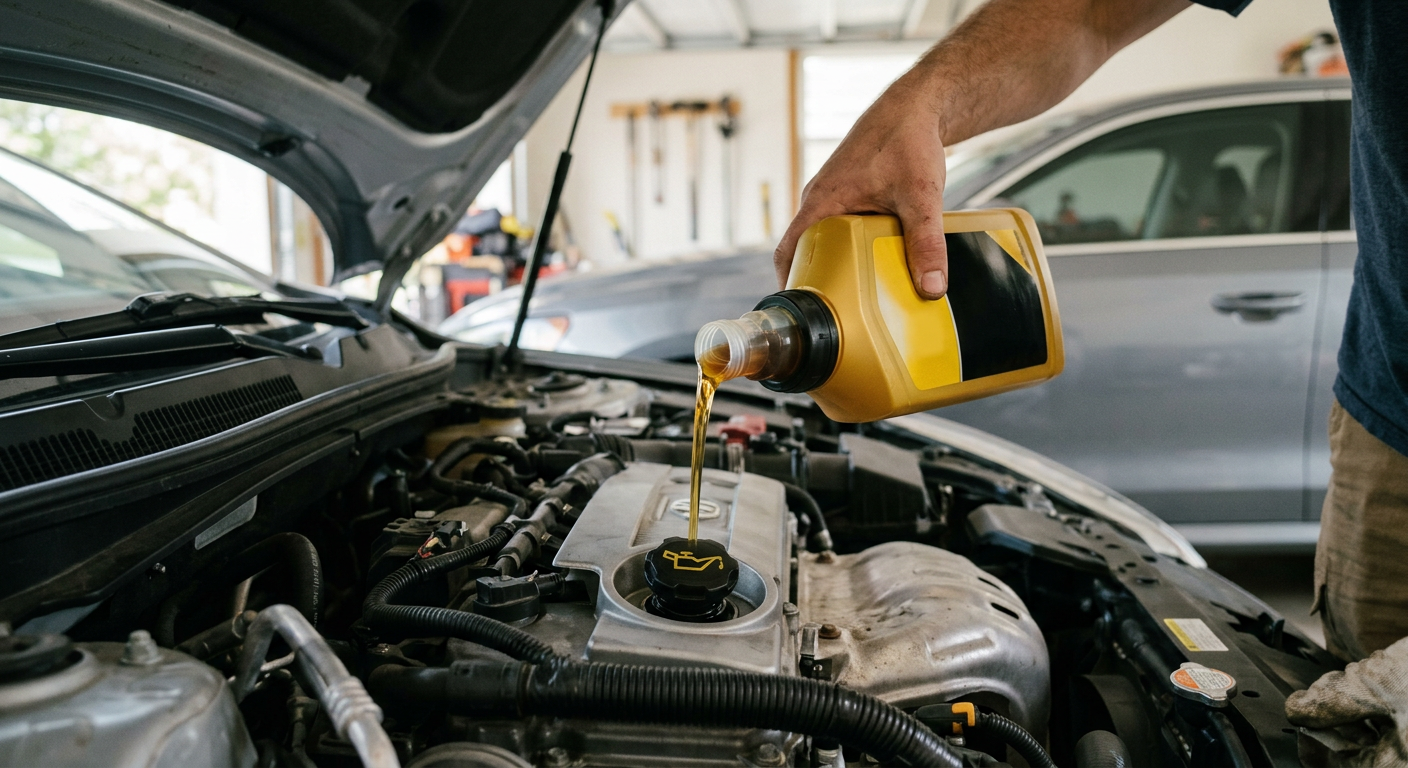
Insert a funnel and add about 80% to 90% of the specified capacity. Wait a moment, then check the dipstick. Add gradually until the level approaches full but does not exceed it. Reinstall the fill cap securely.
Start, Inspect, and Recheck
Start the engine and let it idle for 30 to 60 seconds. Confirm that the oil pressure warning light goes out promptly. Inspect around the drain plug and filter for leaks. Turn the engine off, wait several minutes for the oil to settle, and check the dipstick again. Top off if needed.
Reset the Service Indicator and Dispose of Used Oil Properly
Reset the oil life monitor or maintenance reminder through the dashboard menu or control sequence specified by the vehicle maker. Transfer the used oil into a sealed container and take it, along with the used filter, to a recycling center, auto parts store, or service facility that accepts used motor oil. In the United States, responsible disposal is both an environmental obligation and a practical way to avoid contamination penalties.
Typical Oil Grades and Service Considerations in the U.S. Market
American drivers often encounter 0W-16, 0W-20, 5W-20, 5W-30, and 10W-30 in gasoline applications. The rise of turbocharged engines and fuel economy targets has increased demand for thinner synthetic oils with strong oxidation control and low-speed pre-ignition protection. Cold northern states typically benefit from better low-temperature pumpability, while hotter southern regions and heavy city use demand strong high-temperature deposit control.
Vehicle age also matters. A newer Honda, Toyota, Ford, Hyundai, Kia, Nissan, Chevrolet, or Subaru may call for low-viscosity synthetics that meet specific API and ILSAC performance standards. High-mileage vehicles may benefit from formulations designed to support seal conditioning and deposit control, but the viscosity still needs to remain within the manufacturer’s approved range unless an informed service strategy has been adopted for wear-related reasons.
Product Types for Gasoline Engine Oil Service
| Oil Type | Typical Viscosity | Best Fit | Main Strength | Typical U.S. Use Case | Service Note |
|---|---|---|---|---|---|
| Conventional Mineral Oil | 5W-30, 10W-30 | Older naturally aspirated engines | Lower upfront cost | Basic commuter cars with low annual mileage | Shorter drain intervals are common |
| Synthetic Blend | 5W-20, 5W-30 | Mixed driving conditions | Balanced price and protection | Suburban family vehicles | Check API and OEM approvals |
| Full Synthetic | 0W-20, 5W-30 | Modern GDI and turbo engines | Excellent oxidation and temperature stability | Late-model sedans, SUVs, pickups | Often required for warranty compliance |
| High-Mileage Oil | 5W-30, 10W-30 | Engines above 75,000 miles | Seal support and deposit control | Used cars in broad retail service markets | Not a substitute for mechanical repair |
| Fuel-Economy Low-Viscosity Oil | 0W-16, 0W-20 | Newest gasoline engines | Reduced friction losses | Hybrid and compact passenger vehicles | Use only if specifically approved |
| Performance Synthetic Oil | 5W-30, 5W-40 | Higher load or spirited driving | Thermal stability under stress | Performance sedans and tuned street cars | Must match OEM recommendation |
This table shows why there is no single answer for every driver. The correct product depends on engine design, climate, mileage, driving pattern, and OEM specification. In the U.S., full synthetic oils continue to gain share because they align with modern engine requirements and extended maintenance expectations.
U.S. Market Outlook and Regional Demand
The gasoline engine oil market in the United States remains large despite the gradual growth of electric vehicles. There are still millions of gasoline-powered sedans, SUVs, crossovers, pickups, and light commercial vehicles on the road, especially in major population and logistics centers such as Dallas, Chicago, Phoenix, Miami, Newark, and Inland Empire distribution zones in California. These vehicles drive continued demand for packaged motor oil, quick-lube services, independent workshops, dealer maintenance, and fleet service support.
Market activity is also influenced by regional weather, driving density, and vehicle age. The Sun Belt tends to show high mileage accumulation and heavy personal vehicle use, while the Midwest and Northeast can place extra cold-start stress on lubricants. Ports such as Los Angeles, Long Beach, Houston, Savannah, and New York/New Jersey also play an important role in the distribution of lubricant base oils, additives, packaged engine oil, and imported private-label products.
The line chart indicates a realistic service demand recovery and stabilization pattern. Even with efficiency improvements and EV growth, routine maintenance demand remains supported by the large installed base of gasoline-powered vehicles across the country.
Industries and Applications That Depend on Proper Oil Change Practices
Gasoline engine oil changes matter beyond private car ownership. Several U.S. industries rely on repeatable lubrication practices to reduce downtime and control operating cost. These sectors need predictable oil supply, consistent technical quality, and service guidance.
| Industry | Vehicle or Equipment Type | Typical Operating Pattern | Key Lubrication Concern | Preferred Supply Format | Service Region Example |
|---|---|---|---|---|---|
| Rideshare and Taxi | Sedans, hybrids, compact SUVs | High daily mileage, urban stop-start | Fuel dilution and frequent idle time | Retail packs and workshop stock | New York City, Chicago, Las Vegas |
| Delivery Fleets | Small vans, gasoline pickups | Dense route operations | Heat, repeated restarts, short trips | Bulk and drum supply | Los Angeles, Dallas, Atlanta |
| Construction Support | Gasoline service trucks and generators | Dusty and intermittent load | Contamination control | Pails and drums | Phoenix, Houston, Tampa |
| Rental Car | Sedans, SUVs, minivans | Mixed drivers and fast turnaround | Standardized service procedures | National account supply | Orlando, Los Angeles, Denver |
| Independent Workshops | Multi-brand passenger vehicles | Variable service mix | Inventory complexity | Packaged oil and bulk tanks | Nationwide suburban markets |
| Dealer Service Centers | OEM-specific vehicle parc | Warranty and scheduled maintenance | Exact specification compliance | Bulk branded supply | Nationwide metro dealerships |
This table highlights how application differences change lubricant strategy. A rideshare car in Manhattan and a delivery van in Dallas may both use gasoline oil, but their contamination risks, drain planning, and supplier needs can be very different.
The bar chart shows where purchasing and service opportunities are concentrated. Private vehicle owners remain the largest base, but professional service channels influence repeat volume and brand preference more strongly.
Buying Advice for U.S. Drivers and Commercial Buyers
For individual drivers, the best buying advice starts with the owner’s manual. Confirm viscosity, service category, and oil capacity. Buy from reliable national retailers, dealer parts departments, reputable service centers, or established e-commerce channels with strong traceability. For workshops and fleets, the focus shifts toward specification coverage, inventory efficiency, cost per drain interval, and supplier support.
When selecting a supplier, ask practical questions: Does the oil meet the needed API and ILSAC standard? Is there support for modern GDI and turbocharged gasoline engines? Can the supplier provide technical data sheets, safety documentation, and batch traceability? Is the packaging available in quarts, gallons, pails, drums, and bulk? Can they support high-volume users in California, Texas, Florida, the Midwest, and East Coast service networks without long replenishment delays?
For B2B buyers, especially regional distributors and private-label operators, logistics is just as important as formula quality. Access to port-adjacent warehousing, fast documentation turnaround, and stable fill-line capacity can be decisive. Companies serving U.S. buyers need to understand labeling, shipping lead times, climate-driven viscosity demand, and after-sales technical questions from installers and fleet managers.
Supplier Comparison in the United States
| Company | Service Region | Core Strength | Key Offerings | Best For | Practical Note |
|---|---|---|---|---|---|
| Valvoline | Nationwide U.S. | Strong quick-lube presence and retail visibility | Full synthetic, synthetic blend, high-mileage oils | Retail drivers and service chains | Very accessible through service locations |
| Pennzoil | Nationwide U.S. | Strong passenger car brand recognition | Conventional, synthetic blend, full synthetic lines | Broad consumer market | Commonly stocked in major stores |
| Mobil 1 | Nationwide U.S. | Premium synthetic positioning | Advanced full synthetics for modern engines | Newer vehicles and performance users | Popular for longer service confidence |
| Castrol | Nationwide U.S. | Wide OEM approval coverage | Edge, GTX, high-mileage, full synthetic options | Multi-brand workshop service | Useful for varied vehicle parc |
| Quaker State | Nationwide U.S. | Value-oriented consumer reach | Passenger car motor oils across common grades | Price-sensitive buyers | Good mainstream availability |
| Royal Purple | Nationwide U.S. | Performance-focused brand appeal | Synthetic oils for street and enthusiast use | Performance users and niche retail | Higher price point than mass-market oils |
This comparison is practical for everyday U.S. procurement. The listed companies are visible in national retail and service channels, which makes them easy reference points for end users. However, buyers focused on margin, private labeling, or regional distribution often evaluate additional international manufacturing partners that can meet the same specification framework while offering more flexible business models.
Detailed Supplier and Product Trend Shift
The U.S. lubricant market is gradually shifting from conventional oils toward higher-spec synthetic formulations. The transition is driven by OEM viscosity recommendations, fuel economy demands, turbocharged gasoline engines, and longer consumer expectations for engine cleanliness and service durability.
The area chart reflects the realistic direction of the market. Synthetic oils are gaining share because they better match the requirements of contemporary U.S. gasoline engines, especially in urban heat, high-speed highway travel, and cold winter starts.
Case Studies from Real-World U.S. Use Scenarios
A suburban independent workshop outside Dallas handling Asian and domestic passenger vehicles found that reducing its stock complexity from eight core grades to four high-turn SKUs lowered tied-up inventory while still covering most routine gasoline oil changes. By standardizing around API SP and common viscosity grades, the shop improved service speed and reduced technician error when selecting oil.
A delivery fleet in Southern California shifted from a lower-tier mineral oil schedule to a full synthetic program for gasoline vans operating in hot, congested conditions around Los Angeles and the Inland Empire. The result was improved service consistency, cleaner used oil reports, and less concern about oxidation under heavy stop-start duty. The buyer’s main priority was not only oil performance but also dependable local replenishment and technical response from the supplier.
A Midwest family vehicle owner in Minneapolis followed the manual’s 0W-20 full synthetic recommendation instead of using a heavier oil suggested informally online. Winter starts improved, oil pressure stabilized faster, and fuel economy remained consistent. This case underlines an important point: correct viscosity and service category matter more than hearsay, especially in cold U.S. climates.
An East Coast distributor serving repair shops between Newark and Philadelphia found increasing demand for branded and private-label 0W-20 and 5W-30 synthetic oils. Their customers wanted competitive pricing, fast documentation, and consistent packaging supply. This created room for both established domestic brands and qualified overseas manufacturers with reliable specification compliance and responsive after-sales communication.
Local Supplier Selection Criteria
| Selection Factor | Why It Matters | What to Verify | Risk If Ignored | Best Buyer Type | U.S. Context |
|---|---|---|---|---|---|
| Specification Compliance | Protects engine and warranty alignment | API, ILSAC, OEM documentation | Mismatched oil performance | All buyers | Critical for modern GDI and turbo engines |
| Supply Stability | Prevents stockouts | Lead time, warehouse plan, refill capacity | Service disruption | Distributors and fleets | Important near high-volume metro markets |
| Packaging Flexibility | Supports multiple channels | Quarts, gallons, pails, drums, bulk | Inventory inefficiency | Retailers and workshops | Useful for mixed service networks |
| Technical Support | Improves product matching | TDS, SDS, oil analysis guidance | Wrong oil selection | Workshops and fleets | Needed for multi-brand service work |
| Business Model Flexibility | Supports growth strategy | OEM, private label, wholesale terms | Limited margin options | Brand owners and distributors | Strong in regional market development |
| After-Sales Responsiveness | Builds trust and retention | Claims handling and service follow-up | Relationship breakdown | All B2B buyers | Important for repeat U.S. contracts |
This table helps buyers separate marketing language from operational reality. In the United States, the best oil supplier is often the one that combines technical accuracy, consistent stock, and usable support tools for actual service environments.
Our Company
For U.S. buyers seeking an additional sourcing option beyond domestic shelf brands, Feller offers a practical model built around specification-based manufacturing, flexible cooperation, and region-focused supply support. The company produces a wide range of gasoline engine oils from economy mineral formulations to advanced full synthetics, including modern low-viscosity products engineered for current passenger vehicles, and it operates under ISO 9001 and ISO 14001 systems with products formulated to relevant API, ILSAC, and ACEA performance requirements. That matters for American importers, distributors, workshops, and brand owners who need verifiable consistency, documented testing, and batch traceability rather than broad claims. On the cooperation side, Feller works across OEM and private-label manufacturing, wholesale supply, branded distribution, and packaged retail support, making it relevant to end users, local dealers, independent service networks, lubricant entrepreneurs, and regional warehouse buyers alike. Its production chain spans refining, blending, and automated filling, backed by a documented 99.99% batch pass rate, nitrogen-protected blending technology, and packaging formats from small consumer bottles to bulk industrial containers. For market assurance, the company has long export experience across more than 60 countries, active partner networks in Asia, the Middle East, Europe, and other regions, and an operating model built around fast logistics, technical documentation, pre-sale product matching, and after-sales support that helps U.S.-facing customers manage approvals, labeling, inventory planning, and application guidance with more confidence. Buyers wanting to review capabilities can explore the company background at about the manufacturer, browse the available lubricant categories on the product portfolio page, or discuss sourcing and technical needs through the U.S. inquiry contact page.
Supplier and Product Comparison Snapshot
This comparison chart is useful for B2B thinking. Retail brands often lead in shelf visibility, while manufacturing partners and private-label suppliers can offer stronger flexibility in packaging, pricing structure, regional brand development, and customized commercial models.
Future Trends for 2026
Looking toward 2026, the U.S. gasoline engine oil sector is expected to keep evolving in three main directions: technology, policy, and sustainability. On the technology side, more engines will rely on low-viscosity synthetics optimized for fuel economy, turbocharger protection, chain wear resistance, and direct-injection deposit control. Hybrids will also remain important because their engines cycle on and off frequently, placing unusual stress on oil through moisture buildup and intermittent temperature patterns.
On the policy side, emission efficiency pressure will continue to influence OEM lubricant recommendations, especially around lower-viscosity oils and improved additive chemistry. State-level environmental enforcement and broader supply-chain traceability expectations may also make documentation, recycling compliance, and packaging stewardship more important for workshops and distributors.
On the sustainability side, used oil collection, packaging optimization, extended product durability, and more efficient distribution will matter more in procurement decisions. Large service groups and commercial fleets are increasingly interested in total lifecycle value, not just pail price. That means future winners in the U.S. market will be suppliers that combine technical compliance, logistical reliability, responsible disposal support, and clear operating economics.
Frequently Asked Questions
How often should gasoline engine oil be changed in the United States?
The right interval depends on the vehicle and operating conditions. Many modern vehicles using full synthetic oil may run 5,000 to 10,000 miles, but severe service such as short trips, heavy traffic, heat, towing, or repeated idling can justify shorter intervals. Always follow the owner’s manual and oil life monitoring system where applicable.
Can I switch from conventional oil to full synthetic?
In most gasoline vehicles, yes, as long as the new oil matches the correct viscosity and specification. Full synthetic can improve temperature stability and cleanliness, but it is still important to use the exact approved grade for the engine.
Should I change the oil filter every time?
Yes, that is the standard best practice for passenger vehicles in the U.S. Replacing the filter helps maintain contaminant control and supports the performance of the fresh oil.
What happens if I overfill engine oil?
Overfilling can cause foaming, increased crankshaft drag, elevated oil consumption, seal stress, and in some cases catalyst damage. Add oil gradually and confirm the dipstick reading after the engine has been shut off and allowed to settle.
Is 0W-20 always better than 5W-30?
No. The correct oil is the one specified by the vehicle maker. Some engines are designed for 0W-20 to optimize fuel economy and flow, while others require 5W-30 or a different grade for proper protection and performance.
Where can used engine oil be taken in the United States?
Most auto parts stores, municipal recycling centers, and many repair facilities accept used motor oil. Store it in a clean sealed container and never mix it with coolant, brake fluid, or solvents.
What should distributors look for when sourcing engine oil internationally for the U.S. market?
They should verify performance documentation, packaging consistency, lead times, shipping reliability, safety documentation, batch traceability, and the supplier’s ability to support local customer questions before and after delivery. Flexible OEM and private-label options are also important for margin and brand development.
Conclusion
The right gasoline engine oil change steps are simple in sequence but important in detail: use the correct oil, drain fully, replace the filter, refill carefully, inspect for leaks, and reset the service monitor. In the United States, climate diversity, modern engine design, and heavy urban driving make precision more important than ever. For everyday drivers, choosing a trusted oil that meets the vehicle specification is the safest route. For workshops, distributors, and fleet buyers, the best opportunity comes from combining technical compliance with stable supply, practical packaging, and dependable support. That is why both established U.S. brands and qualified international manufacturing partners can play a meaningful role in this market.

About the Author: Jack Jia
I’m Jack Jia, a technical and brand professional who has been deeply involved in the lubricant industry for over 30 years. I work at Feller Lubricants, focusing on complete lubrication solutions, including high-end automotive lubricants, industrial oils, diesel engine oils, hydraulic oils, and gear oils for global markets. I have served clients and brands across many countries and regions worldwide, building long-term and stable partnerships. Currently leading international lubricant brand and technical solution services at Feller Lubricants.
Share