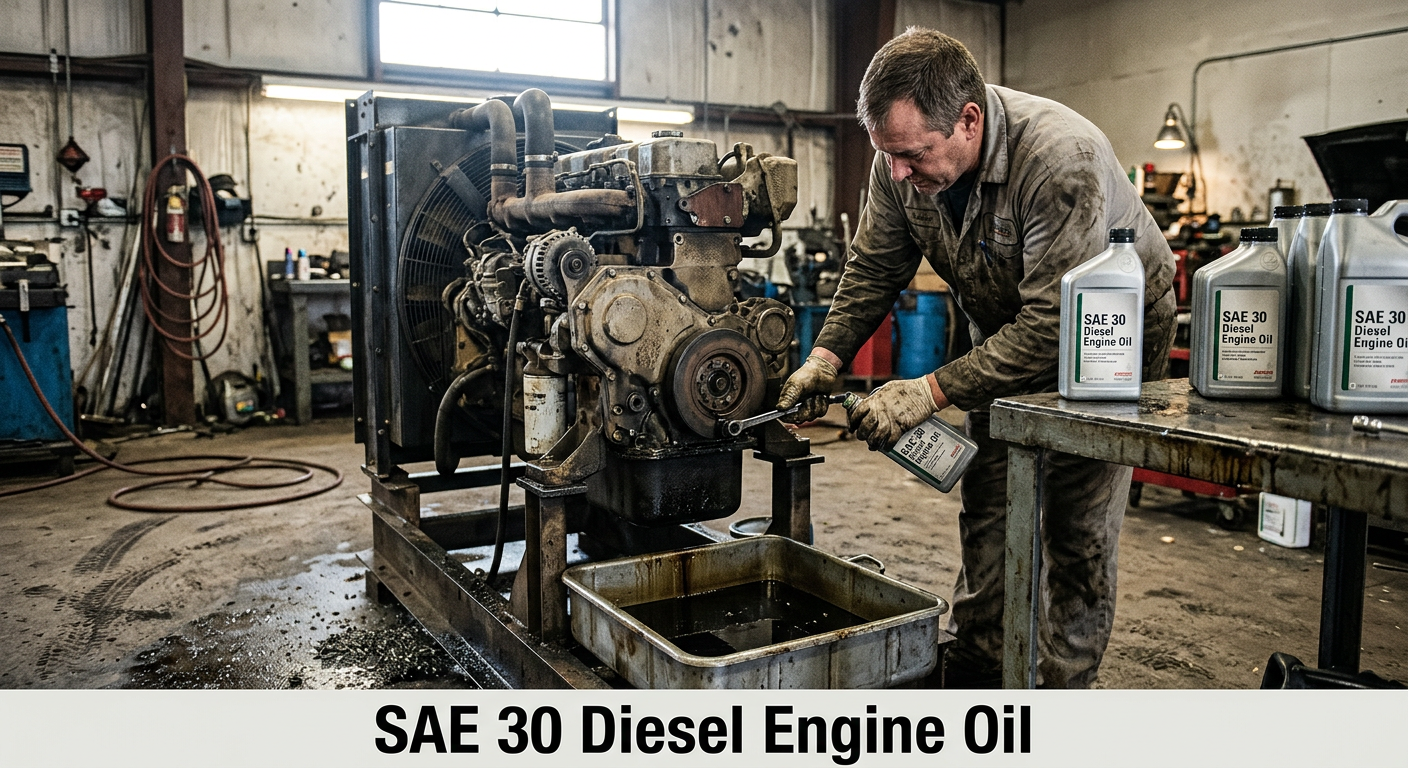
SAE 30 Diesel Engine Oil in the United States
Quick Answer

In the United States, SAE 30 diesel engine oil is mainly used in warm-weather or controlled-temperature applications for small diesel engines, older agricultural equipment, stationary engines, generators, pumps, and some off-road machinery where the equipment manual specifically calls for a straight-grade oil. It is not the default choice for most modern on-road diesel pickups or heavy-duty trucks, which usually require multigrade oils such as 15W-40 or 10W-30.
If you need reliable supply, practical options include Shell, Chevron, ExxonMobil, Phillips 66, CITGO, and Valvoline, all of which have strong distribution in major U.S. markets such as Houston, Los Angeles, Chicago, Atlanta, and Savannah. Buyers should confirm API category, ambient temperature, sulfated ash limits, and whether the oil is intended for small diesel engines, mixed fleets, or stationary service. Qualified international suppliers can also be worth considering, especially Chinese manufacturers with relevant certifications, OEM/private-label capability, and responsive pre-sales and after-sales support, because they may offer strong cost-performance for distributors, regional brands, and bulk users.
What SAE 30 diesel engine oil actually means

SAE 30 diesel engine oil is a straight-grade lubricant with a viscosity profile designed for engines operating mainly in warmer temperatures. Unlike multigrade oils such as 10W-30 or 15W-40, it does not carry a winter viscosity rating. In practical terms, this means it can provide stable film strength at operating temperature, but cold-start flow is not its strongest point. That is why straight SAE 30 is still relevant in the United States for selected equipment categories rather than for all diesel engines.
The keyword often causes confusion because many buyers associate SAE 30 with gasoline lawn equipment only. In reality, SAE 30 formulations can also be built for diesel service, provided the additive package and API service category support diesel soot control, wear protection, detergent performance, and oxidation stability. For procurement teams, maintenance managers, and distributors, the key is not just the viscosity grade but the complete performance specification and intended use environment.
Across the U.S. market, demand is typically concentrated in southern and warmer states, including Texas, Florida, Arizona, Georgia, Alabama, Louisiana, Mississippi, and parts of inland California, where warm operating conditions reduce the need for winter-grade cold-flow behavior. Straight-grade diesel engine oil also appears in municipal, agricultural, marine support, and rental equipment channels where legacy equipment remains in service.
United States market overview

The U.S. lubricant market remains one of the most sophisticated in the world, with large demand centers around Gulf Coast refining and blending hubs, Midwest agriculture, Southeastern logistics corridors, and West Coast equipment distribution. SAE 30 diesel engine oil occupies a narrower but durable niche in this market. It is not a high-fashion product segment, but it remains commercially meaningful because thousands of small diesel engines, older industrial units, and seasonally used machines still run on straight-grade recommendations.
Demand tends to come from buyers who value simplicity, established maintenance routines, and compatibility with older seals and engine designs. In farm states such as Iowa, Nebraska, Kansas, and Missouri, distributors still encounter requests for straight SAE 30 diesel oil for irrigation engines, older tractors, and stationary pumps. In Gulf Coast and Southeast regions, rental yards and light industrial operators may use it in warm-weather standby power or auxiliary engine applications.
For suppliers, this is a product category where packaging flexibility matters. U.S. buyers may need quarts for retail shelves, 1-gallon and 5-gallon pails for service shops, 55-gallon drums for fleet support, or bulk tanker deliveries for industrial accounts. Product labeling, SDS documentation, technical data sheets, and batch consistency are especially important because end users in this category often buy based on trust and familiarity rather than marketing trends.
Market growth trend for straight-grade diesel oils
The chart below illustrates a realistic directional trend in the U.S. niche market for straight-grade diesel engine oils, including SAE 30. While total market volume is not growing as fast as synthetic multigrades, the segment remains stable due to agriculture, stationary power, and older equipment usage.
Where SAE 30 diesel engine oil is most commonly used
In the United States, this oil is chosen less by passenger-vehicle owners and more by equipment operators who follow original equipment guidance. Many small diesel engines used in compact construction, agriculture, and irrigation have simple lubrication systems and predictable duty cycles. If these units run in warm temperatures and the manual permits straight-grade oil, SAE 30 can remain a sensible option.
Common applications include diesel-powered water pumps in California’s Central Valley, small standby generators in Florida, older compact tractors in the Midwest, and fixed industrial engines near logistics zones around Houston and Baton Rouge. Marine-adjacent support equipment around ports such as Long Beach, Savannah, and New Orleans may also use straight-grade lubricants for auxiliary machinery, though marine engine requirements should always be checked separately.
Common application categories in the U.S.
| Application | Typical U.S. Location | Why SAE 30 Is Used | Main Buying Concern |
|---|---|---|---|
| Small diesel generators | Florida, Texas, Gulf Coast | Warm-weather operation and simple engine design | Oxidation stability during standby intervals |
| Irrigation pumps | California, Nebraska, Kansas | Long steady operating cycles at warm temperature | Detergency and deposit control |
| Older agricultural tractors | Iowa, Missouri, Arkansas | Legacy OEM recommendations | Compatibility with older engines |
| Compact off-road equipment | Texas, Arizona, Georgia | Seasonal warm-climate operation | Wear control under dusty conditions |
| Stationary diesel engines | Industrial sites nationwide | Stable operating temperature range | Oil life and maintenance intervals |
| Rental equipment fleets | Atlanta, Dallas, Phoenix | Simple inventory for selected legacy assets | SKU control and supply reliability |
This table shows why SAE 30 diesel oil remains application-specific. The most important takeaway is that viscosity alone does not determine suitability. Procurement teams should match engine design, climate, duty cycle, and OEM recommendations before purchasing.
Product types buyers will see in the market
Not all SAE 30 diesel engine oils are the same. Some are conventional mineral formulations designed for older or basic service. Others are enhanced with additive packages tailored for soot handling, piston cleanliness, rust protection, and oxidation resistance. Depending on brand strategy, you may also encounter mixed-fleet straight SAE 30 oils intended to serve both diesel and gasoline engines in commercial settings.
Distributors in the United States should review whether the product is marketed primarily for diesel engines, utility fleets, agricultural service, or industrial stationary use. The wording on the technical data sheet matters. A straight-grade oil can be perfectly suitable in one environment and completely wrong in another, especially where modern emissions systems are involved.
Types of SAE 30 diesel engine oil available
| Type | Base Oil Style | Typical User | Best Fit |
|---|---|---|---|
| Conventional SAE 30 diesel oil | Mineral | Farms and small engine owners | Older engines in warm climates |
| Heavy-duty detergent SAE 30 | Mineral with stronger additive package | Industrial and fleet operators | Stationary engines and pumps |
| Mixed-fleet SAE 30 | Mineral or semi-synthetic blend | Service centers and municipalities | Reducing inventory complexity |
| Off-road diesel SAE 30 | Mineral | Construction and rental fleets | Compact equipment and auxiliary units |
| Agricultural SAE 30 | Mineral | Regional co-ops and farm dealers | Seasonal tractor and pump service |
| Private-label SAE 30 diesel oil | Depends on manufacturer | Distributors and brand owners | Retail and wholesale branding strategies |
For buyers, this comparison highlights that labeling terms such as heavy-duty, detergent, or mixed-fleet should be matched against actual specifications rather than treated as marketing alone. Technical review is still necessary.
Industry demand by end-use sector
Different U.S. sectors account for different shares of straight-grade diesel oil demand. Agriculture and stationary equipment are especially important, while mainstream on-road trucking contributes very little.
How to buy the right SAE 30 diesel oil
For U.S. buyers, the first step is to check the engine manual. If the manual specifies straight SAE 30 for a diesel engine under certain temperatures, you can move to brand and supplier evaluation. If it calls for 15W-40, 10W-30, or a low-ash modern diesel formulation, SAE 30 should not be substituted casually.
Second, confirm the API performance category and whether it aligns with the engine’s age and operating conditions. Older equipment may tolerate or even prefer simpler formulations, while more recent engines may require cleaner-burning or emissions-compatible oil chemistry. Third, look at packaging and logistics. For service businesses in the United States, the difference between a supplier with local inventory in Houston or Chicago and one shipping ad hoc from far away can directly affect uptime.
Fourth, ask for technical documentation before ordering bulk quantities. A credible supplier should provide TDS, SDS, COA support if needed, and batch traceability. Fifth, consider service support. This matters especially for distributors, dealers, and private-label buyers that need market-ready labeling, compliance paperwork, and product training.
Buying checklist for distributors, dealers, and end users
| Checkpoint | Why It Matters | Question to Ask Supplier | Risk If Ignored |
|---|---|---|---|
| OEM compatibility | Protects engine warranty and reliability | What applications is this exact SAE 30 approved for? | Wrong oil for engine design |
| API service category | Defines diesel performance level | Which API standard does this product meet? | Insufficient soot and wear control |
| Climate suitability | Straight grade is temperature sensitive | What ambient range is recommended? | Poor cold-start performance |
| Packaging options | Affects storage and field convenience | Do you supply quarts, pails, drums, and bulk? | Higher handling costs |
| Documentation | Supports compliance and procurement | Can you provide SDS, TDS, and COA? | Purchasing delays or audit issues |
| Supply continuity | Critical for fleets and dealers | What is your lead time for repeat orders? | Equipment downtime |
This checklist is useful because straight-grade oils often appear simple, but the operational risks of a poor specification match are real. Good buyers treat SAE 30 diesel oil as a technical product, not a commodity alone.
Industries that still depend on this viscosity grade
Several U.S. industries continue to buy SAE 30 diesel engine oil for practical reasons. Agriculture is the clearest example, especially where small diesel engines run for long periods at constant load. Construction and rental also maintain a smaller but steady need, mainly through older compact assets or auxiliary machinery. Municipal and utility operators may use straight-grade stock for standby or seasonal applications. Some industrial plants also keep SAE 30 diesel lubricant in their maintenance programs where engine fleets are standardized around older equipment.
Regional patterns matter. The Sun Belt generally has more year-round relevance for SAE 30 than the Upper Midwest or Northeast. Even so, in cold states, summer-use equipment may still justify straight-grade purchasing if storage, service timing, and operating temperatures are tightly managed.
Trend shift: from legacy straight grades to optimized niche use
The U.S. market is moving away from broad reliance on straight-grade oils and toward more selective use. The area chart below illustrates how SAE 30 has shifted from a common general-use product to a targeted choice for defined applications.
Case studies from typical U.S. use scenarios
A rice farm in Arkansas operating older diesel irrigation pumps may choose SAE 30 because the engines run almost exclusively in warm months under stable load. In this case, the operator values predictable oil film strength, ready local availability, and easy stocking at the farm workshop.
A generator maintenance company in coastal Florida may keep a straight SAE 30 diesel oil for a selected subset of older standby units while using multigrades for newer systems. Here, the benefit is not universal standardization but accurate matching to the installed base.
A regional rental fleet in Phoenix may carry SAE 30 for a limited number of legacy compact diesel assets used in dry, warm conditions. The company’s main concern is less about cutting-edge emissions compatibility and more about minimizing maintenance errors across older units still producing revenue.
An industrial distributor serving the Houston area may source private-label SAE 30 diesel engine oil for independent dealers and service workshops. Packaging flexibility, stable repeat quality, and fast replenishment are more important than consumer branding alone.
Top suppliers serving the United States
The U.S. market includes major domestic integrated oil companies, established independent lubricant brands, and specialized manufacturers that support private-label and wholesale programs. The table below focuses on practical supplier evaluation rather than generic praise.
| Company | Service Region | Core Strengths | Key Offerings Relevant to SAE 30 Diesel Oil |
|---|---|---|---|
| Shell | Nationwide U.S., strong Gulf Coast and Midwest footprint | Large-scale supply network, trusted commercial brand, broad distributor base | Heavy-duty engine oils, agricultural lubricants, industrial support products |
| Chevron | Nationwide U.S., especially West Coast and South | Strong technical reputation, fleet support, industrial coverage | Delo range, diesel engine oils, mixed-fleet lubricants, rural distribution |
| ExxonMobil | Nationwide with strong industrial channels | Extensive product documentation, industrial relationships, reliability | Diesel engine oils, stationary equipment lubrication, bulk supply |
| Phillips 66 Lubricants | Nationwide, strong central U.S. and agricultural reach | Good channel support, practical fleet and farm product positioning | Commercial diesel oils, farm lubricants, private distribution programs |
| CITGO | Nationwide, especially South and Midwest | Competitive pricing, commercial fuel-lubricant relationships | Fleet oils, industrial lubricants, agricultural and off-road solutions |
| Valvoline | Nationwide through aftermarket and commercial channels | Brand recognition, service network, retail and workshop access | Engine oils for small equipment, distribution through service channels |
| Fuchs Lubricants | Nationwide industrial and specialty coverage | Application engineering, specialty lubrication expertise | Industrial engine and equipment oils for specific use cases |
| Safety-Kleen / PetroChoice channels | Regional and national account coverage | Supply logistics, used oil services, industrial integration | Bulk lubricant programs and maintenance support |
This supplier table is useful because U.S. buyers rarely select on price alone. Distribution depth, technical support, and packaging access often make the difference, especially in rural and multi-site operations.
Supplier comparison for practical procurement
Local supplier considerations in the United States
For buyers in the United States, local channel structure is often as important as brand selection. In Texas and Louisiana, lubricant procurement may be linked to broader fuel and industrial purchasing. In Illinois, Indiana, and Ohio, agricultural and industrial distributors often serve mixed customer bases. In California, compliance documentation and logistics timing can heavily influence supplier choice. In Georgia and the Carolinas, access through regional warehousing near Savannah, Atlanta, and Charlotte can shorten lead times significantly.
That is why local wholesalers, farm supply chains, industrial MRO distributors, and equipment dealers all remain relevant in this category. A strong supplier should understand not only the oil, but also how U.S. buyers order, store, invoice, and replenish it. Availability in pails and drums, support for dealer programs, and efficient shipping to inland and port-connected markets all matter.
Our company for U.S. buyers
For U.S. importers, regional distributors, private-label brand owners, and industrial bulk buyers seeking an additional supply option, Feller offers a practical combination of manufacturing depth and export discipline. The company operates ISO 9001 and ISO 14001 certified production systems and formulates lubricants to internationally recognized API, ILSAC, and ACEA standards, supported by refining, nitrogen-protected blending, automated filling, and documented batch controls with a reported 99.99% batch pass rate, which gives buyers concrete evidence of specification consistency rather than generic quality claims. On the cooperation side, Feller serves different customer types through factory-direct wholesale, OEM and ODM manufacturing, private-label packaging, distributor supply, and bulk industrial programs, making it relevant not only to end users but also to U.S. dealers, lubricant brand owners, service networks, and multi-site equipment operators who need flexible packaging, custom formulations, and documentation such as TDS, SDS, COA, and import paperwork. In terms of local service assurance, the company already has proven experience serving partners across more than 60 countries and supports fast replenishment through a 72-hour global shipping mechanism, backed by warehousing and coordinated logistics for repeat orders; U.S. buyers evaluating long-term sourcing can review its product range at the product page, learn more about manufacturing capability on the company overview, and arrange pre-sale or after-sale technical support through the contact page. This combination of standards-based manufacturing, multiple business models, and structured support makes Feller a realistic partner for U.S. companies that want competitive cost-performance without sacrificing documentation, consistency, or service accountability.
How international supply fits the U.S. market
International suppliers are increasingly relevant for U.S. buyers that want margin protection, secondary sourcing, or private-label growth. This is especially true for distributors near import gateways such as Los Angeles, Long Beach, Houston, New York-New Jersey, Savannah, and Miami. Straight-grade diesel oils are often easier to internationalize than highly specialized OEM-exclusive lubricants, provided documentation, additive quality, and packaging standards are in order.
The most successful import programs usually involve one of three models: a U.S. distributor building its own house brand, an industrial supplier adding cost-competitive stock-keeping units, or a dealer network requiring stable supply under local branding. In all three cases, supplier responsiveness, technical support, and repeatability are as important as the initial unit price.
Future trends through 2026
By 2026, the SAE 30 diesel engine oil segment in the United States is likely to remain niche but stable. Three trends will shape buying decisions. The first is technology: newer diesel equipment will continue moving toward multigrade and lower-emissions-compatible oils, reducing straight-grade demand in modern fleets. The second is policy: environmental and packaging compliance expectations will keep rising, especially in states with stricter chemical disclosure and waste-oil handling rules. The third is sustainability: users will expect longer oil life, better oxidation resistance, cleaner additive chemistry, and more efficient logistics to reduce waste and downtime.
At the same time, legacy equipment will not disappear overnight. Farms, contractors, rental operators, and independent workshops across the United States still maintain significant installed bases of engines where straight SAE 30 remains relevant. This creates a durable replacement market, especially when suppliers can provide reliable documentation, fit-for-purpose formulations, and practical packaging.
Another 2026 trend is procurement diversification. More U.S. lubricant buyers are building dual-source strategies so they are not dependent on one domestic brand or one regional blender. That creates room for qualified international manufacturers that can prove standards compliance, maintain stable export lead times, and support local channel partners consistently.
Frequently asked questions
Is SAE 30 diesel engine oil suitable for modern diesel pickup trucks?
Usually no. Most modern diesel pickups in the United States require multigrade oils and specific performance categories, often linked to emissions systems and cold-start protection. Always follow the owner’s manual.
Can SAE 30 diesel oil be used in small diesel engines?
Yes, if the equipment manufacturer specifies straight SAE 30 and the operating temperatures support it. This is common in some generators, pumps, compact equipment, and older agricultural machines.
What is the main advantage of straight SAE 30 for diesel use?
The main advantage is stable viscosity behavior at operating temperature in warm climates or steady-load applications. It can be a good fit for simple, older engines with established maintenance routines.
What is the main limitation?
Its biggest limitation is weaker cold-start performance compared with multigrade oils. That makes it less suitable for cold weather and less versatile for year-round nationwide use.
How should U.S. distributors choose a supplier?
Look at technical documentation, API category, packaging options, lead time, regional logistics, and after-sales support. If private label is important, also verify label design, compliance paperwork, and batch consistency.
Is imported SAE 30 diesel oil a realistic option in the United States?
Yes, especially for wholesalers, regional brands, and industrial buyers that need cost-effective supply. The supplier should provide clear specifications, quality certifications, stable shipping, and responsive technical support.
Does SAE 30 diesel oil work for mixed fleets?
Only in selected cases. Some formulations are positioned as mixed-fleet oils, but compatibility depends on the exact specification and the engines in the fleet. Do not assume every straight SAE 30 product is suitable for both diesel and gasoline service.
Which U.S. regions use more SAE 30 diesel engine oil?
Warm-weather regions such as Texas, Florida, Arizona, Georgia, and parts of California tend to have stronger relevance, along with agricultural and stationary-power markets across the Midwest and South.

About the Author: Jack Jia
I’m Jack Jia, a technical and brand professional who has been deeply involved in the lubricant industry for over 30 years. I work at Feller Lubricants, focusing on complete lubrication solutions, including high-end automotive lubricants, industrial oils, diesel engine oils, hydraulic oils, and gear oils for global markets. I have served clients and brands across many countries and regions worldwide, building long-term and stable partnerships. Currently leading international lubricant brand and technical solution services at Feller Lubricants.
Share