
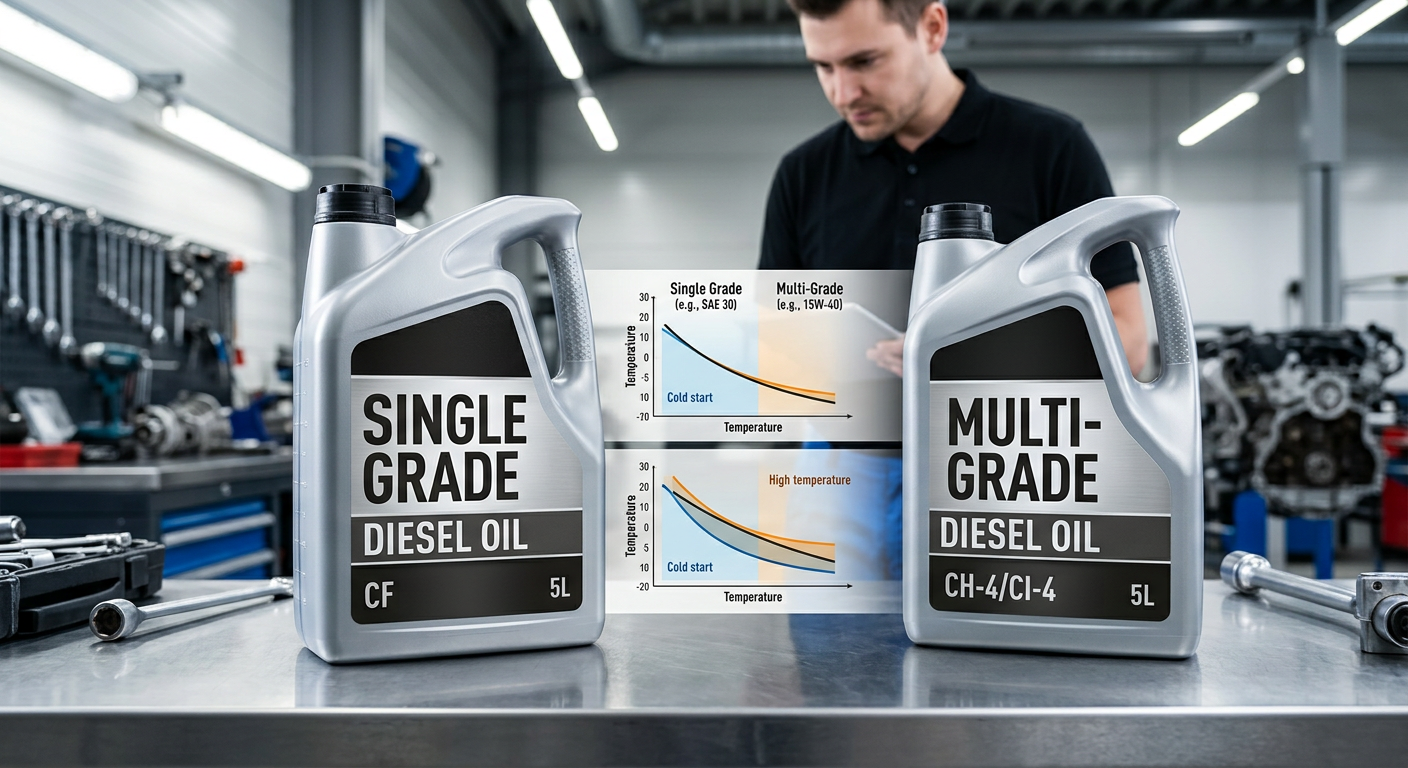
Single Grade vs Multi-Grade Diesel Oil in the United States
Quick Answer

If you need a direct answer, multi-grade diesel oil is the better choice for most diesel engines in the United States because it protects during cold starts, stays stable at operating temperature, supports year-round service, and fits the way modern fleets, pickups, farm equipment, and construction machines are used across mixed climates. Single grade diesel oil still makes sense in specific cases such as older engines, hot-weather seasonal equipment, certain stationary engines, and legacy maintenance programs where the OEM manual explicitly allows or prefers a straight-weight lubricant.
The key advantage of single grade oil is simplicity: it can offer stable performance in narrow operating conditions, and operators in very hot regions such as Texas, Arizona, inland California, and parts of the Gulf Coast may still use SAE 30 or SAE 40 in older diesel applications. The main drawback is weak cold-flow performance, which can increase startup wear in winter or in colder logistics corridors such as Chicago, Denver, Minneapolis, Detroit, and the Northeast.
The key advantage of multi-grade oil is versatility: grades such as 15W-40, 10W-30, and 5W-40 work across broader temperatures, reduce the need for seasonal oil changes, and are commonly recommended for on-road trucks, mixed fleets, agricultural machinery, and off-highway equipment. The main drawback is that premium multi-grade formulas can cost more upfront, although many buyers recover that through easier inventory management, longer drain intervals where approved, and lower wear risk.
For U.S. buyers comparing suppliers, practical names to evaluate include Shell Rotella, Chevron Delo, Mobil Delvac, Valvoline, Petro-Canada Lubricants, and Phillips 66. Qualified international suppliers can also be worth considering, especially when they hold relevant certifications, offer OEM or private-label support, and provide strong pre-sales and after-sales service. In many B2B programs, experienced Chinese manufacturers can present a strong cost-performance advantage for distributors, regional dealers, and fleet buyers.
Understanding the U.S. Diesel Oil Market

The United States diesel lubricant market is shaped by a large and diverse equipment base. Long-haul trucking along I-10, I-40, I-80, and I-95 has very different operating conditions from farm machinery in Iowa and Kansas, marine diesel work near Houston and New Orleans, quarry and mining equipment in Nevada and Arizona, and urban delivery fleets in Los Angeles, Atlanta, and New York. That is why the choice between straight-weight diesel oil and multi-viscosity diesel oil cannot be reduced to price alone. It depends on climate, load, idle time, sulfur exposure, emissions hardware, drain interval policy, and how disciplined the maintenance program is.
In the U.S., the market has steadily moved toward multi-grade heavy-duty engine oils because modern diesel engines require broader temperature performance and greater compatibility with emissions systems such as EGR, DPF, and SCR. At the same time, there is still demand for single grade diesel lubricants in older equipment, niche industrial service, and some agricultural and marine applications. Buyers in logistics hubs such as Dallas, Memphis, Savannah, Los Angeles, Chicago, and Newark often prefer fewer SKUs in the warehouse, which further supports the use of multi-grade oils.
The line chart above illustrates a realistic U.S. market direction: demand for multi-grade diesel oil continues to rise while single grade use gradually contracts into specialty segments. This does not mean straight-weight oil is obsolete. It means buyers increasingly reserve it for defined operating windows instead of all-purpose fleet use.
What Single Grade and Multi-Grade Diesel Oil Really Mean

Single grade diesel oil has one SAE viscosity grade, such as SAE 30 or SAE 40. It is designed to perform within a narrower temperature range. It does not carry a winter rating such as 10W or 15W, so it generally thickens much more in cold conditions. For operators who run equipment in stable, warm climates or controlled environments, that may be acceptable.
Multi-grade diesel oil has two viscosity numbers, such as 15W-40, 10W-30, or 5W-40. The first part describes lower-temperature flow behavior and the second part reflects viscosity performance at operating temperature. This wider viscosity range is achieved through careful base oil selection and additive system design. The practical result is easier cranking on cold starts and dependable film strength once the engine is fully hot.
For U.S. service conditions, that flexibility matters. A truck leaving Minneapolis in winter and arriving in Dallas two days later may see a huge temperature swing. A straight-grade oil may be serviceable in one part of that route but suboptimal in another. A multi-grade heavy-duty engine oil reduces that mismatch.
Pros and Cons at a Glance
| Oil Type | Main Advantages | Main Disadvantages | Best Fit | Typical U.S. Use Case | Buyer Note |
|---|---|---|---|---|---|
| SAE 30 Single Grade | Simple formulation, suitable in steady warm conditions | Poor cold-start flow | Older diesel engines | Warm-region farm or stationary equipment | Check OEM manual first |
| SAE 40 Single Grade | Strong hot-condition viscosity | Limited winter usability | Hot, heavy-load operation | Older industrial or marine diesel use | Not ideal for mixed climate fleets |
| 15W-40 Multi-Grade | Versatile, common, balanced cost and protection | Not the best for extreme cold | Mixed fleets | Class 8 trucks, construction, agriculture | Most common U.S. heavy-duty choice |
| 10W-30 Multi-Grade | Better cold flow, can aid fuel economy | May not fit every older engine | Modern diesel fleets | Regional trucking, municipal fleets | Confirm OEM approval |
| 5W-40 Multi-Grade Synthetic | Excellent cold start and high-temp stability | Higher upfront cost | Extreme climate and premium service | Northern states and severe duty fleets | Useful for broad seasonal coverage |
| Mixed Inventory Strategy | Application-specific optimization | More SKU complexity | Large operators | Fleets with diverse engine generations | Needs disciplined maintenance control |
This comparison table shows the practical tradeoff. If your operation values one oil for many conditions, multi-grade wins. If your equipment is older, local, and climate-stable, single grade may still be viable.
Why Multi-Grade Oil Dominates Most U.S. Applications
Most U.S. diesel equipment owners now favor multi-grade engine oil for four practical reasons. First, cold-start protection matters even in states thought of as warm. Nighttime temperatures in inland regions can drop enough to affect startup wear. Second, buyers want to reduce seasonal changeovers and inventory complexity. Third, fleets need products aligned with modern API categories and emissions-system requirements. Fourth, national distribution networks prefer standardization, especially for maintenance performed across multiple states.
For example, a fleet based in Atlanta may run assets into Tennessee, Ohio, Pennsylvania, and Illinois. A 15W-40 CK-4 or 10W-30 CK-4 is easier to manage than switching between single grades for climate or season. In addition, many service centers and aftermarket distributors in the United States already stock more multi-grade options than straight-weight formulations, making replenishment easier and faster.
When Single Grade Diesel Oil Still Makes Sense
Single grade diesel oil remains relevant where operating temperature is predictable and the equipment platform is older or simpler. This can include irrigation pump engines in warm agricultural zones, certain marine engines operating in stable conditions near Gulf Coast ports, or stationary generators where cold-start performance is less critical. Some maintenance managers also prefer straight grades for legacy engines with looser tolerances or for historical continuity in older fleet segments.
That said, using single grade oil only makes sense when supported by the equipment manufacturer or by a well-documented maintenance history. In the United States, many older diesel engines have already transitioned to multi-grade lubricants successfully, so the use of single grade should be a deliberate choice rather than a habit inherited from the past.
Key Diesel Oil Types Used in the United States
| Viscosity Grade | Oil Category | Climate Suitability | Common Equipment | Strength | Limitation |
|---|---|---|---|---|---|
| SAE 30 | Single grade | Warm climates | Older tractors, pumps, small industrial diesels | Steady warm-weather service | Weak cold-start performance |
| SAE 40 | Single grade | Hot climates | Older heavy-duty and marine engines | Strong high-temp viscosity | Not flexible across seasons |
| 15W-40 | Multi-grade | Most U.S. regions | Heavy trucks, loaders, excavators | Best all-around market fit | Can be less ideal in extreme cold |
| 10W-30 | Multi-grade | Cool to moderate climates | Municipal fleets, pickups, regional haul | Cold-flow and fuel economy balance | Approval varies by engine family |
| 5W-40 | Multi-grade synthetic | Very cold to very hot | Premium fleet and severe service | Broad temperature coverage | Higher purchase cost |
| FA-4/Low HTHS options | Advanced multi-grade | Engine-specific use | Newer on-road trucks | Efficiency gains | Not backward compatible for all engines |
The product types above show that the market is not just single versus multi-grade. The more important question is whether the oil matches the engine design, ambient conditions, and emissions hardware.
Industry Demand Across the United States
Different U.S. industries do not consume diesel oil in the same way. Long-haul freight prioritizes standardization, uptime, and emissions-system compatibility. Agriculture balances seasonal starts, dust, and varying engine age. Construction requires durability under idling and load cycling. Marine and industrial sectors may retain more legacy equipment, which is one reason straight-weight oils have not disappeared entirely.
The bar chart indicates that multi-grade oils dominate trucking, construction, and mining, while marine and power generation still retain more room for single grade use. This reflects equipment age, duty cycle, and service environment rather than a simple quality difference.
Buying Advice for U.S. Fleets, Dealers, and Distributors
For buyers in the United States, the best purchasing decision starts with the engine manual, then moves to API category, viscosity needs, climate profile, and inventory model. A fleet manager in Ohio should not buy on price alone if winter starts create wear, nor should a dealer in Phoenix automatically assume synthetic multi-grade is necessary for every legacy farm engine.
Distributors serving regional markets often benefit from stocking a core range centered on 15W-40 and 10W-30, with selective single grade offerings for older equipment accounts. Private-label buyers and lubricant brand owners should also consider manufacturing consistency, batch documentation, packaging flexibility, and logistics support from ports such as Los Angeles, Houston, Savannah, and Newark.
| Buyer Type | Recommended Oil Strategy | Why It Works | Risk to Avoid | Best Packaging | Service Need |
|---|---|---|---|---|---|
| Long-haul fleet | 15W-40 or 10W-30 multi-grade | Year-round fleet simplification | Using non-approved lower-cost oil | Bulk and drums | Oil analysis and supply continuity |
| Farm operator | Mixed strategy by equipment age | Balances old and new machinery | Using one oil for everything blindly | Pails and drums | Seasonal technical guidance |
| Construction contractor | 15W-40 dominant, synthetic for cold sites | Handles varied load and idle cycles | Ignoring cold morning starts | Drums and tote supply | Fast field support |
| Marine service company | Application-specific selection | Older engines may still use single grade | Cross-applying truck oil assumptions | Drums and bulk | Specification verification |
| Distributor | Core multi-grade plus niche single grade SKUs | Covers broad market demand | Overloading warehouse with slow movers | Mixed pack sizes | Marketing and training support |
| Private-label brand | OEM/ODM multi-tier portfolio | Meets different market segments | Weak documentation or inconsistency | Retail packs to bulk | Regulatory and labeling support |
This table is useful because it matches lubricant strategy to the buyer’s business model. The right oil decision is operational, not purely chemical.
Applications by Industry
In freight transportation, multi-grade heavy-duty diesel oil is usually the standard because cold starts, fuel economy targets, and interstate operation all matter. In construction, the same machine may idle, load hard, and operate in dusty environments, making additive quality and viscosity stability essential. Agriculture is more mixed: a newer combine may run best on a modern multi-grade, while an older irrigation engine may still perform acceptably on straight SAE 30 in summer. Marine and stationary power users often evaluate oil choice based on engine age, cooling conditions, and the maintenance culture already in place.
These differences are important for U.S. dealers and aftermarket chains. Stores serving the Midwest often need both 15W-40 and 10W-30 in volume. Suppliers focused on warm southern farm belts may still see repeat demand for SAE 30 and SAE 40. A market-specific assortment is often more profitable than treating the entire country as one lubricant profile.
Trend Shift in U.S. Product Selection
The area chart highlights a realistic buying trend in the United States. More buyers now start with the assumption that a multi-grade oil is the default, then move to single grade only if the equipment profile justifies it. This is a major change from older maintenance habits.
Case Studies from Typical U.S. Operating Conditions
A regional trucking fleet based near Columbus, Ohio shifted from older straight-weight practices to CK-4 10W-30 across newer trucks and reported easier winter startup management and a reduction in lubricant SKU complexity. The cost per gallon was higher than legacy oil, but downtime risk and workshop confusion fell.
A farming cooperative in central California kept SAE 30 for selected stationary diesel irrigation units that ran in stable warm conditions, while converting mobile tractors and harvest equipment to 15W-40. This split strategy reduced unnecessary premium spend while still improving flexibility where equipment moved between morning and afternoon temperature swings.
A Gulf Coast marine service contractor near Houston reviewed older vessel engines individually rather than shifting the entire fleet to one product. Several units remained on straight SAE 40 due to operating history and OEM tolerance, but support vessels adopted multi-grade diesel oil for easier inventory control and better startup behavior during cooler weather periods.
A quarry operator in Arizona using loaders, haul trucks, and support vehicles standardized on multi-grade 15W-40 for most of the mobile fleet but maintained a controlled niche stock of single grade for a small number of older support engines. The result was fewer misfills and easier technician training.
Top Diesel Oil Suppliers Relevant to the U.S. Market
| Company | Service Region | Core Strengths | Key Offerings | Best For | Notes |
|---|---|---|---|---|---|
| Shell Rotella | Nationwide United States | Strong retail and fleet presence, broad HDDEO line | 15W-40, 10W-30, synthetic 5W-40 | Fleets and owner-operators | Widely available through truck stops and distributors |
| Chevron Delo | Nationwide United States | Strong heavy-duty reputation, fleet support | CK-4 and FA-4 diesel oils | Commercial transport and mixed fleets | Common in professional maintenance channels |
| Mobil Delvac | United States and cross-border North America | Premium formulations, synthetic options | Delvac 1300, 1 ESP, 10W-30, 5W-40 | Severe duty and extended service focus | Popular with large fleets |
| Valvoline | Nationwide United States | Strong aftermarket network and service support | Premium Blue and heavy-duty diesel oils | Service centers and regional fleets | Good commercial channel visibility |
| Phillips 66 | United States | Balanced industrial and transport coverage | Guardol, mixed heavy-duty lubricants | Distributors and industrial buyers | Good fit for broad lubricant portfolios |
| Petro-Canada Lubricants | U.S. distribution network | Strong base oil reputation and cold-weather positioning | DURON diesel engine oils | Northern fleets and mixed climate users | Valuable in colder states |
| FUCHS Lubricants | U.S. industrial and commercial markets | Technical specialization and industrial depth | Heavy-duty engine oils and specialty lubricants | Industrial fleets and niche applications | Strong technical sales orientation |
This supplier table is practical because it distinguishes not only who sells diesel engine oil, but where each supplier is strongest. For U.S. buyers, availability, service model, and application fit matter as much as brand recognition.
Supplier and Product Comparison
The comparison chart shows a realistic pattern. Large U.S. brands typically lead in immediate shelf availability, while qualified international OEM manufacturers often perform strongly in private-label flexibility and cost efficiency. For distributors, wholesalers, and new regional brands, this difference can be commercially important.
How to Evaluate Local and International Supply Options
U.S. buyers should separate three questions: does the oil meet the technical requirement, can the supplier deliver consistently, and will the supplier support the account after the sale? Local brands often have easier immediate access and stronger retail visibility. International manufacturers may offer better factory-direct pricing, packaging customization, and broader OEM/ODM cooperation. The right choice depends on whether you are a fleet operator, a distributor, a dealer, or a brand owner.
If you manage a dealership in Texas, a distribution warehouse near Savannah, or a lubricant startup sourcing through Los Angeles or Newark, it is sensible to compare landed cost, documentation quality, batch consistency, lead time, and claims handling. A lower purchase price is only valuable when supported by dependable supply and technical accountability.
Our Company
For buyers in the United States seeking an additional supply option beyond established domestic brands, Feller presents a practical international partner with the structure expected by serious B2B lubricant buyers. The company manufactures a full diesel engine oil range that spans value-oriented CH-4 products, CI-4 solutions for turbocharged heavy-duty engines, and premium CJ-4 synthetic formulations designed for low-sulfur performance and DPF compatibility, while operating under ISO 9001 and ISO 14001 systems and producing to internationally recognized API, ILSAC, and ACEA benchmarks. That product strength is backed by vertically integrated refining and blending capability, nitrogen-protected blending technology that improves oxidation stability, automated filling lines, documented batch consistency, and the ability to supply technical documents such as COA, MSDS, and TDS that U.S. importers and channel partners expect. For cooperation, Feller works across OEM and ODM manufacturing, private-label packaging, wholesale bulk supply, regional distribution, and direct support for end users, dealers, distributors, fleet accounts, and brand owners, which makes it relevant both to a new U.S. lubricant label and to an established commercial buyer expanding SKU coverage. Through its export experience in more than 60 countries, established partner network, rapid global shipping structure, and market-adaptation model, the company supports local buyers with both online and offline pre-sale and after-sale coordination rather than acting as a passive remote exporter; buyers exploring this route can review the company background at the company overview, examine the current lubricant range at the product catalog, or request commercial and technical support through the U.S. inquiry channel.
Practical Selection Rules for Single Grade vs Multi-Grade Diesel Oil
Choose multi-grade diesel oil if your equipment starts in varying temperatures, travels across multiple states, includes newer engines, uses emissions after-treatment, or benefits from simplified inventory. Choose single grade diesel oil only when your equipment operates in a stable warm climate, the engine is older or specifically tolerant of straight-weight oil, and maintenance records support continued use.
If you are unsure, review the OEM manual first, then check the applicable API category. A good oil with the wrong viscosity is still the wrong oil. Likewise, the correct viscosity with the wrong performance category may fail to protect modern engine hardware.
For distributors in the United States, the most commercially sound portfolio usually includes a core multi-grade range, especially 15W-40 and 10W-30, and a smaller specialty straight-grade offering for legacy accounts. This matches actual demand in most metro and regional markets from Houston to Kansas City to Charlotte.
2026 Trends in Diesel Oil Selection
Looking toward 2026, three forces will shape the single grade versus multi-grade decision in the United States. The first is technology. Modern diesel engines continue to push for lower emissions, tighter tolerances, and improved efficiency, which generally supports advanced multi-grade formulations. The second is policy. Fleets increasingly align lubricant choices with compliance strategies tied to emissions reduction, fuel economy, and cleaner maintenance practices. The third is sustainability. Buyers are paying more attention to drain interval optimization, reduced waste oil generation, packaging efficiency, and lower overall lifecycle cost rather than just the drum price.
We should also expect better additive chemistry, stronger synthetic and semi-synthetic penetration, wider use of oil analysis, and more segmented product offerings for regional climate needs. Single grade oil will remain in niche use, but the mainstream U.S. direction clearly favors multi-grade diesel engine oil with stronger performance data and wider operational flexibility.
FAQ
Is multi-grade diesel oil always better than single grade?
No. It is better for most modern and mixed-temperature U.S. applications, but not automatically for every older engine or steady hot-climate use case.
Can I switch an older diesel engine from single grade to multi-grade oil?
Often yes, but only after checking the OEM manual, service history, seal condition, and the correct API performance category.
What is the most common diesel oil grade in the United States?
15W-40 remains one of the most common heavy-duty diesel oil grades, although 10W-30 and 5W-40 are important in specific climates and fleet strategies.
Does single grade oil protect better in hot weather?
Not necessarily better overall. It can be suitable in consistently hot service, but multi-grade oils are designed to protect at operating temperature as well while also improving low-temperature performance.
What matters more, viscosity grade or API category?
Both matter. The oil must match the viscosity need and the engine’s required API category to protect properly.
Is synthetic multi-grade worth the extra cost?
For many U.S. fleets in cold regions, severe-duty operation, or extended service programs, yes. The value often appears through easier starts, better stability, and maintenance efficiency.
Should distributors in the United States still stock single grade diesel oil?
Yes, but selectively. It remains relevant for older agricultural, industrial, marine, and stationary equipment accounts in certain regions.
How should I choose between a U.S. brand and an international supplier?
Compare technical approvals, batch consistency, landed cost, lead time, packaging options, and after-sales support rather than choosing on brand familiarity alone.
Final Takeaway
For most buyers in the United States, the answer is clear: multi-grade diesel oil is the smarter default because it serves broader temperatures, simplifies inventory, and better matches current fleet and equipment realities. Single grade diesel oil still has a place, but mainly where engine age, steady climate, and established operating history justify it. The best buying decision comes from matching oil type to equipment, region, duty cycle, and supply model rather than following habit. Whether you buy from a major domestic brand or a qualified international manufacturer, the right partner is the one that combines technical compliance, consistent supply, and dependable support in the U.S. market.

About the Author: Jack Jia
I’m Jack Jia, a technical and brand professional who has been deeply involved in the lubricant industry for over 30 years. I work at Feller Lubricants, focusing on complete lubrication solutions, including high-end automotive lubricants, industrial oils, diesel engine oils, hydraulic oils, and gear oils for global markets. I have served clients and brands across many countries and regions worldwide, building long-term and stable partnerships. Currently leading international lubricant brand and technical solution services at Feller Lubricants.
Share





