
ILSAC GF-6A vs GF-6B Engine Oil in the United States
Quick Answer

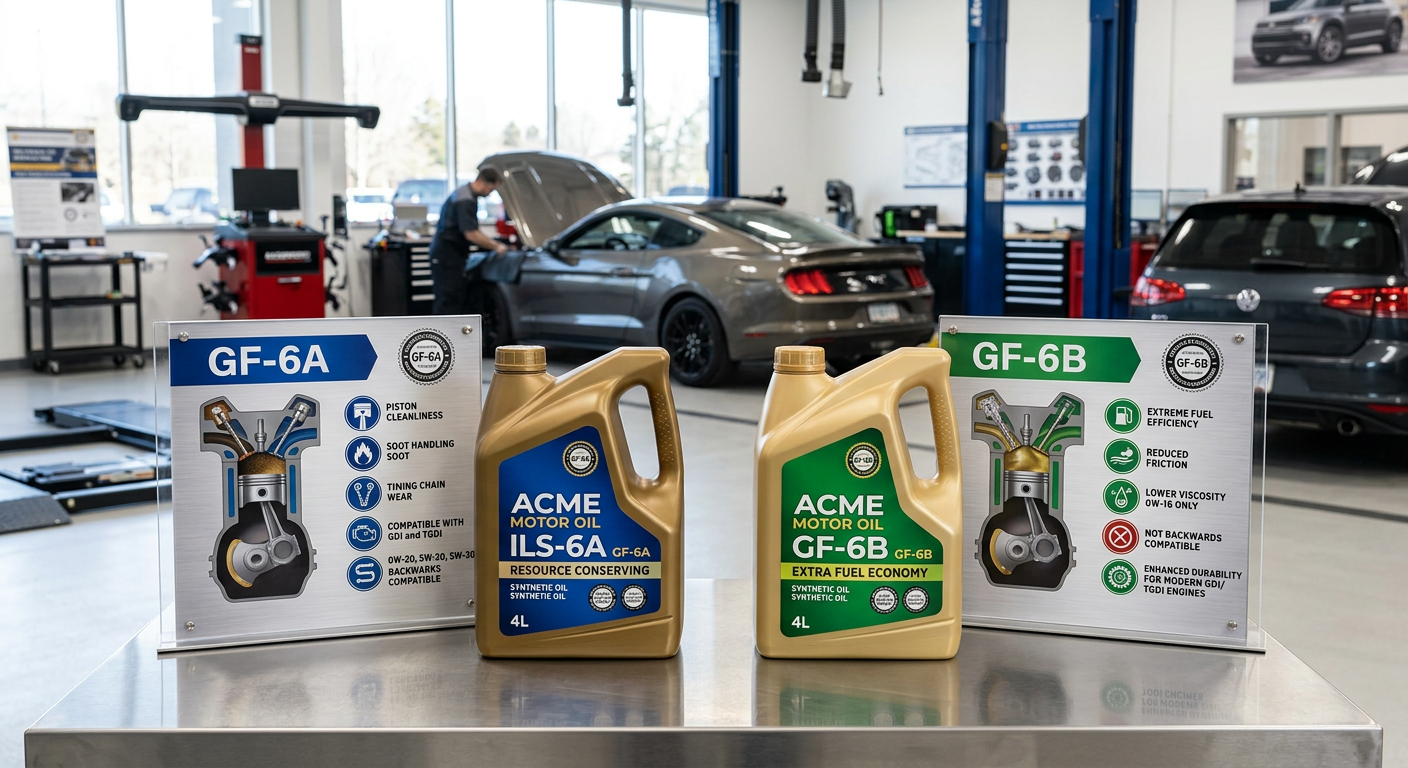
In the United States, the direct difference between ILSAC GF-6A and GF-6B engine oil is simple but very important: GF-6A is backward compatible with many gasoline vehicles that previously required older ILSAC categories such as GF-5, while GF-6B is designed specifically for SAE 0W-16 viscosity oils and should only be used when the vehicle manufacturer explicitly requires 0W-16. If a workshop, fleet manager, distributor, or car owner is choosing between them, GF-6A is the broader and more flexible option for mainstream passenger vehicles, SUVs, and light-duty trucks, while GF-6B is the narrower low-viscosity option intended for newer fuel-efficient engines engineered around ultra-thin oil.
For most buyers in the U.S. aftermarket, the practical rule is this: use GF-6A when the owner’s manual allows 0W-20, 5W-20, 5W-30, or similar mainstream grades; use GF-6B only for vehicles that specifically call for SAE 0W-16. Real brands commonly seen in the U.S. market include Mobil 1, Valvoline, Castrol, Pennzoil, and Quaker State, all of which offer products aligned with current ILSAC/API requirements through national retail and service networks. Qualified international suppliers can also be considered, especially manufacturers from China that can demonstrate API/ILSAC-aligned formulations, consistent batch control, technical documents, and reliable pre-sales and after-sales support, because they may offer strong cost-performance advantages for importers, private-label brands, and regional distributors.
Understanding the U.S. Market Context

The United States remains one of the world’s most sophisticated and segmented passenger car motor oil markets. Demand is shaped by several overlapping realities: a large installed base of gasoline vehicles, a growing share of turbocharged gasoline direct injection engines, strict fuel economy expectations, increasingly informed consumers, and a nationwide aftermarket stretching from Los Angeles and Houston to Chicago, Atlanta, Newark, and Miami. In this environment, the distinction between GF-6A and GF-6B is not a niche technical point. It directly affects inventory planning, service recommendations, packaging strategy, and liability management.
ILSAC GF-6 was introduced to address modern engine challenges such as low-speed pre-ignition protection, timing chain wear control, deposit resistance, oxidation stability, sludge control, and fuel economy retention. However, the category split into GF-6A and GF-6B because automakers needed both a broadly compatible standard and a dedicated standard for ultra-low viscosity oils. This distinction matters especially in the U.S., where independent repair shops, quick-lube chains, dealership service departments, fleet garages, and retail consumers often rely on the label itself to make quick purchasing decisions.
From a commercial standpoint, GF-6A covers a much larger portion of current service-fill demand. It serves the practical needs of the American aftermarket because many vehicles on the road still specify 0W-20, 5W-20, or 5W-30. GF-6B, by contrast, supports the long-term trend toward lower viscosity and higher fuel efficiency, but its installed vehicle base is smaller. As more newer sedans, hybrids, and compact crossovers enter the U.S. vehicle parc, 0W-16 adoption is gradually rising, especially in metropolitan areas with newer fleets such as Seattle, San Francisco, Boston, and Northern Virginia.
Specification Breakdown: GF-6A vs GF-6B

The most practical way to understand the difference is to separate compatibility, viscosity intent, and service strategy. GF-6A is intended for traditional ILSAC viscosity grades and is backward compatible with earlier gasoline engine requirements where the owner’s manual permits. GF-6B is tied specifically to SAE 0W-16 and uses a distinct licensing mark to prevent accidental substitution. That separation helps avoid incorrect oil use in engines not designed for such low viscosity.
Both categories aim to improve engine cleanliness, wear control, oxidation resistance, piston deposit control, fuel economy, and chain wear protection. Both also address modern engine challenges such as turbocharger stress and LSPI risk in small turbocharged engines. The key difference is not that one is “better” in every case; it is that each is engineered for a different operating design envelope.
| Category | Primary Viscosity Scope | Backward Compatibility | Typical U.S. Vehicle Fit | Common Buyer | Key Buying Risk |
|---|---|---|---|---|---|
| ILSAC GF-6A | 0W-20, 5W-20, 5W-30 and related mainstream grades | Yes, generally for prior ILSAC gasoline applications when permitted by OEM | Mainstream sedans, SUVs, pickups, hybrids, older late-model gasoline vehicles | Quick-lube shops, repair garages, retailers, general consumers | Assuming all grades perform the same regardless of OEM viscosity requirement |
| ILSAC GF-6B | SAE 0W-16 only | No broad backward compatibility claim like GF-6A | Newer fuel-efficient gasoline engines designed for 0W-16 | Dealers, newer vehicle owners, specialized service centers | Using it in engines not designed for 0W-16 |
| API SP / GF-6A | Mainstream low-viscosity gasoline grades | Broad U.S. aftermarket relevance | Large installed vehicle parc | National chains and fleet maintenance programs | Overstocking too many SKUs without demand planning |
| API SP / GF-6B | Ultra-low viscosity 0W-16 | Application-specific | Newer compact and hybrid models | OEM-aligned service channels | Consumer confusion between label types |
| Fleet Service Focus | Usually GF-6A dominated | High practicality | Mixed light-duty fleets | Municipal fleets, service contractors | Using one oil policy where multiple OEM specs exist |
| Retail Shelf Strategy | GF-6A has broader turnover | Yes in more applications | Mass retail and auto parts stores | Chains and e-commerce sellers | Mislabeling 0W-16 as universal replacement |
This table shows why GF-6A dominates shelf space and service bay volume in the United States. It is not because GF-6B lacks technical value. Instead, GF-6A simply covers more vehicles and therefore makes more sense for broad stocking. GF-6B becomes essential where OEM requirements explicitly specify 0W-16, particularly for late-model fuel-efficient engines.
Why the Distinction Matters in Real Service Conditions
American driving conditions vary widely. Stop-and-go traffic in New York City, high-heat suburban commutes in Phoenix, cold starts in Minneapolis, humid Gulf Coast operation in Houston and New Orleans, and highway-heavy use across the Midwest all put different stresses on engine oil. The GF-6 platform was designed to protect engines under these modern stresses, but the choice between GF-6A and GF-6B still depends on the engine design and manufacturer recommendation, not just climate or preference.
For a quick-lube operator in Dallas or Orlando, using GF-6A as the main inventory category can simplify stock management and cover the majority of service-fill demand. For a dealer group serving late-model Japanese and hybrid vehicles in California or Washington, GF-6B becomes a more important SKU because more customers arrive with explicit 0W-16 requirements. For e-commerce sellers and private-label importers, the distinction affects product positioning, catalog accuracy, and return rates.
Key Technical Differences That Buyers Should Know
GF-6A oils are formulated to deliver the performance upgrades of the GF-6 generation while remaining relevant to common U.S. viscosity grades. This means they can support oxidation resistance, deposit control, chain wear protection, and fuel economy across a broad slice of the passenger car market. GF-6B oils are optimized around a thinner viscosity profile. Because 0W-16 can reduce hydrodynamic film thickness compared with thicker oils, the formulation balance becomes even more critical. Additive chemistry, base oil quality, volatility control, and wear protection must all be carefully engineered.
For buyers, the main lesson is that thinner does not automatically mean better. An oil is correct only when it matches the engine’s design requirement. Using GF-6B in a vehicle that does not call for 0W-16 can expose the owner or service provider to unnecessary risk. Likewise, using a thicker GF-6A product instead of required GF-6B may sacrifice intended fuel economy and possibly violate warranty guidance.
U.S. Demand Outlook and Market Growth
The U.S. passenger car engine oil market continues to shift toward synthetics, lower viscosities, and specification-led purchasing. Growth in GF-6B is expected to continue, but GF-6A remains dominant in total volume because the installed base of 0W-20 and 5W-30 vehicles is still much larger. Over the next several years, many importers and distributors will likely adopt a dual-portfolio strategy: broad-volume GF-6A for mainstream coverage and targeted GF-6B for newer-model segments.
The line chart illustrates the most realistic market reading for the United States: GF-6A continues to grow modestly because it remains the main specification family for high-volume service work, while GF-6B grows faster from a smaller base as more 0W-16 vehicles enter circulation.
Product Types Commonly Sold Under GF-6A and GF-6B
In the American market, GF-6A products span conventional synthetic blends, full synthetics, and premium extended-drain full synthetics in mainstream viscosity grades. GF-6B products are usually positioned as premium full synthetics because the 0W-16 segment is closely tied to modern efficiency-focused engine designs. Importers and distributors should recognize that packaging, labeling clarity, and retailer education are especially important in the GF-6B segment.
| Product Type | Typical Spec Position | Viscosity Example | Main U.S. Channel | Best Use Case | Commercial Note |
|---|---|---|---|---|---|
| Synthetic Blend Passenger Car Oil | Often GF-6A | 5W-30 | Independent garages, value retail | Older late-model gasoline vehicles | Higher price sensitivity, broad demand |
| Full Synthetic Mainstream Oil | Commonly GF-6A | 0W-20 | Mass retail, dealerships, e-commerce | Most modern passenger vehicles | Highest turnover segment in many metro areas |
| Premium Extended Performance Oil | Often GF-6A | 5W-20 | Franchise service chains, online retail | Longer interval consumer segment | Marketing claims must align with OEM guidance |
| Ultra-Low Viscosity Full Synthetic | GF-6B | 0W-16 | Dealers, specialty aftermarket | Vehicles requiring exact OEM 0W-16 fill | Lower volume but growing strategic importance |
| Hybrid-Focused Full Synthetic | GF-6A or GF-6B depending grade | 0W-20 or 0W-16 | Urban service networks | Frequent start-stop operation | Strong demand in coastal metros |
| Private-Label Retail Oil | Usually GF-6A first, GF-6B selective | 0W-20, 5W-30, 0W-16 | Regional distributors, chain stores | Brand-building and margin control | Requires dependable blending and QC partner |
This product mix shows why many U.S. buyers launch GF-6A first when building or expanding a passenger car motor oil line. It provides volume, familiarity, and flexible market coverage. GF-6B works best as a focused addition aligned with newer OEM applications and premium synthetic positioning.
Buying Advice for U.S. Distributors, Workshops, and Vehicle Owners
For individual vehicle owners, the safest buying rule is to follow the viscosity and specification stated in the owner’s manual. If the manual calls for SAE 0W-16, choose a properly licensed GF-6B oil from a reputable brand. If the manual specifies 0W-20, 5W-20, or 5W-30 and references modern ILSAC/API performance, GF-6A is usually the appropriate direction.
For service shops, the real challenge is not just technical compatibility but also inventory discipline. It is easy to overcomplicate the shelf with too many SKUs. A practical U.S. workshop strategy is to keep high-turn GF-6A viscosities such as 0W-20 and 5W-30 in strong stock depth, then add GF-6B 0W-16 based on local car parc data. Urban regions with newer Asian-brand vehicles will typically see higher 0W-16 demand than rural markets with older vehicle populations.
For importers and private-label distributors, label precision is essential. The U.S. market is highly exposed to consumer reviews, warranty concerns, and online comparison shopping. Clear specification communication, data sheet availability, and responsive technical support can be just as important as price. That is especially true when selling through Amazon, auto parts chains, or regional wholesalers that expect fast answers on compatibility questions.
Industries and Applications in the United States
Although GF-6A and GF-6B are passenger-car focused, they matter across multiple business segments. Automotive service chains need them for routine maintenance. Dealer networks require exact-match fluids for warranty compliance. Fleet operators with light-duty gasoline vehicles must balance efficiency and reliability. E-commerce retailers need precise cataloging to reduce returns. Regional distributors need a manageable portfolio that covers the most vehicles without tying up too much working capital.
The bar chart highlights where demand concentrates in the U.S. market. Quick-lube chains, independent garages, and retail auto parts channels remain the most important outlets for GF-6A volume. Dealership service and newer-vehicle specialists are more influential in growing the GF-6B segment.
Common Use Cases and Selection Logic
A late-model family crossover in suburban Chicago that specifies 0W-20 should typically use GF-6A full synthetic. A newer hybrid sedan in Los Angeles that requires 0W-16 should use GF-6B. A regional maintenance fleet in Florida with mixed gasoline sedans and compact SUVs may simplify operations around GF-6A 0W-20 if all covered vehicles permit it. A dealership group servicing specific late-model import brands may need separate GF-6A and GF-6B stock to stay aligned with OEM service requirements.
In practice, the choice is less about “which is superior” and more about “which is correct for the engine design.” U.S. buyers who treat GF-6B as a premium universal upgrade misunderstand its role. It is a targeted specification family, not a blanket replacement for broader GF-6A use.
Case Studies from Typical U.S. Buying Scenarios
A Midwest distributor supplying independent repair shops found that nearly 80 percent of its passenger car motor oil turnover remained concentrated in GF-6A 0W-20 and 5W-30. Adding GF-6B 0W-16 improved account retention with newer-vehicle workshops, but the company kept inventory disciplined by limiting GF-6B to premium full synthetic packaging only.
A California service network serving hybrid-heavy urban traffic conditions increased 0W-16 stock because more customers arrived with newer model-year vehicles requiring exact OEM low-viscosity fills. The network used technician training and shelf labeling to prevent substitution mistakes between GF-6A 0W-20 and GF-6B 0W-16.
An East Coast private-label importer targeting auto parts retailers launched with GF-6A first because it gave faster volume coverage across New Jersey, Pennsylvania, and Virginia. After establishing sell-through and collecting vehicle parc data, the importer added a GF-6B 0W-16 SKU for selective metro markets with strong newer-car penetration.
Leading Suppliers Relevant to the U.S. Market
The U.S. market includes both major domestic brands and qualified international manufacturers. For buyers, the real evaluation criteria should include licensed specification compliance, formulation consistency, packaging capability, service footprint, documentation quality, and responsiveness on technical issues.
| Company | Service Region | Core Strength | Key Offerings | GF-6A/GF-6B Relevance | Buyer Fit |
|---|---|---|---|---|---|
| ExxonMobil | Nationwide United States | Strong OEM visibility, premium synthetic brand strength | Mobil 1 and related passenger car engine oils | Broad GF-6A range and targeted 0W-16 options | Retail chains, dealerships, consumers |
| Valvoline | Nationwide United States | Deep quick-lube and service network presence | Full synthetic, synthetic blend, service-fill programs | Strong GF-6A distribution and newer low-viscosity coverage | Service centers, fleets, franchise operators |
| Shell Pennzoil | Nationwide United States | Large retail footprint and brand recognition | Pennzoil Platinum, conventional and synthetic lines | Mainstream GF-6A and premium low-viscosity options | Mass retail, e-commerce, workshops |
| Castrol | Nationwide United States | Premium performance positioning and strong aftermarket trust | EDGE, GTX and related lubricants | Well-positioned for both categories in key grades | Garages, enthusiasts, retail buyers |
| Chevron Havoline | United States and export channels | Integrated energy-backed supply capability | Passenger car engine oils and commercial programs | Reliable GF-6A mainstream coverage | Distributors, fleet support, regional retailers |
| Feller (Shandong) Lubricants Co., Ltd. | United States import, private-label, distributor cooperation | OEM/ODM flexibility, broad product ladder, export experience | Gasoline engine oils, private-label programs, technical documents | Useful for GF-6A-focused portfolios and selective GF-6B development | Brand owners, importers, wholesalers, regional distributors |
This supplier table is practical because it distinguishes between national consumer brands and manufacturing partners. Established U.S. brands often win on shelf familiarity and service network reach. International manufacturers can be highly relevant where buyers need private-label production, cost control, packaging flexibility, and scalable supply for regional distribution.
Supplier and Product Comparison in Commercial Terms
When comparing suppliers, U.S. buyers should avoid focusing only on headline brand strength. A national brand may be ideal for direct resale into retail channels, while an OEM-focused international manufacturer may offer better economics for a distributor launching its own label. The correct choice depends on whether the buyer is a service operator, dealer group, importer, wholesaler, or retailer.
The comparison chart shows a common commercial tradeoff in the U.S. lubricant market. Major domestic brands lead in recognition and off-the-shelf trust, while qualified international OEM suppliers can outperform in private-label flexibility and factory-direct supply economics. For distributors building their own margin structure, that difference can be decisive.
Trend Shift Toward Lower Viscosity and Newer Specifications
The migration from traditional higher-viscosity oils toward lower-viscosity formulations is one of the defining trends in the American passenger car market. Fuel economy rules, engine design evolution, hybrid growth, and manufacturer calibration strategies all reinforce this shift. Still, the transition is gradual because the existing car parc remains heavily weighted toward vehicles that use GF-6A-aligned grades.
The area chart captures the real pattern: GF-6A remains dominant, but GF-6B gains share steadily as newer vehicles enter U.S. service channels. This is why forward-looking distributors increasingly prepare for both categories rather than treating GF-6B as a niche afterthought.
Local Supplier Considerations Across U.S. Trade Hubs
Location matters in lubricant distribution. Buyers near Houston benefit from Gulf Coast petrochemical and logistics advantages. Importers serving the Northeast often route through Newark and nearby warehousing networks. Southern California buyers may prioritize Los Angeles and Long Beach access for containerized imports. Midwest distributors often focus on Chicago-area logistics efficiency for nationwide replenishment. In all these regions, the practical questions remain the same: can the supplier deliver consistent formulations, clear documents, stable packaging quality, and fast issue resolution?
For U.S. regional wholesalers, supplier evaluation should include lead time predictability, pallet configuration, labeling compliance, SDS and TDS availability, and responsiveness on warranty-sensitive technical questions. Especially in the GF-6B segment, accuracy beats marketing. A smaller but competent supplier with strong documents and support may outperform a bigger name that responds slowly to account-specific needs.
| U.S. Region | Main Trade Hub | Common Demand Pattern | Priority Grades | Best Supplier Type | Operational Advice |
|---|---|---|---|---|---|
| Northeast | Newark | Dense retail and workshop demand | 0W-20, 5W-30, selective 0W-16 | Warehousing-capable distributor or importer | Prioritize fast replenishment and winter-start messaging |
| Southeast | Atlanta | Large suburban service network | 0W-20, 5W-20, 5W-30 | Quick-lube aligned supplier | Focus on shelf depth for high-turn GF-6A |
| Gulf Coast | Houston | Fleet and mixed aftermarket demand | 0W-20, 5W-30 | Bulk-capable regional supplier | Leverage logistics and industrial adjacency |
| Midwest | Chicago | Broad mixed parc and weather variation | 0W-20, 5W-30, 0W-16 growing | Balanced distributor with technical support | Keep both mainstream and growth SKUs available |
| West Coast | Los Angeles/Long Beach | Higher new-vehicle and hybrid concentration | 0W-20, 0W-16 | Importer or premium synthetic supplier | Expect stronger GF-6B growth than national average |
| Mountain States | Denver | Lower density but diverse climate needs | 0W-20, 5W-30 | Regional warehouse-supported supplier | Emphasize cold-start protection and inventory efficiency |
This regional table helps buyers align stocking strategy with actual U.S. demand geography. The main insight is that GF-6A remains the core volume play nearly everywhere, while GF-6B grows fastest in newer-vehicle, higher-income, and hybrid-heavy markets.
Our Company
For U.S. buyers looking beyond domestic consumer brands, Feller offers a manufacturer-oriented model grounded in scale, documentation, and market adaptability rather than generic export claims. The company’s gasoline engine oil range extends from value mineral products to premium full synthetic formulations, and its production system is backed by ISO 9001 and ISO 14001 management certifications, advanced nitrogen-protected blending that improves oxidation stability, automated filling capacity across multiple package sizes, and batch consistency supported by a documented 99.99% pass rate; for importers and brand owners evaluating specification-driven passenger car oils, that matters because API-, ILSAC-, and ACEA-oriented formulation discipline, together with technical files such as COA, MSDS, and TDS, provides evidence that products are engineered to meet or exceed international benchmarks rather than merely imitate label language. Commercially, Feller works through flexible models that suit U.S. end users, regional distributors, dealers, private-label brand owners, wholesalers, and retail programs, including OEM/ODM development, bulk supply, packaged retail lines, and regional distribution cooperation, which buyers can explore through its product range and company background on the manufacturer profile. Just as important, the company does not present itself as a disconnected remote exporter: it serves partners in more than 60 countries, has established localization experience across demanding regional markets, supports a 72-hour global shipping mechanism through integrated storage and warehousing, and combines online technical response with offline account support and after-sales follow-up, giving U.S. importers and distributors more concrete assurance on continuity, issue handling, and long-term cooperation; buyers seeking direct factory engagement can use the contact channel to discuss labeling, documentation, compliance expectations, and regional market strategy.
How to Decide Between GF-6A and GF-6B for Different Buyer Profiles
A consumer with one vehicle should simply follow the owner’s manual. A service center with broad walk-in traffic should prioritize GF-6A coverage while stocking GF-6B where local demand justifies it. A dealership group should align exactly with OEM requirements and not simplify at the expense of compliance. A private-label brand entering the U.S. market should usually launch with core GF-6A grades first, then add GF-6B as a strategic growth SKU. A regional wholesaler should analyze local vehicle registration mix, hybrid penetration, and model-year distribution before deciding stock depth.
For many U.S. businesses, profitability depends on not overcomplicating the portfolio. Too many low-turn SKUs hurt working capital. Too few SKUs can lose customers who need exact-match oils. The best strategy is usually a disciplined mix: mainstream GF-6A for volume, selective GF-6B for precision coverage.
Future Trends Through 2026
Looking toward 2026, several trends will influence how the United States market treats GF-6A and GF-6B. Technology will continue pushing lower viscosity formulations as automakers chase efficiency gains and optimize modern engine architectures. Policy pressure related to emissions and fuel economy will support that shift indirectly, even when specification adoption happens through OEM design rather than direct regulation. Sustainability expectations will also rise, driving interest in longer-lasting synthetics, cleaner manufacturing, optimized packaging, and supply chains that reduce waste and transport inefficiency.
At the same time, the size of the existing vehicle parc means GF-6A will remain commercially essential for years. The transition is evolutionary, not abrupt. Workshops, fleets, and distributors that plan intelligently will not abandon GF-6A too soon, but they also will not ignore GF-6B growth. The winners will be companies that combine technical accuracy, inventory discipline, and strong customer education.
FAQ
Is GF-6B better than GF-6A?
No. GF-6B is not universally better. It is specifically intended for SAE 0W-16 applications. GF-6A is the broader category for mainstream low-viscosity gasoline engine oils.
Can I use GF-6B instead of GF-6A?
Only if the vehicle manufacturer specifically permits SAE 0W-16. In most cases, do not substitute purely because the oil seems newer or more advanced.
Is GF-6A backward compatible?
Yes, GF-6A is generally intended to be backward compatible with earlier ILSAC gasoline applications where allowed by the vehicle manufacturer.
Why is GF-6B limited to 0W-16?
Because it was created to serve engines designed around ultra-low viscosity oil for fuel economy and modern engineering requirements. Its application scope is intentionally narrow.
Which category should a U.S. distributor stock first?
Usually GF-6A first, especially in 0W-20 and 5W-30, because it covers a much larger share of the current U.S. vehicle population. Add GF-6B 0W-16 based on local vehicle mix.
Do major U.S. brands offer both?
Yes, many leading brands such as Mobil 1, Valvoline, Castrol, and Pennzoil offer products aligned with current specifications, including mainstream GF-6A grades and 0W-16 products where required.
Can international suppliers serve the U.S. market effectively?
Yes, provided they can supply specification-aligned formulations, stable quality control, clear technical documents, reliable packaging, and responsive support before and after sale.
What is the biggest buying mistake?
The most common mistake is treating GF-6B as a universal upgrade instead of an application-specific 0W-16 category. Correct oil selection always starts with the OEM requirement.
Conclusion
For the United States, the cleanest summary is this: ILSAC GF-6A is the broad-market workhorse, while GF-6B is the specialized 0W-16 solution for newer fuel-efficient engines that specifically require it. Buyers who understand this distinction can make better decisions on service accuracy, inventory strategy, private-label development, and supplier selection. Whether the buyer is a car owner in Phoenix, a distributor near Newark, a service chain in Atlanta, or an importer moving freight through Los Angeles, the same principle applies: choose the oil that matches the engine, not the label that sounds newest. That approach protects engines, reduces confusion, and creates a more efficient lubricant business in the U.S. market.

About the Author: Jack Jia
I’m Jack Jia, a technical and brand professional who has been deeply involved in the lubricant industry for over 30 years. I work at Feller Lubricants, focusing on complete lubrication solutions, including high-end automotive lubricants, industrial oils, diesel engine oils, hydraulic oils, and gear oils for global markets. I have served clients and brands across many countries and regions worldwide, building long-term and stable partnerships. Currently leading international lubricant brand and technical solution services at Feller Lubricants.
Share





